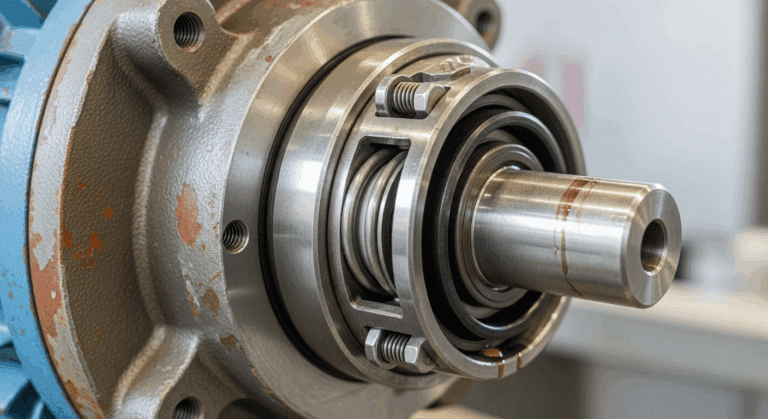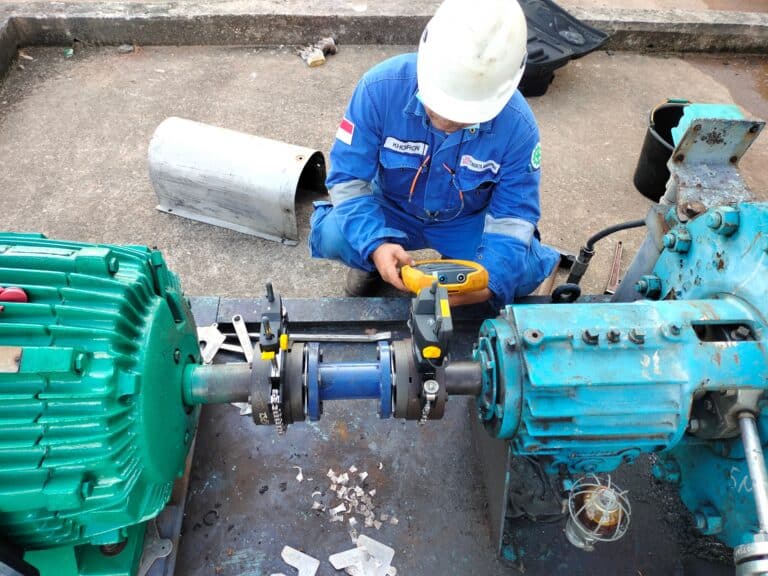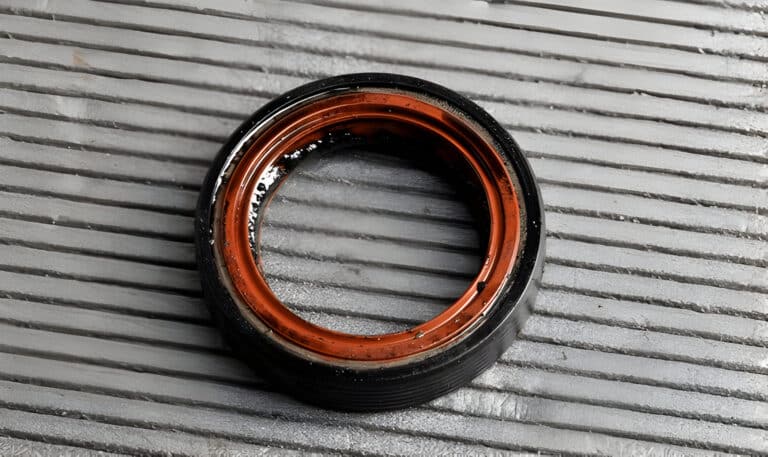

I worked on a pump where the maintenance team replaced a scored seal with an upgraded design — better materials, tighter tolerances, higher cost. The new seal failed within weeks. The Weibull analysis showed infant mortality, meaning the failure had nothing to do with the seal itself. The scoring pattern on the original faces pointed to inadequate flush cooling, but nobody read that pattern before ordering the replacement.
The scoring pattern on your seal faces is a diagnostic message. Radial scratches from particle contamination are often lappable. Concentric grooving from dry running usually means replacement — and a hard look at your seal environment before installing anything new.
Scoring Pattern Classification
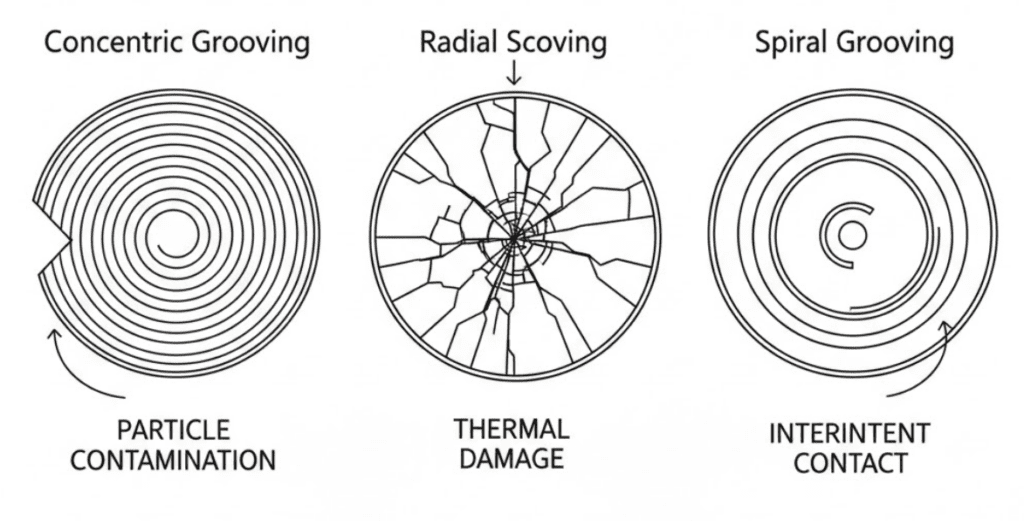
Three distinct scoring patterns appear on mechanical seal faces, and each one traces back to a different root cause.
Concentric grooving looks like a phonograph record — tight, circular grooves tracking the rotation direction. This pattern develops when particles embed in the softer carbon face and grind against the hard face like a grinding wheel. Once abrasive particles lodge in the carbon, every shaft rotation cuts a deeper groove into the silicon carbide or tungsten carbide mating face. The damage to the hard face extends below what you can see or measure with a profilometer.
Radial scoring runs perpendicular to rotation — fine to deep cracks radiating outward from the seal face center. This is thermal damage. Heat checking creates radial cracks that act as cutting and scraping edges against the mating face. The root cause is inadequate face lubrication, insufficient cooling, or fluid vaporization at the interface. I see this most often with low specific gravity liquids at high shaft speeds.
Spiral grooving traces a helical path across the face. Wear debris passing across the seal faces creates this pattern, and it typically indicates the seal operated with intermittent contact rather than full fluid film separation.
The pattern tells you where to look next. Concentric grooves point to particle ingress or contamination in the seal environment. Radial cracks point to thermal management. Spiral grooves point to operating conditions or alignment. Without reading the pattern first, any repair or replacement decision is a coin flip.
Repair or Replace Decision Criteria
Before measuring groove depth, check two things: the scoring pattern and the remaining face material.
Concentric grooving from embedded particles almost always means replacement. The grinding wheel mechanism damages the hard face below the visible groove depth. I’ve seen technicians lap concentric grooves to optical flatness, only to have the seal leak within months because the subsurface damage compromised the material structure. If concentric grooving covers more than a third of the contact band, replace both faces.
Radial scoring from heat checking is more nuanced. Light radial scratches — shallow enough that you cannot catch a fingernail in them — are often repairable through lapping. The thermal damage tends to be shallow and uniform across the face. Deep radial cracks that propagate through the face thickness require replacement.
For any scoring pattern, the 90% thickness rule applies: if more than 90% of the original face thickness remains after lapping to remove the scoring, the face is reusable. Below that threshold, you have consumed too much wear life, and the seal will not deliver an acceptable service interval.
Face flatness after repair must meet these tolerances:
| Face Material | Flatness Target |
|---|---|
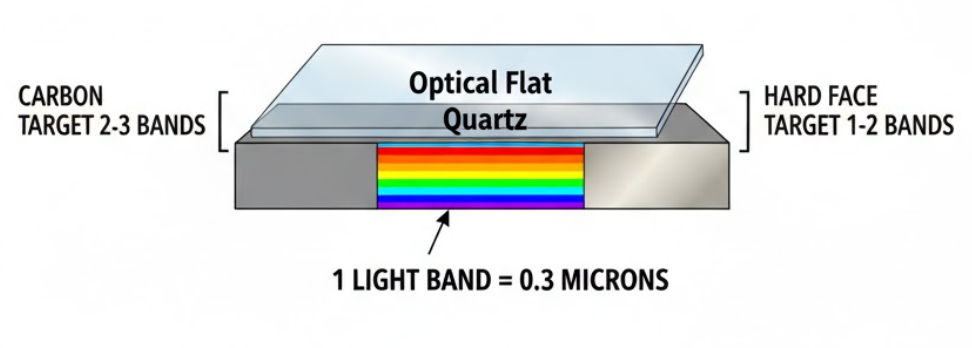
| Carbon / Carbon Graphite | 2-3 helium light bands (0.6-0.9 um) |
| Tungsten Carbide / Silicon Carbide / Ceramic | 1-2 helium light bands (0.3-0.6 um) |
One helium light band equals 0.3 microns. For high-pressure applications above 40 bar, tighten to one light band regardless of material. If you cannot achieve these targets after lapping, the face is not repairable.
Once seal faces separate by just two microns, both visible leakage and particle ingress begin. Scoring is self-accelerating — the initial damage opens a gap, particles enter, and the scoring worsens. A marginally scored face today becomes an unrepairable face next month, so catch it early.
Lapping Feasibility by Face Material
Not all face materials respond equally to lapping.
Carbon graphite laps relatively quickly but requires specific technique. Never use lapping compound on carbon faces — lap dry on ceramic stones of varying grit. Carbon is forgiving for light radial scoring because the material removes evenly. A skilled technician can restore a carbon face to three light bands in the field.
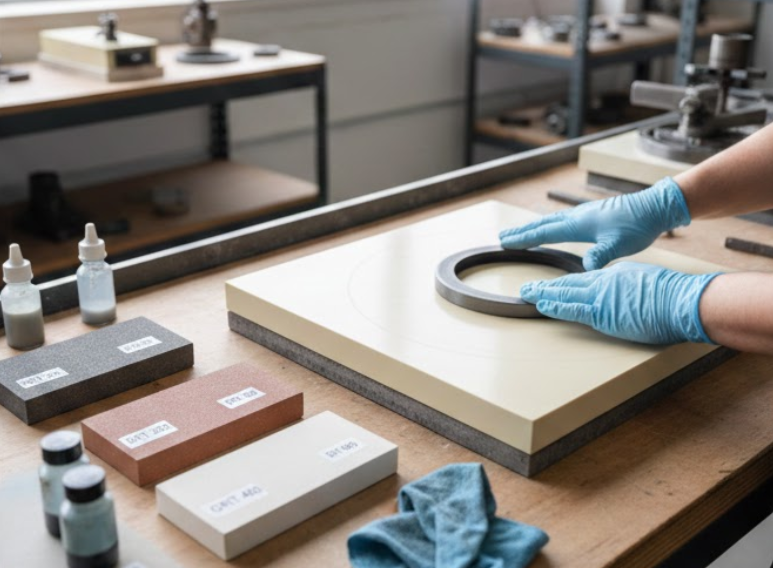
Tungsten carbide takes considerably more time and pressure to lap. Light scratches and minor flatness deviations under five microns are correctable through controlled re-lapping. I have seen petrochemical plants cut seal face costs by half and reduce lead times from six weeks to four days by re-lapping TC faces with light damage rather than ordering new. The economics work when the damage is limited to surface scratches without deep cracks.
Silicon carbide is the hardest common face material and takes even longer to restore. The achievable surface finish after re-lapping is 0.02-0.05 um Ra for both TC and SiC, which meets factory specifications. However, the labor cost for SiC lapping can approach the cost of a new face, making the decision material-dependent.
The common 50% cost rule — replace if repair exceeds half the new seal price — oversimplifies the decision for scored seals. A face that costs only 30% to re-lap will still fail in three months if the scoring was concentric and the particle source remains. Pattern-based assessment should always precede cost calculation.
Preventing Recurrence
Repairing or replacing a scored seal without addressing the root cause guarantees a repeat failure. The scoring pattern you documented in your initial assessment is your prevention roadmap.
For concentric grooving, the particles came from somewhere. Check the flush plan effectiveness, seal chamber cleanliness, and process fluid filtration. If particles are inherent to the process, consider upgrading to hard-on-hard face combinations like SiC/SiC, which resist particle embedding because neither face is soft enough to trap abrasives.
For radial scoring from heat checking, the faces overheated. Verify flush flow rates, check for dry running conditions, and confirm the flush plan matches the actual operating temperature. Hard-on-hard pairs increase dry running risk because the thinner fluid film dissipates heat poorly without the self-lubricating properties of carbon.
This tradeoff illustrates exactly why the scoring pattern drives the material decision. Concentric grooving and radial scoring require opposite material strategies. Choosing a face combination without first reading the damage pattern puts you back on the failure cycle.
Making the Right Call
The repair-or-replace decision for scored seal faces comes down to three questions in order: What is the scoring pattern? What root cause does that pattern indicate? And only then — is the face physically repairable?
Skip the first two questions, and you risk the most expensive outcome: a perfectly lapped seal face installed back into the same environment that destroyed it. Read the pattern, fix the cause, then decide whether to lap or replace. That sequence prevents more repeat failures than any material upgrade alone.