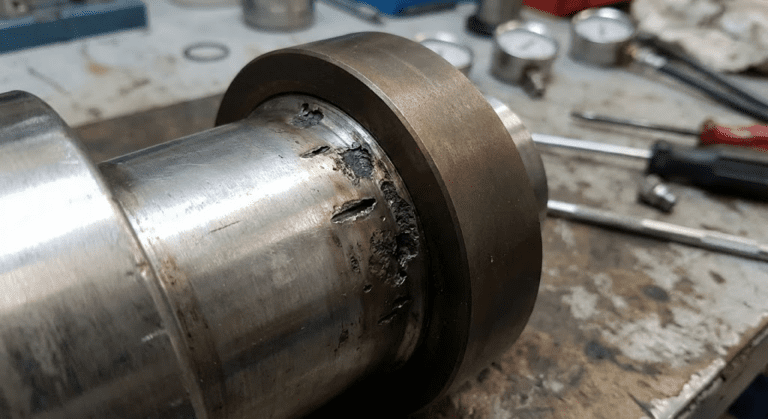
Normal wear accounts for only 1-5% of mechanical seal failures. The remaining 95%+ failed prematurely from operating problems, installation errors, or misapplied selection. Many of those seals ended up in the scrap bin when they still had repairable wear patterns. I have examined hundreds of slurry-damaged seals over 15 years, and the pattern repeats: technicians see aggressive scoring, assume the seal is finished, and order a replacement. The real problem is not the damage itself. It is that most technicians were never taught how to read abrasive wear patterns and distinguish repairable erosion from terminal face degradation.
Assessing Slurry Damage Patterns
Before touching a lapping plate, you need to determine what the damage is actually telling you. Slurry wear creates distinct patterns that differ fundamentally from thermal or chemical damage, and confusing primary symptoms with secondary ones sends your entire diagnosis astray.
Scoring Pattern Identification
Abrasive slurry produces spiral grooving on seal faces that resembles a worn phonograph record. This results from particles trapped between rotating faces cutting concentric or spiral tracks. Compare this to heat checking, which shows fine radial cracks, or blistering, which progresses through three stages from glossy raised spots to cracking to pits. Silicon carbide rarely exhibits heat checking, while tungsten carbide and stellite are susceptible. If you see radial cracks on SiC faces, the damage is almost certainly not thermal, and you need to look at mechanical causes.
Contact Pattern Analysis
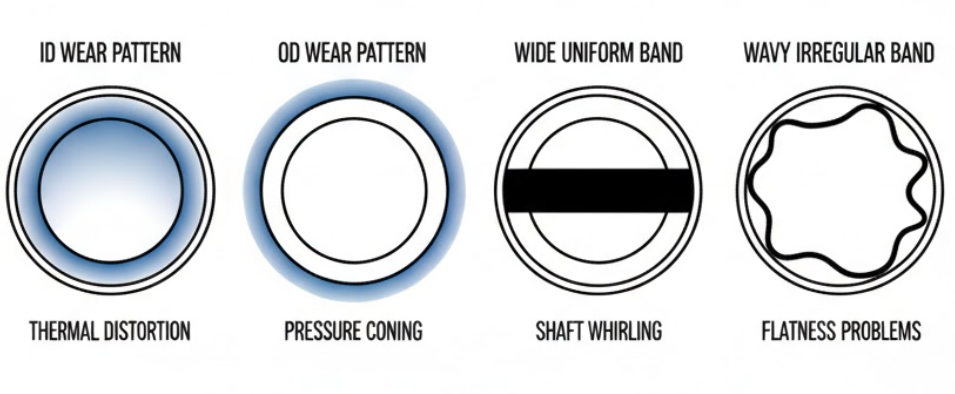
Where the wear appears on the face tells you the root cause. Wear concentrated at the inside diameter suggests thermal distortion. Wear at the outside diameter indicates pressure-induced coning. A wide, uniform wear band points to shaft whirling, while wavy patterns reveal operational flatness problems. For slurry damage specifically, I look for asymmetric scoring depth. Abrasive particles cluster and form a concentrated erosion front, so early-stage slurry scoring often looks worse than it actually is. The seal may still be in its break-in phase, where the aggressive wear front has not yet established a steady-state pattern.
This is the assessment skill gap that leads to unnecessary replacements. A technician sees deep scoring on one sector of the face and condemns the seal, when the damage may be localized break-in wear with the remaining face still within tolerance.
Repair or Replace Decision Criteria
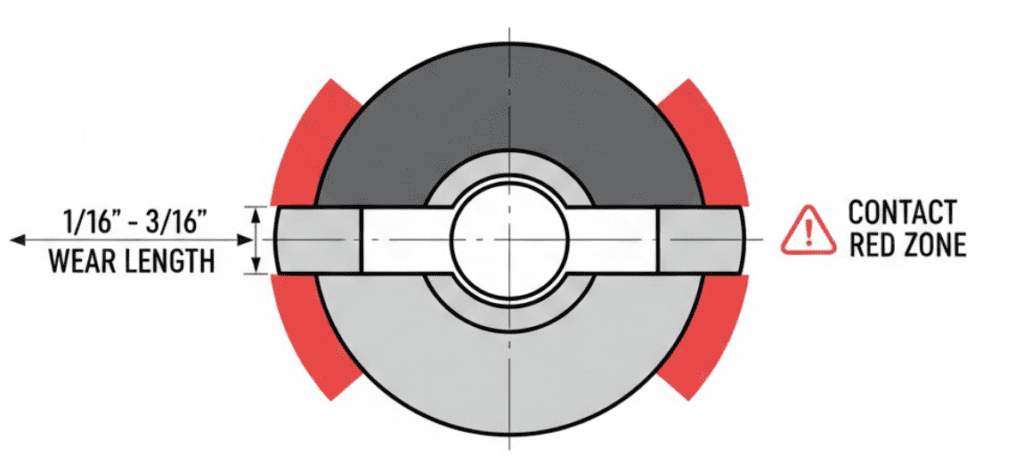
Available seal face wear length is typically 1/16 to 3/16 inch before contact shifts to adjacent components. This is your primary go/no-go measurement. If remaining face width is above the minimum after stock removal to restore flatness, the seal is a repair candidate.
The Economics
Face re-lapping costs 30-40% of the original seal price. Full repair programs run 40-50% less than a new seal. The threshold I follow: if total repair cost exceeds 50% of replacement cost, replace it.
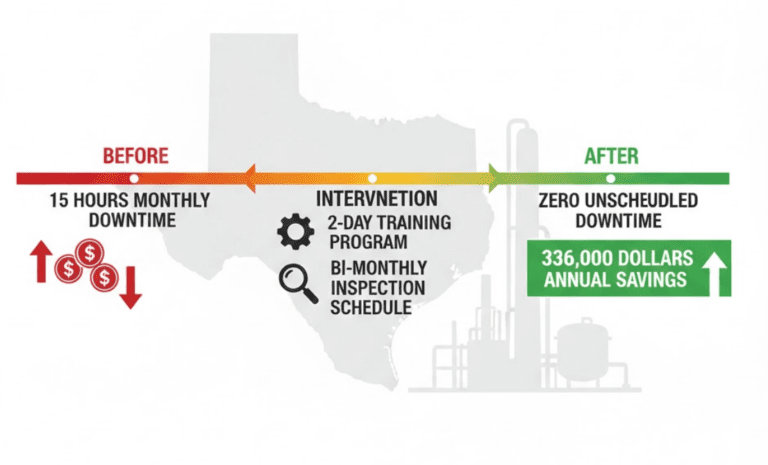
For a synthetic fiber manufacturer running a Bornemann pump with an EagleBurgmann double cartridge seal in slurry service, Gallagher Fluid Seals performed a full restoration including face refinishing, element exchange, and leak testing. The repair doubled seal life compared to the previous attempt. With downtime valued at $15,000 per hour, the repair-versus-replace decision carries real consequences.
When Repair Will Not Work
Carbon faces typically cannot be lapped back to specification. They require replacement. Hard faces like silicon carbide and tungsten carbide are lappable, provided scoring depth stays within stock removal limits. A seal repaired twice that fails a third time should be replaced with an upgraded configuration, not repaired again. Material fatigue accumulates, and some degradation is invisible during inspection.
Face Restoration Procedure
Slurry-scored faces require more aggressive stock removal than normal wear restoration, which changes the lapping approach.
Surface Finish Targets
Your acceptance criteria after lapping: surface finish Ra below 0.12 micrometers (Rz below 1), parallelism within 2 micrometers, and flatness within three helium light bands, just under 1 microinch. The API 682 standard specifies these tolerances for a reason. A face that looks flat to the eye can be several light bands out and will leak immediately.
Lapping Technique for Slurry Scoring
Move the seal face across the lapping plate in an alternating figure-8 pattern with no downward pressure beyond the component’s own weight. For slurry-scored faces with directional grooves, you need to remove more material than a normal re-lap, which means starting with a coarser diamond compound and stepping down to finishing grade.
A skilled technician can achieve three helium light bands with a cast iron plate and diamond compound. However, for slurry-scored faces where stock removal requirements are high and damage is asymmetric, professional-grade equipment produces more consistent results. The risk with field lapping on heavily scored faces is removing material unevenly, creating a new taper that causes immediate leakage.
One critical handling rule: never touch lapped seal faces or lubricate them before assembly. Fingerprint oils and lubricants on freshly lapped surfaces create the exact contamination film that causes immediate post-repair leakage. Ceramic components that have been dropped must be discarded regardless of visible condition. Internal micro-cracks from impact shock will propagate under thermal cycling during operation.
Secondary Component Inspection
This is where most repair attempts fail silently. Technicians restore seal faces to specification, reassemble with degraded secondary components, and wonder why the seal leaks within weeks.
Abrasive particles do not only attack seal faces. They migrate into O-ring grooves, erode spring coils, score drive pin slots, and embed in elastomer surfaces. In slurry service, every secondary sealing element must be treated as suspect.
Inspect O-rings for embedded particles, hardening, and compression set. Check springs for reduced free length, which indicates coil erosion from abrasive contact. Examine drive pins and their mating slots for wear that allows rotational play. Measure sleeve surfaces under the secondary seal for scoring that would create a leak path.
Before replacing the seal, check these secondary elements. A perfect set of faces on worn springs with scored sleeves will not hold pressure. API 682 Edition 4 specifies clearance tolerances of 1 mm for seals up to 60 mm and 2 mm for larger seals. Verify all clearances against these standards before reassembly.
Preventing Recurrence After Repair
A repaired seal returned to the same conditions will fail the same way. Address the root cause during reinstallation.
Flush pressure must be a minimum of 15 psi above stuffing box pressure to keep abrasive particles away from seal faces. Verify this with a gauge, not an assumption. Settling slurry particles 75 micrometers and larger cause the most aggressive face scoring. If your flush system cannot exclude particles of this size, no amount of repair will extend seal life.
For pumps operating below 50% of best efficiency point, vibration loads accelerate slurry seal wear regardless of face material quality. Check shaft deflection against the API 610 maximum of 0.002 inch before reinstalling a repaired seal.
On material upgrades: if the original seal used tungsten carbide faces, consider switching to silicon carbide for the repair. SiC provides better resistance to heat checking in abrasive service, reducing the risk of thermal crack propagation between maintenance intervals.
Repair Decision Checklist
Every slurry seal that crosses your bench deserves a proper damage assessment before you write the purchase order for a replacement. The technicians who consistently extend seal life in abrasive service are not doing anything exotic. They measure face wear against the 1/16 to 3/16 inch threshold, verify flatness to three light bands after lapping, and inspect every secondary component for particle damage.
The seal faces get all the attention, but the springs, O-rings, and drive elements operating in the same abrasive environment determine whether your repair lasts six months or two years. Check the whole assembly, not just the faces.