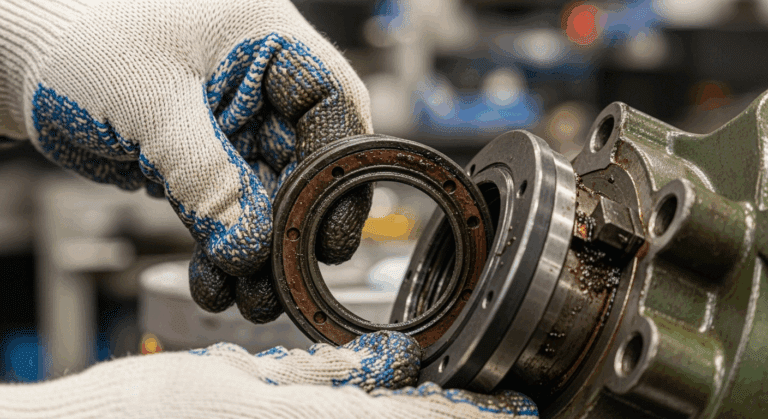

I’ve lost count of how many times a technician has told me “I replaced the faces and the O-rings, but it’s leaking again six months later.” Half the time, the spring was the problem all along. Springs don’t crack like seal faces or extrude visibly like elastomers. They lose force quietly, and that gradual degradation gets blamed on every other component before anyone thinks to measure spring free height.
Spring Failure Mechanisms
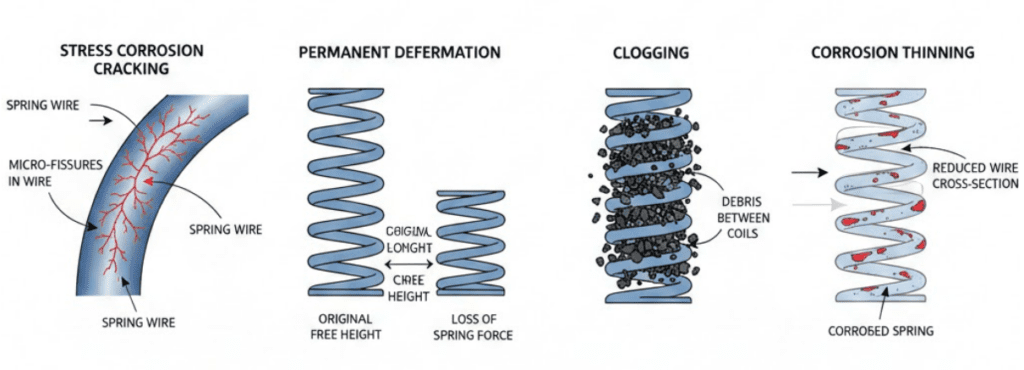
Seal springs fail through four distinct mechanisms. Unlike face cracks or O-ring extrusion, none of these produce obvious visible damage until late-stage failure.
Stress Corrosion Cracking
Broken springs are almost always caused by stress corrosion, not mechanical fatigue. When stainless steel flexes in the presence of halogens — chlorine, fluorine, bromine — small fissures develop in the metal. Particles enter these cracks, and the next compression cycle amplifies the mechanical force until the spring snaps.
The danger is that stress corrosion produces micro-cracks invisible to the naked eye. A spring can look perfectly fine during a visual inspection and fail catastrophically on the next startup. For any application handling halogenated fluids, I recommend Hastelloy C springs as the baseline specification. The cost difference is minimal compared to the downtime from a broken spring.
Permanent Deformation and Free Height Loss
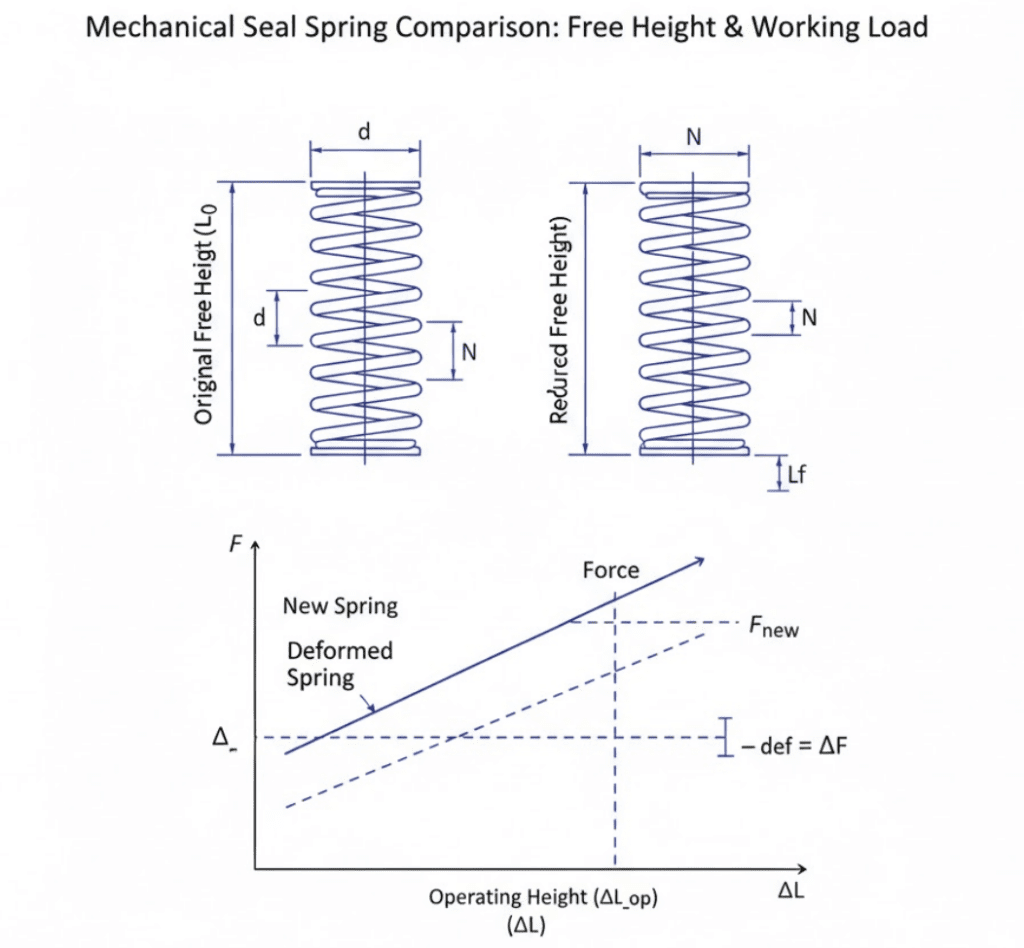
Springs take a permanent “set” over time. The free height gradually decreases, which reduces the working load at operating height. Working stress should not exceed 0.3 times the tensile strength of the spring material — exceed that threshold consistently, and the spring will lose force faster than expected.
This is the most commonly missed failure mode. The spring still looks intact, still has the right number of coils, still sits in the correct position. But it has lost enough closing force that intermittent leakage develops — leakage that technicians chase with face replacements because nothing looks wrong with the spring.
Clogging
Solids buildup around or between spring coils restricts the dynamic seal ring’s movement. The spring can’t deliver its full stroke, and effective face-closing force drops. Multi-spring designs are particularly vulnerable because the small wire cross-section collects debris more readily than a single coil spring or wave spring. In slurry or high-solids applications, I’ve seen multi-spring seals clog within months while a single-spring design of the same size runs for years.
Corrosion Thinning
General corrosion attacks the spring wire uniformly, reducing the cross-section and lowering the spring rate. The fluid type has a 6:1 effect on seal life comparing best and worst average service lives, and springs are often the first component to show the damage. Stainless steel springs in mildly acidic services lose material slowly enough that the seal operates normally for a year or two before the accumulated thinning drops spring force below the closing threshold.
Diagnosing Spring Failure
Before replacing the seal, check whether the damage you’re looking at is primary or secondary. A worn seal face may be the secondary symptom of a primary spring force problem. Failing to distinguish the two means you fix the wrong thing and the seal fails again on schedule.
Primary vs Secondary Symptoms
Face wear, scoring, and heat checking are the damage patterns technicians spot first — they’re visible, they’re dramatic, and they match the troubleshooting checklist. But ask this: did the face fail because of a material or lubrication problem, or did it fail because reduced spring force allowed the faces to separate intermittently, introducing contaminants into the sealing gap?
I worked on a Goulds 3196 ammonia pump at a cold storage facility where the seal had failed less than a year after replacement. The maintenance team was ready to order another seal. We pulled the pump apart and found significant wear on multiple components — the seal wasn’t the root cause. Piping had tight 90-degree elbows instead of gentle slopes, and laser alignment revealed major misalignment. The seal was just the messenger.
The One Diagnostic That Matters
Measure the spring free height and compare it to the manufacturer’s original specification. Any measurable loss in free height means the spring is delivering less closing force than design intent — and once that gap widens, face separation and leakage follow.
Standard checklists have you inspect faces, check O-rings, verify alignment, review operating parameters — all valid, but none of them catch a spring that has quietly lost its force. You need the original manufacturer data sheet and a simple force-displacement measurement to calculate whether your spring still delivers adequate load.
The Compression Myth
When a seal starts leaking, a common field response is to increase spring compression. I’ve seen technicians add shims or adjust setting heights to squeeze more force out of an aging spring. This approach is backwards. Excessive compression accelerates face wear and can cause burnout. The correct response is to measure actual spring force against specification. If it’s low, the spring needs replacement — not more compression.
Spring Replacement Procedure
Once you’ve confirmed spring failure, the replacement procedure depends on seal type and whether you’re replacing just the spring or the full seal.
Replace Spring or Replace Seal?
For component seals, individual spring replacement is feasible if the faces and secondary seals pass inspection. Check face flatness to three helium light bands and confirm O-ring durometer hasn’t shifted. If both pass, replacing only the spring saves the cost of a full seal.
For cartridge seals, replacing the complete cartridge is almost always the better call. The labor to disassemble, inspect every component, replace the spring, and reassemble exceeds the cost difference in most applications. The exception is large-diameter seals where the cartridge itself represents major capital.
Specification Matching
Match these four parameters exactly when sourcing a replacement spring:
- Wire diameter — controls spring rate
- Free length — determines working force at operating height
- Material grade — must match or exceed original corrosion resistance
- Coil count and direction — affects fit in the drive mechanism
Getting the wire diameter or free length wrong by even small margins changes the closing force enough to cause premature failure or excessive face wear. Never substitute a “close enough” spring from a different seal model.
Spring Type Selection for Replacement
If the original spring failed due to clogging or corrosion, replacing it with the same type guarantees the same failure. Single-spring designs resist both clogging and corrosion better than multi-spring arrangements because the heavier wire cross-section sheds debris and withstands chemical attack longer. In heavily contaminated services, consider whether a bellows seal eliminates the spring failure mode entirely.
Post-Replacement Verification
After installation, verify spring compression against the manufacturer’s setting dimension. Measure installed height with a depth micrometer and confirm it falls within the specified operating range. Run the pump and monitor for initial leakage — a properly set spring should produce stable, minimal leakage within the first hour of operation.
Next Steps After Spring Replacement
The spring replacement itself is straightforward. The harder question is why the spring failed in the first place. If stress corrosion cracked it, upgrading to Hastelloy C prevents recurrence. If clogging killed it, changing to a single-spring or bellows design addresses the root cause. If permanent deformation was the problem, the application may be running at pressures or temperatures that exceed the spring’s design envelope.
Document the failure mode, the spring’s condition at removal, and the replacement specifications. Without that record, you are fixing the same problem on the same schedule indefinitely.