
The O-ring looked perfect. No cracks, no swelling, no discoloration. Yet the seal failed three weeks after reassembly. I have worked through this exact scenario more times than I can count, and the root cause is almost always the same: the technician relied on visual inspection alone. An O-ring can remain leak-tight for well over a year at elevated temperatures despite severe internal material degradation. The problem is invisible until it becomes catastrophic.
Visual checks catch the obvious failures. Tactile and dimensional assessment catches the rest. If you are only looking at your secondary seal elements during maintenance, you are missing the degradation that actually causes unplanned shutdowns.
How O-Rings and Bellows Degrade in Mechanical Seals
Degradation in secondary seal elements follows two distinct paths, and only one is reliably visible.
Surface degradation shows itself clearly. Cracking from thermal cycling, extrusion marks from excessive clearance gaps, chemical swelling that changes cross-section dimensions — these are the signs every technician learns to spot. If you see radial cracks, nibbled edges, or a sticky surface residue, that O-ring is done.
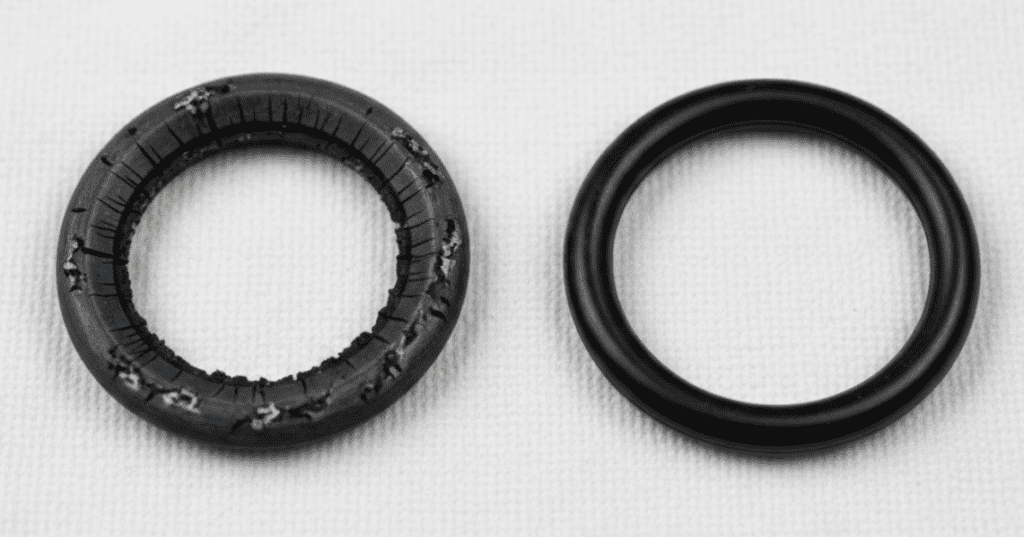
Subsurface degradation is the problem. Chemical attack operates as a molecular breakdown that changes the physical properties of the elastomer itself. Once this process starts, it is irreversible. An O-ring may appear intact while chemical reactions progress beneath the surface, producing either a hard and brittle material (increased cross-linking) or a softer, weaker one (chain scission). Neither condition is detectable by eye.
In mechanical seal applications, this distinction is critical because secondary seals operate under continuous compression. Even a moderately degraded O-ring maintains its shape in the groove and appears functional. The degradation only reveals itself under the dynamic conditions that follow reassembly — thermal cycling, pressure transients, shaft movement.
What the spec sheet does not tell you is that elastomer degradation starts well below published maximum temperature ratings. Stress relaxation dominates after roughly 20 days of service, meaning the O-ring progressively loses its ability to recover from compression regardless of whether it looks damaged.
The Three-Step Assessment Method
I have seen this failure pattern dozens of times: the seal looked fine during shutdown inspection, but compression set measurement told a completely different story. Start visual, then tactile, then dimensional.
Visual Inspection
Check for the obvious disqualifiers first. Any of these mean immediate replacement:
- Radial cracking or surface crazing
- Blistering (explosive decompression damage)
- Permanent deformation visible in the groove impression
- Discoloration beyond normal service darkening
- Extrusion marks or nibbling on the low-pressure side
If the O-ring passes visual inspection, most technicians stop here. That is the mistake.
Tactile Assessment
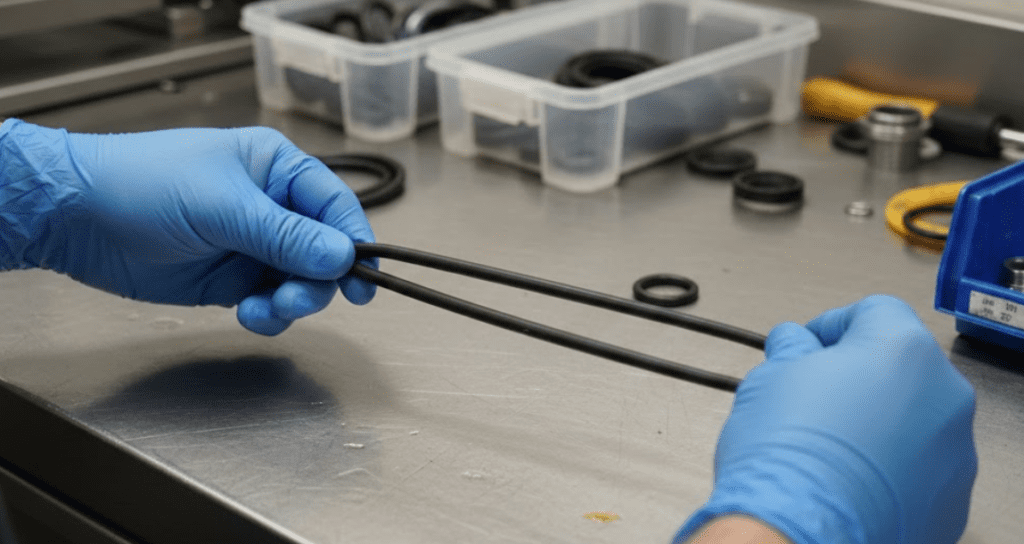
Remove the O-ring from its groove and assess by hand. Carefully stretch the O-ring to about 150% of its relaxed diameter and release. A healthy elastomer snaps back immediately with no permanent set. An end-of-life O-ring recovers slowly, incompletely, or not at all.
Check hardness by pressing with a fingernail or thumbnail. Excessive hardening indicates thermal or chemical degradation even when the surface looks normal. An O-ring that feels glassy or rigid compared to a new sample of the same compound has lost its sealing resilience.
One warning: Shore A hardness readings taken on installed O-rings are notoriously variable because the curved surface produces inconsistent indenter contact. Use the stretch-and-release test as your primary tactile method. It is faster and more reliable in field conditions.
Dimensional Assessment
Compression set is the single most important measurable property of any elastomeric seal. It quantifies what tactile testing estimates: how much permanent deformation has occurred.
Measure the O-ring cross-section after removal and compare to the nominal dimension. The ASTM D395 standard defines the test formally — compressing to 75% of original thickness and measuring recovery after release. In field conditions, a simplified version works: measure recovered cross-section against the specification.
An 80-85% compression set means end-of-life for most elastomers. At that point, the O-ring has lost nearly all its ability to recover and seal against pressure transients. I have seen seals in H2S service that passed seven-day functional testing but failed catastrophically at 30 days — the compression set decline and porous defects were only detectable through measurement, not visual checks.
Bellows-Specific Degradation Patterns
Bellows assessment requires a different approach than O-rings, and this is where most maintenance programs fall short. No one talks about bellows degradation criteria, yet bellows failures are among the costliest seal failures I encounter.
Elastomeric Bellows
Rubber bellows degrade similarly to O-rings but with an added failure mode: fatigue cracking at the convolution roots. Check each convolution fold for micro-cracks by gently flexing the bellows section. Surface cracks that open during flexion but are invisible at rest indicate fatigue progression.
Chemical attack on elastomeric bellows follows the same subsurface pattern as O-rings. The bellows may maintain its shape but lose the spring force needed to keep seal faces in contact. If the bellows feels noticeably softer or stiffer than a new unit, replace it regardless of visual condition.
Metal Bellows
Metal bellows present a unique diagnostic challenge. Two crack types appear visually identical but have fundamentally different root causes and require completely different corrective actions.
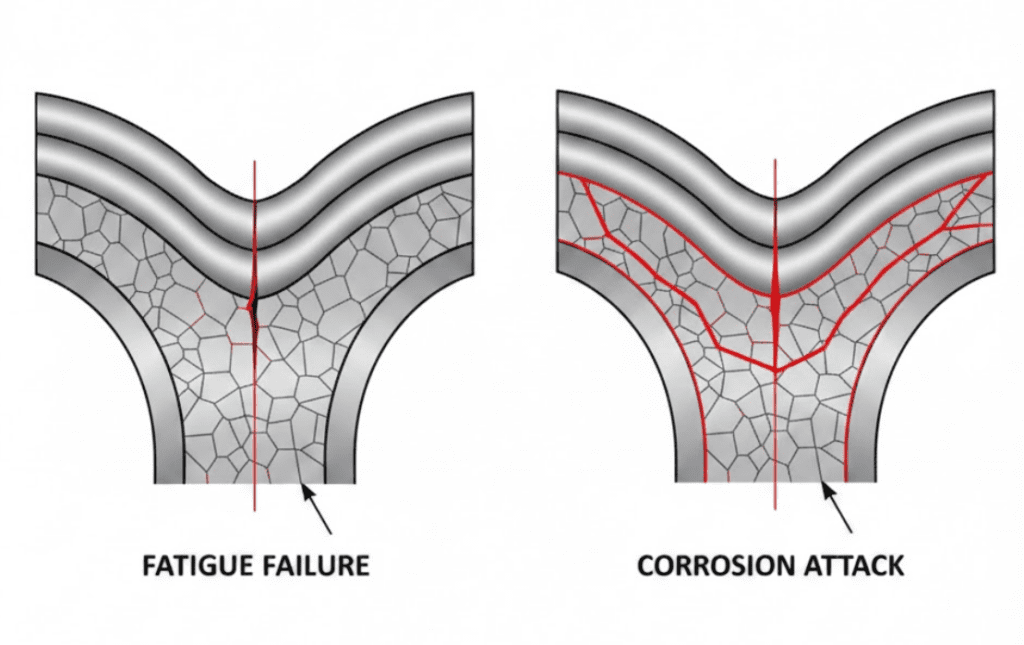
Transgranular cracking — cracks running through the grain structure — indicates mechanical fatigue from vibration or thermal cycling. These cracks typically originate in the bellows valley, the highest-stress area. The corrective action is addressing the vibration source or thermal cycling pattern.
Intergranular cracking — cracks running along grain boundaries — indicates corrosion attack, particularly from media containing chlorine, bromine, or fluorine. Without microscopic examination, these two crack types look the same. If you find cracks in a metal bellows and simply replace it without determining the crack type, you are likely to see the same failure again.
The API 682 standard specifies bellows materials for a reason. If the process fluid has changed since original seal selection, the bellows metallurgy may no longer be appropriate — and corrosion cracking will be the first sign.
When to Replace, When to Monitor
The replace-or-continue decision should not be binary, and it should not be calendar-based. I recommend a three-tier severity framework.
Replace now. Any visual defect (cracking, blistering, extrusion). Compression set above 80%. Bellows cracks of any type. Hardness change greater than 15 Shore A points from nominal. Elastomer that fails the stretch-and-release test. These conditions mean the secondary seal element will not survive the next operating cycle reliably.
Plan replacement. Compression set between 50-80%. Slight hardening or softening detectable by hand. No visible defects but the component has been in service beyond the elastomer’s rated thermal life for the actual operating temperature. Schedule replacement at the next planned maintenance window.
Continue monitoring. Compression set below 50%. Tactile properties match a new component. No visible defects. The component is performing within its design envelope and can be reused for this service interval.
Before replacing the seal, check whether the degradation pattern suggests a systemic problem. An O-ring with chemical attack in a service that should be compatible with the elastomer type may indicate process contamination or temperature excursions. Replacing the O-ring without addressing the root cause guarantees a repeat failure. Identifying the elastomer type in a seal is the first step in confirming material-process compatibility.
The Assessment That Prevents Callbacks
The technicians I trust most never declare an O-ring or bellows “good” based on appearance alone. They remove it, stretch it, measure it, and compare it to a known reference. That three-step discipline — visual, tactile, dimensional — is what separates a routine seal rebuild from the kind that gets a callback two months later.
Compression set measurement is the single most underutilized tool in secondary seal element assessment. It takes less than a minute with a caliper, and it catches the degradation that causes the most frustrating failures: the ones where everything looked fine.