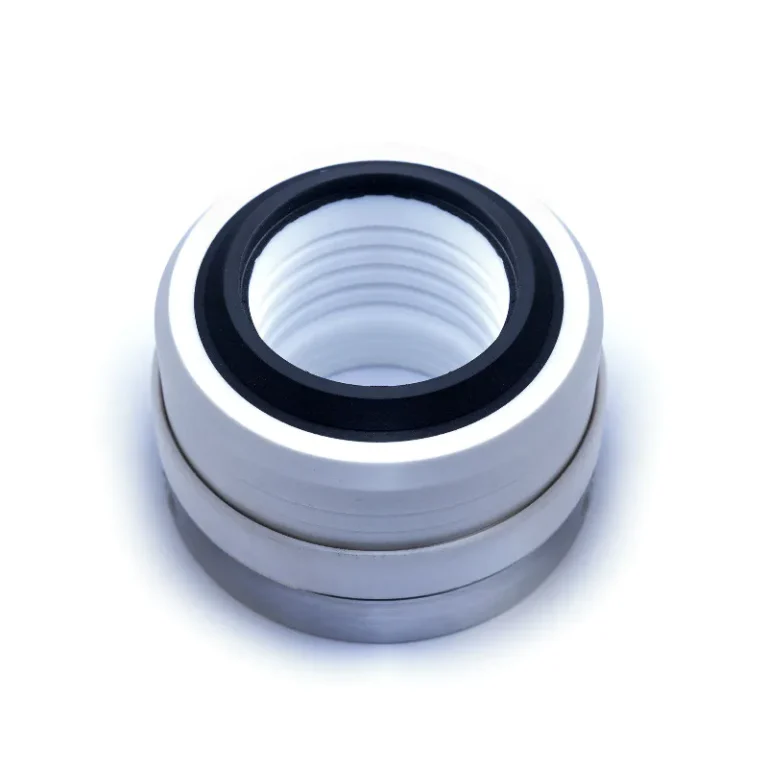
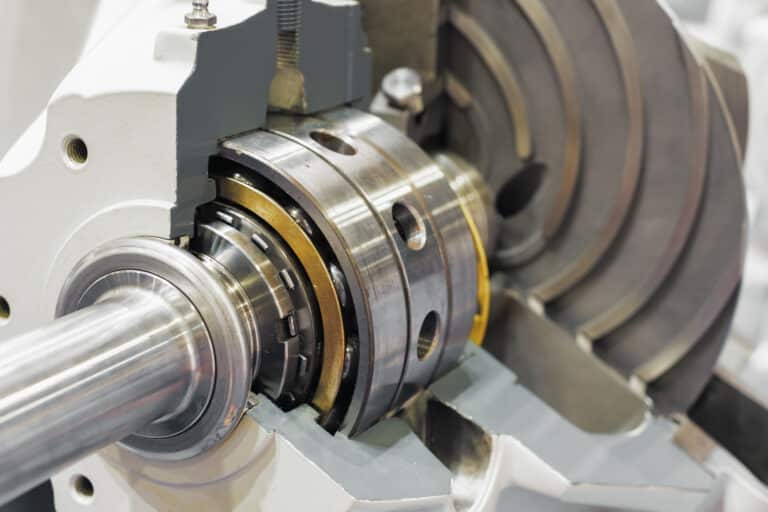
Metal bellow mechanical seals solve one of the biggest headaches in rotating equipment: seal hangup. If you have ever dealt with a pump that keeps leaking because the dynamic O-ring stuck to the shaft, you will understand why engineers get excited about these seals — they eliminate that sliding elastomer completely.
A bellows seal uses a flexible metallic bellows instead of the springs and O-rings of a traditional pusher. The bellows acts as both the spring element and the secondary seal in one component — which is what makes a bellows mechanical seal work where conventional seals fail.
I have seen facilities switch to metal bellows seals after burning through pushers every few months in high-temperature services. A well-specified bellow seal in a coking service can stretch MTBF from six weeks to three years.

What Is a Bellows Seal?
A metal bellows seal is a mechanical seal in which a flexible, corrugated element replaces the conventional spring and dynamic O-ring of a pusher. The bellows does two jobs at once — it provides the closing force that keeps the faces loaded, and it seals the gap between rotating and stationary components. No sliding elastomer, no separate spring pack.
Bellows seals split into two material families. Metal bellows use welded or formed alloy diaphragms (SS316, AM350, Inconel, Hastelloy, titanium) and handle temperatures from cryogenic to 800°F with aggressive chemistry. Rubber bellows use an elastomer element — geometry similar, service envelope much narrower. Water pumps, HVAC, and light-duty chemical service typically run on rubber bellows mechanical seals; anything above about 200°C or outside elastomer compatibility requires metal.
The API 682 standard formalizes the distinction. Type B combines a metal bellows with a static O-ring secondary, rated to 350°F. Type C replaces the O-ring with a flexible graphite gasket and extends to 750°F — same element form, qualified for the higher band where no elastomer survives.
How Do Bellows Mechanical Seals Work?
Metal bellows seals maintain a thin fluid film between two precision-lapped faces while the bellows flexes to accommodate shaft movement — no sliding parts to stick, fret, or hang up.
What Are the Key Components?
A metal bellows seal has five main components that work together:
The metal bellows is the heart of the seal. It is a flexible, corrugated metal tube made from thin diaphragms welded together. This bellows does double duty. It provides the spring force that keeps the seal faces together, and it acts as the secondary seal between the rotating and stationary parts. Most bellows use plates only 0.004 inches thick — thin enough that the bellows works as both spring element and secondary seal in the same component.
The stationary seal face sits fixed in the seal housing. It is typically made from silicon carbide or tungsten carbide because these materials can handle the heat and wear at the sealing interface.
The rotating seal face attaches to the shaft and spins with it. Carbon graphite is the most common material here. It pairs well with the harder stationary face and provides some self-lubricating properties.
Static O-rings and gaskets seal the points that do not move. These are the connections between the seal components and the pump housing or shaft.
The drive mechanism transfers torque from the shaft to the rotating seal components. This keeps everything spinning together without slipping.
How Does the Sealing Mechanism Function?
Step 1: Creating the Seal
When you install the seal and pressurize the system, the fluid pressure acts on the effective area of the bellows. This hydraulic force, combined with the mechanical spring force of the bellows itself, pushes the rotating face against the stationary face.
Step 2: Forming the Fluid Film
A microscopic film of process fluid forms between the faces. This film is essential. It lubricates the interface and carries away heat. Without it, the faces would run dry and fail within minutes.
Step 3: Compensating for Movement
As the equipment runs, the shaft moves. It experiences thermal expansion, vibration, and slight misalignment. The bellows flexes to absorb all this movement while maintaining constant face loading. Traditional seals need a sliding O-ring to do this. The bellows handles it without any sliding contact.
Step 4: Self-Adjusting Operation
The bellows continuously adjusts throughout operation. If the shaft moves axially, the bellows compresses or extends. If there is angular misalignment, it flexes to compensate. The seal faces stay in contact with consistent pressure regardless of these movements.
This self-adjustment is why metal bellows seals excel in applications with shaft runout, thermal cycling, or vibration.
Bellows Seal vs Pusher Seal: What Is the Difference?
A pusher uses a spring plus a dynamic O-ring that slides along the shaft; a bellows eliminates that sliding elastomer and lets the bellows flex instead. One design change reshapes every downstream trade-off.
| Dimension | Bellows Seal | Pusher Seal |
|---|---|---|
| Dynamic secondary seal | None — bellows flexes | Sliding O-ring on shaft |
| Typical failure mode | Bellows fatigue, weld cracking | Hangup, fretting, O-ring chemical attack |
| Temperature ceiling | 800°F with graphite secondaries | 400-500°F limited by elastomer |
| Reverse-pressure handling | Limited — 70/30 balance is standard | Native — handles reversal cleanly |
| Best fit | High-temp, coking, elastomer-hostile chemistry | Dual pressurized, HF acid, abrasive, cost-driven |
When Pusher Still Wins
Reverse-pressure capability is limited on a standard bellows — the 70/30 balance that optimizes forward-pressure face loading does not reverse cleanly, which is why Plan 53/54 barrier arrangements often default to pusher. Hydrofluoric acid is the second scenario: if a bellows ruptures under HF, the leak path is hard to control; a pusher fails more gracefully.
The diagnostic signatures — fretting patterns, weld crack progression, face-load symptoms — are covered in the specialist pusher vs bellows seal failure modes article.
Rubber Bellows Seals: The Elastomer Version
A rubber bellows seal, also called an elastomer bellows seal, replaces the metal diaphragm stack with a molded elastomer bellows, usually NBR, EPDM or FKM. The bellows grips the shaft and carries the rotating face, and a coil spring around it supplies the closing force: the elastomer gives the flexibility and the secondary seal, but unlike a metal bellows it is not the spring. Type 21 and Type 1 are the common patterns.
Because the bellows flexes instead of sliding, a rubber bellows seal shares the metal bellows’ advantage over a pusher: no dynamic O-ring to hang up on deposits or fret the shaft. Its limits are the elastomer’s. Temperature and chemical compatibility set the service window, which is why water pumps, HVAC circulators and light-duty chemical service run on rubber bellows, and why hot, aggressive or cryogenic duty moves to metal. Matching the elastomer to the fluid is the main selection step: see NBR vs EPDM and FKM vs EPDM.
Types of Metal Bellows Seals: Edge-Welded vs Formed
Edge-welded outperforms formed in nearly every measurable way, but costs more:
| Feature | Edge-Welded Bellows | Formed Bellows |
|---|---|---|
| Manufacturing | Individual diaphragms welded at alternating edges | Tubing shaped by hydraulic pressure or rolling |
| Material Options | Stainless steel, Inconel, Hastelloy, titanium | Limited to high-elongation metals (stainless steel, brass, bronze) |
| Flexibility | Highest (thin diaphragms in mils) | Lower (thicker walls) |
| Temperature Range | Cryogenic to over 1000°F | Much narrower range |
| Spring Rate | Precisely controllable | Higher and less consistent |
| Pressure Capability | Superior | Moderate |
| Cost | Higher per unit | Lower when mass-produced |
| Best Applications | Oil & gas, aerospace, power generation | General industrial, moderate-duty |
Edge-welded bellows are built by stamping thin diaphragms, welding pairs at their inner diameters, then welding those pairs at the outer diameters. Spring rate is tuned by adding or subtracting convolutions — formed bellows lose that tunability because forming locks wall thickness and geometry together.
Industry diaphragm thickness spans 0.0015 to 0.020 inches; 0.004 inches is a typical target for seal service. Thinner plates drop the spring rate, face loading, and heat at the sealing interface. Think of a leaf-spring stack — a single thick plate would be too stiff, but multiple thin layers deliver strength without stiffness.
My recommendation: specify edge-welded for petrochemical, power generation, and any demanding service — the performance difference justifies the cost premium. I have seen formed bellows fail repeatedly in refineries where edge-welded designs ran for years. Formed bellows make sense for water pumping, HVAC, and moderate applications.
See the detailed welded metal bellows selection guide for convolution count, alloy choice, and pressure balance at specifier depth, and the welded vs formed bellows manufacturing breakdown for the production-process trade-offs behind the cost delta.
Single-Ply vs Double-Ply Bellows
Single-ply covers most standard applications — simpler, more flexible, lower cost. Double-ply uses two thin layers, giving higher strength without the stiffness penalty of thicker single-ply material.
Choose double-ply when you need:
- Higher pressure capability — up to 1000 psi versus around 360 psi for standard single-ply
- Services with thermo-sensitive fluids that might solidify
- Applications requiring more start-up torque
Above 400 psi forward pressure, single-ply is out.
What Are the Operating Limits and Specifications?
Metal bellows handle conditions that destroy conventional seals, but they do have limits.
Temperature, Pressure, and Speed Ratings
| Parameter | Standard Rating | Extended Rating | Notes |
|---|---|---|---|
| Temperature | -100°F to 800°F | Up to 850°F with graphite packing | Operate at 80% of max for longevity |
| Pressure | Vacuum to 360 psi | Up to 1000 psi (double-ply) | Some designs handle 500 psi without shaft step |
| Speed | Up to 5000 fpm | Varies by design | Check manufacturer specs |
The API 682 standard anchors these numbers. Category 1 covers -40°F to 500°F and 315 psi; Category 2 and 3 extend to 750°F and 615 psi — the band most metal bellows qualify into for refinery service. A vendor’s “up to 800°F” quote is a Type C design beyond the 750°F upper edge of Category 2/3 territory.
Temperature considerations: the bellows is rarely the limiting factor — the secondary sealing elements set the upper limit:
- VITON O-rings: below 200°C (392°F)
- FFKM (perfluoroelastomer): 200-260°C (392-500°F)
- Flexible graphite: beyond 260°C (500°F), up to 425°C (800°F)
For the highest-temperature services, use flexible graphite throughout to eliminate elastomers entirely.
Limitations worth naming: flashing hydrocarbon service is a known weak spot — marginal vapor suppression drives stick-slip at the faces and fatigues the bellows. The 5000 fpm rating is linear velocity; the RPM ceiling depends on shaft diameter, so run the numbers before assuming a bellows fits a small-bore high-speed pump.
Bellows Engineering Facts Most Specs Miss
Three mechanical properties of bellows behave differently from coil springs — knowing them changes how you install, troubleshoot, and accept bellows hardware at site.
The bellows settles after commissioning. Free length stabilizes at roughly 15–25% shorter than as-welded length after initial cycling. A new bellows will appear longer than the service-worn one you pulled out — that is normal, not a manufacturing defect. Setting compression in the field against the factory dimension instead of the broken-in dimension over-loads the faces for the first hundred hours.
Compression is safe; extension is not. Bellows should operate primarily in compression, with 20% extension as the maximum. Extension fatigues the convolutions asymmetrically — weld roots and diaphragm inner diameters see higher cyclic stress on the pull stroke than the push stroke. If you install a bellows with the face too far out and the spring element has to extend to reach contact, you have halved its cycle life before the pump is even commissioned. Verify setting height against the assembly drawing every time.
Spring rate is hypersensitive to diaphragm thickness. A ±5% change in diaphragm material thickness produces roughly a ±15% change in spring rate. Face-closing force — and therefore face wear rate, heat generation, and seal life — depends on manufacturing tolerances you cannot see from the outside. This is why bellows convolution count and weld quality matter in a way coil-spring count does not. Some manufacturers run more convolutions than the industry-standard eight specifically to reduce per-convolution stress and extend fatigue life.
The framing that often unlocks correct specification: bellows construction exists to solve two failure modes pusher seals cannot — shaft hang-up (when the dynamic O-ring cannot slide because the shaft frets, the process crystallizes, or corrosion roughens the sleeve) and elastomer disqualification (when temperature or chemistry takes the O-ring out, above ~150°C standard / ~200°C FKM / ~325°C FFKM). Outside those two failure modes, a pusher seal is cheaper, simpler, and adequate.
How Do You Select the Right Bellows Material?
The alloy must resist corrosion from the process fluid while holding mechanical properties at operating temperature.
Which Alloy Is Best for Your Application?
| Material | Temperature Capability | Corrosion Resistance | Cost | Best For |
|---|---|---|---|---|
| SS 316/316L | Moderate | General | $ | Standard applications, non-corrosive fluids |
| AM350 | Good | Good | $$ | Refinery services, cost-conscious projects |
| Inconel 718 | Excellent | Excellent | $$$ | Aerospace, chemical, petroleum, high-temp |
| Hastelloy C | Excellent | Superior | $$$$ | Hot acids, alkalis, chlorinated solvents |
| Titanium | Good | Excellent | $$$$ | Aerospace, marine, weight-critical |
SS316 with silicon carbide faces covers water-based systems and mild process fluids; AM350 steps up for refinery hydrocarbon services at reasonable cost. Inconel 718 is the workhorse for corrosive chemicals at high temperatures — stronger corrosion resistance than AM350, and it is age-hardened by heat treatment. Hastelloy C is the standard for hot acids, alkalis, and chlorinated solvents, paired with tungsten carbide faces.
Cowseal supplies metal bellows seals in SS316, Inconel 718, and Hastelloy C configurations with edge-welded construction for high-temperature and corrosive services.
What Seal Face Materials Should You Specify?
Seal faces withstand friction, heat, and chemical attack while holding flatness measured in millionths of an inch.
Premium carbon graphite handles most services — look for blister-resistant grades that will not degrade when trace moisture in the carbon hits high temperatures. API 682 specifies this as the standard face material.
Silicon carbide provides excellent hardness and wear resistance. Self-sintered grades are harder and more chemically resistant than reaction-bonded, but more brittle.
Tungsten carbide is the toughest option, specified for abrasive services or when both faces need to be hard materials.
Pairing: standard is carbon against silicon carbide. Silicon carbide against silicon carbide handles extreme service but requires better lubrication.
When to Choose a Bellows Seal
Metal bellows solve problems that plague conventional designs — hangup, fretting, temperature ceilings, chemical attack — by eliminating the dynamic O-ring entirely.
Specify a bellows seal when you face:
- Temperatures above 150°C (300°F)
- Fluids that coke, crystallize, or leave deposits
- Chemical environments that attack elastomers
- Maintenance access that is difficult or expensive
- Critical services where reliability justifies higher initial cost
Stay with a pusher seal when:
- The service is dual pressurized and reverse-pressure capability matters
- You are running HF acid or any fluid where rupture-leak control is critical
- The fluid flashes aggressively and vapor suppression is marginal
- Cost dominates and the service envelope is moderate
Key selection decisions:
- Edge-welded for demanding services, formed for moderate duty
- Single-ply for standard applications, double-ply above 360 psi
- Alloy from the matrix — SS316 for mild, Inconel 718 or Hastelloy C for aggressive chemistry
- API 682 compliance for petroleum, gas, and chemical industry applications
If your current seals show the classic elastomer-hangup signature — fretting grooves, glazed or torn O-rings, leakage every six to twelve weeks — the switch to bellows typically pays back inside one maintenance cycle. The all types of mechanical seal bellows listing maps component-level differences across elastomer and metal variants for teams evaluating a broader portfolio.