NBR is the workhorse oil-service elastomer in seal applications — roughly one-thirtieth the cost of FKM and the standard fitment for almost every petroleum-handling pump below 100 °C. The catch: in hot water, steam, or aniline-bearing process fluids, NBR cracks within months while EPDM handles the same service for years. The cost advantage disappears the moment NBR meets the wrong fluid, so the selection comes down to media type first and temperature ceiling second.
Which Elastomer Should You Choose: NBR or EPDM?
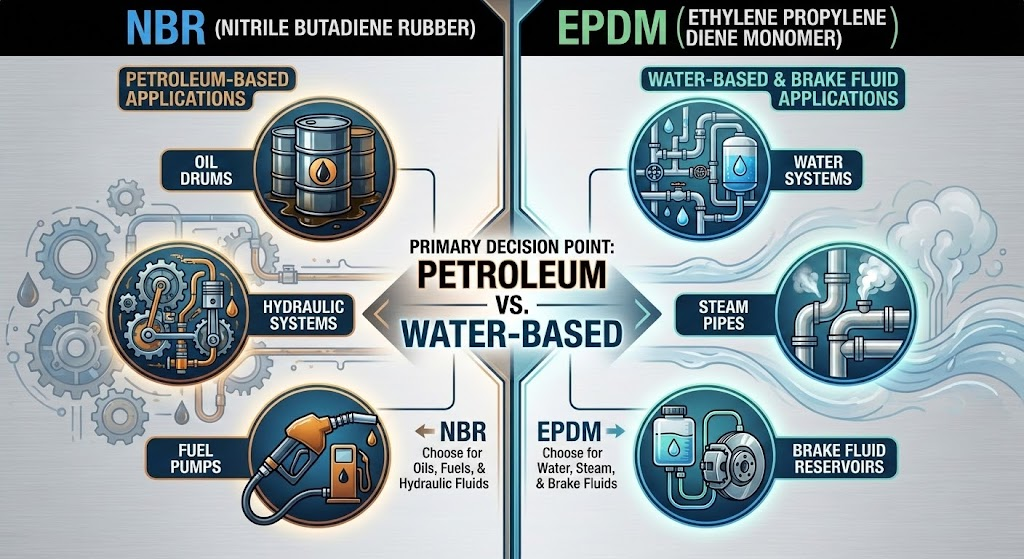
Choose NBR for petroleum-based media. Choose EPDM for water-based or glycol-based media. This rule eliminates most selection errors.
The One Rule That Matters
Media compatibility determines elastomer selection. Temperature is secondary. Using EPDM “just to be safe” in an oil application causes the seal to swell, soften, and fail faster than a correctly specified NBR seal would.
For petroleum oils, lubricants, and fuels: specify NBR.
For water, steam, and glycol coolants: specify EPDM.
If your application involves petroleum AND requires temperatures above 120C, neither material works. You need HNBR or FKM.
Quick Decision Matrix
| Application | Material | Reason |
|---|---|---|
| Petroleum oils/lubricants | NBR | Excellent hydrocarbon resistance |
| Mineral hydraulic fluids | NBR | Industry standard, proven performance |
| Gasoline/diesel fuel | NBR | Designed for fuel contact |
| Hot water/steam | EPDM | Resistant up to 150C |
| Glycol coolant / hot water | EPDM | Only common elastomer rated for hot water |
| Ozone exposure near motors | EPDM | NBR cracks under ozone attack |
| Alcohols (ethanol, methanol) | EPDM | NBR not compatible with alcohols |
| Food contact | Either | Both available FDA-compliant |
| Potable water | EPDM preferred | NSF 61 certified grades available |
Of the three common rubber types (NBR, FKM, and EPDM), EPDM is the only one rated for hot water and steam — the deciding factor for hot-water, coolant, and glycol barrier-fluid seal service, where NBR and standard FKM fall short.
NBR Properties and Specifications
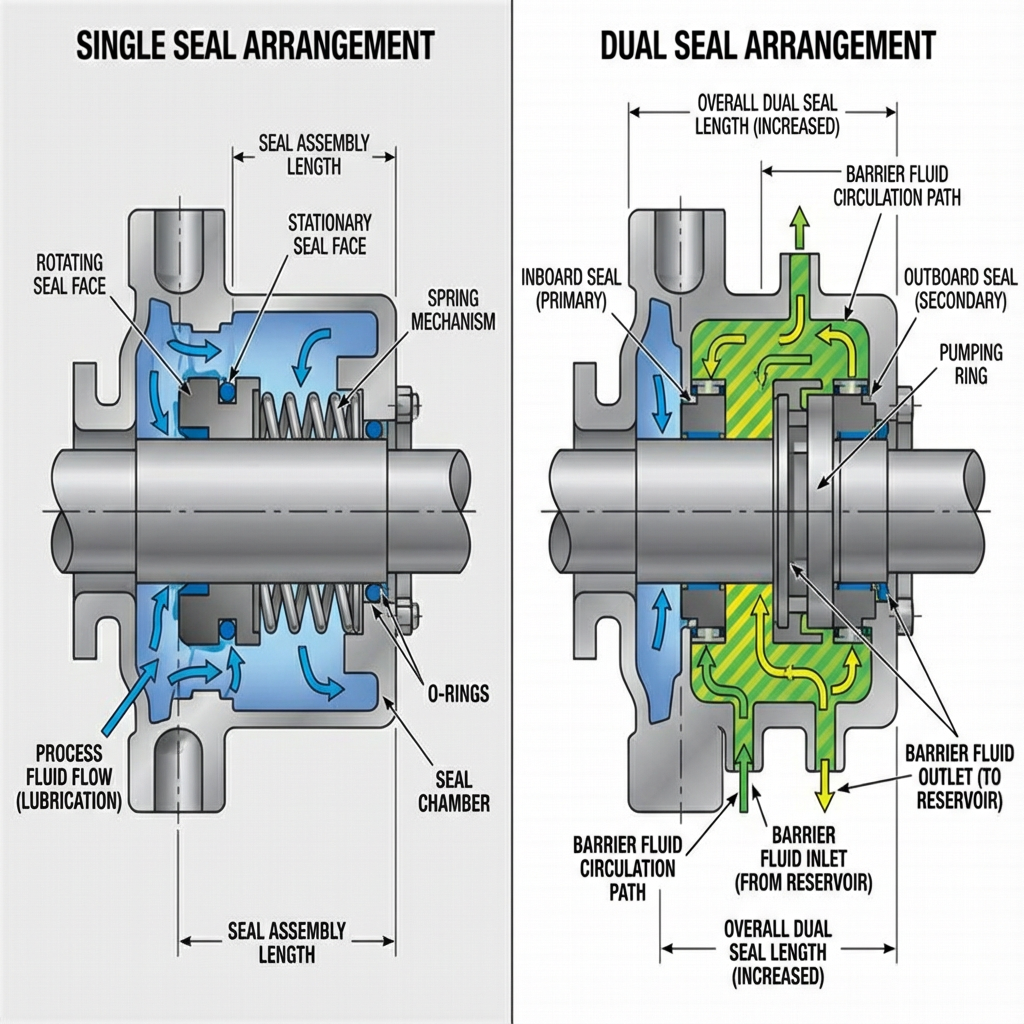
NBR (nitrile butadiene rubber) provides excellent resistance to petroleum products across a temperature range of -35C to +120C. In a mechanical seal it is the secondary seal: the O-ring or wedge sitting in the seal chamber behind the rotating face. That combination makes it the default fitment for oil-service pumps.
Temperature and ACN Content Trade-offs
NBR is a copolymer of acrylonitrile (ACN) and butadiene. The ACN content directly controls the balance between oil resistance and low-temperature flexibility.
- 50% ACN: Optimum oil resistance, but low-temperature flexibility drops to -3C
- 33% ACN: Standard formulation balancing oil resistance and flexibility to -35C
- 18% ACN: Excellent cold flexibility to -48C, but only moderate oil resistance
For most applications requiring both solvent resistance and low-temperature flexibility, specify 33% ACN content. This is the industry default for good reason.
I recommend low-ACN formulations (18-25%) only when operating temperatures regularly drop below -40C. The trade-off in oil resistance is significant, so verify your lubricant compatibility before switching.
Chemical Resistance Profile
NBR shows excellent resistance to:
- Petroleum oils and mineral oils
- Hydraulic fluids (petroleum-based)
- Aliphatic hydrocarbons
- Greases and fats
NBR has poor resistance and should be avoided with:
- Ozone and UV exposure
- Ketones (acetone)
- Alcohols (ethanol, methanol)
- Strong acids
NBR degrades rapidly when exposed to ozone. If your application involves outdoor exposure or proximity to electric motors (which generate ozone), switch to EPDM regardless of fluid type.
When to Specify NBR
Specify NBR for:
- Lube-oil and oil-transfer pump seals
- Fuel-transfer pump seals
- Lubricated rotating equipment
- Indoor pump applications without ozone exposure
NBR seals in hydraulic systems typically provide reliable long-term service when correctly specified. The material cost is lower than EPDM, and availability is excellent for standard durometer ranges.
EPDM Properties and Specifications
EPDM (ethylene propylene diene monomer) handles hot water and steam that would destroy NBR, as well as glycol-based fluids. The generic temperature range extends from -50C to +150C, making it the go-to secondary-seal material for hot-water pumps and for the glycol barrier-fluid loops on dual seals.
Temperature and Curing Effects
EPDM temperature limits depend on the curing method:
- Peroxide-cured EPDM: -50C to +150C (higher heat resistance)
- Sulfur-cured EPDM: -45C to +120C
EPDM O-rings are highly resistant to hot water, steam, and environments with excess moisture, capable of withstanding temperatures up to 150C (302F). For steam service, always specify peroxide-cured compounds.
The material exhibits elongation at break of 300% to 600%, providing excellent flexibility and resilience during thermal cycling. Tear resistance ranges from 10 to 40 kN/m, adequate for most mechanical seal applications.
Chemical Resistance Profile
EPDM shows excellent resistance to:
- Water (hot and cold)
- Steam (up to 150C)
- Glycol-based coolants and barrier fluids
- Alcohols (ethanol, methanol, isopropyl)
- Ozone and UV exposure
- Dilute acids and bases
EPDM has poor resistance and should be avoided with:
- Petroleum oils
- Mineral oils
- Hydrocarbon fuels
- Aromatic solvents
EPDM swells and degrades in petroleum contact. I have seen cases where EPDM O-rings increased significantly in volume within hours of oil exposure. The swollen seal extruded from its groove and caused immediate leakage.
When to Specify EPDM
Specify EPDM for:
- Hot water and steam systems
- Glycol coolant and barrier-fluid loops
- Seals mounted near motors that generate ozone
- Alcohol-based cleaning systems
- Pump cooling seal systems
EPDM is cost-effective compared to silicone or fluorocarbon (FKM) and provides a broader temperature range than nitrile. For water service, it remains the default recommendation.
Temperature-Based Selection Guide
Temperature alone does not determine elastomer selection. However, once you have matched the material to your media type, temperature range narrows your compound options.
| Temperature Range | Petroleum Media | Water/Glycol Media |
|---|---|---|
| Below -40C | Low-ACN NBR (18-25%) | EPDM |
| -40C to +100C | Standard NBR (33% ACN) | EPDM |
| +100C to +120C | NBR (peroxide-cured) | EPDM |
| +120C to +150C | HNBR | EPDM (peroxide-cured) |
| Above +150C | HNBR or FKM | Special-grade EPDM or FFKM |
For applications spanning multiple temperature zones, select the compound that handles your peak operating temperature. Occasional excursions above the rated maximum accelerate aging but do not cause immediate failure if kept brief.
I recommend maintaining at least 10C margin below the material’s maximum continuous service temperature. This margin accounts for localized hot spots at seal faces and provides a safety factor for process upsets.
When Neither NBR Nor EPDM Works: HNBR Alternative
HNBR (hydrogenated nitrile butadiene rubber) fills the gap when you need oil resistance above 120C. EPDM cannot handle hydrocarbons at any temperature, so upgrading to EPDM for high-temperature oil service causes immediate failure.
Why HNBR Exists
NBR loses mechanical properties above 120C. The butadiene component degrades, causing hardening and eventual cracking. But switching to EPDM introduces chemical incompatibility with the oil itself.
HNBR solves this problem through hydrogenation, which stabilizes the polymer backbone. The result is a material applicable to the temperature range of -40C to +170C while maintaining oil and fuel resistance comparable to NBR.
When to Specify HNBR
Specify HNBR for:
- High-temperature petroleum applications (above 120C)
- Applications requiring better ozone resistance than NBR
- Extended service life requirements justifying higher material cost
- High-pressure petroleum barrier-fluid service
HNBR costs significantly more than standard NBR. For high temperature mechanical seal applications running above 120C with petroleum-based barrier fluids, the additional cost extends seal life significantly.
Selection Summary
For petroleum service below 120 °C, NBR remains the industry standard at roughly one-thirtieth the cost of FKM. For hot water and steam, EPDM handles conditions that would rapidly degrade nitrile compounds, and it remains the default for glycol service. Applications involving mixed media, high temperatures, or aggressive chemicals beyond these two materials need HNBR, FKM, or PTFE alternatives instead.