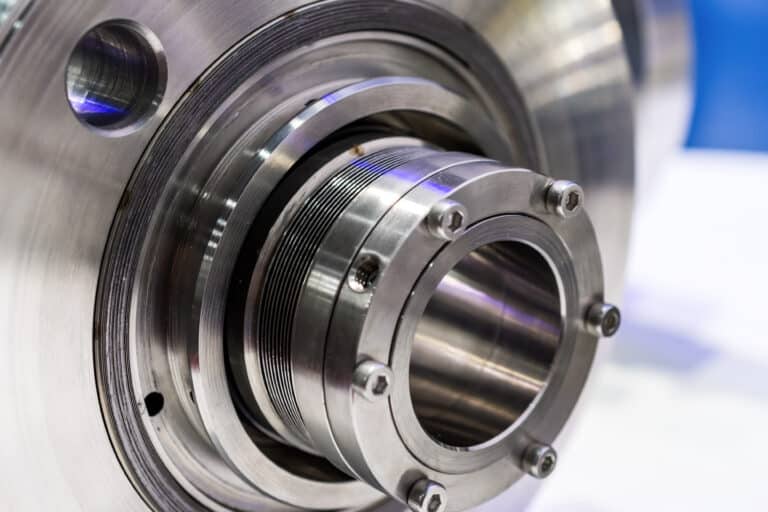
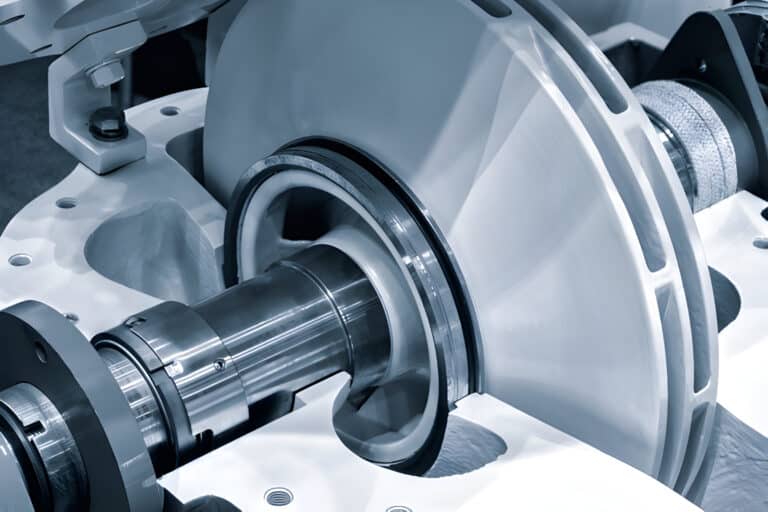
Market research estimates place John Crane at roughly 15% global mechanical seal market share and Flowserve at approximately 12%. Those numbers suggest a clear leader — but they tell you almost nothing about which brand belongs in your pump. Across the industry, we’re seeing procurement teams spend weeks comparing product specs between these two manufacturers, only to discover that the specs barely differ for standard applications. The real decision comes down to which brand’s service infrastructure and installed equipment ecosystem matches your facility.
How John Crane and Flowserve Compare at a Glance
John Crane operates as the sealing division of Smiths Group with over 6,300 employees and GBP 1,115 million in FY2025 revenue. Flowserve is a much larger diversified flow-control company — 16,000 employees, USD 4.729 billion in annual revenue, operations in 50+ countries. But size is misleading here.
John Crane is a pure-play sealing and filtration business. Roughly 63% of its revenue comes from the energy sector, concentrating its R&D and field engineering on refinery, petrochemical, and upstream applications. Flowserve spreads across pumps, valves, and seals, giving it broader process equipment integration but less singular focus on sealing technology.
John Crane brings deeper sealing specialization for energy-intensive applications. Flowserve brings a wider equipment ecosystem where seals integrate with its own pumps and valves. Which advantage matters depends on what equipment already sits on your plant floor.
Where Each Brand Wins on Technology
John Crane’s Gas Seal and Reliability Technology
On pump mechanical seals, John Crane’s edge is reliability engineering and condition monitoring — its cartridge seals and seal support systems are built to extend pump MTBF, and it tends to wrap the seal hardware inside long-term managed-reliability service agreements rather than selling it as a standalone part.
Flowserve’s Material Science and Energy Transition Push
Flowserve has pushed harder on advanced seal-face materials for pumps, with Diamond-Like Carbon (DLC) coatings reported to cut friction-related energy loss by up to 18% in high-speed pump service, and it pairs its seals with an integrated flow-control and aftermarket network across refining and chemical pump trains.
The hidden cost most buyers miss is that these technology advantages apply to a narrow band of specialty applications. For 80% of standard pump seals in water, light hydrocarbons, or general chemical service, the technology gap between these two brands is negligible.
Why the “Better Brand” Might Be Wrong for Your Plant
A mechanical seal can shatter within 30 seconds of dry running. That failure happens regardless of whether the nameplate reads John Crane or Flowserve. Tom Borrino, a Regional Engineer at John Crane, puts it bluntly: seals are very repeatable — operate the same seal under the same conditions, and expect the same failure rate every time. The brand on the box does not change the physics.
Experienced practitioners confirm it consistently: all face-type mechanical seals work the same way, and there are no great technology advantages between one manufacturer’s seal and another’s. The pump type, process conditions, environmental controls, and maintenance procedures are the variables.
Equivalence tables prove this at a technical level. A Burgmann MG901 equals a John Crane Type 1 equals a Sealol 43CE. For standard component seals like these, they are interchangeable across manufacturers. When comparing options, the key factors are your operating conditions, your spare parts pipeline, and your local support network — not the logo on the seal gland.
Mapping your facility’s actual operating conditions against seal selection criteria will do more for reliability than any brand preference.
Service Infrastructure Is the Real Differentiator
John Crane’s Managed Reliability Programs
John Crane operates over 200 service centers across 50 countries. But the network matters less than what John Crane does with it. The Performance Plus program offers three tiers: a full Managed Reliability Programme (MRP) with dedicated onsite engineers, a lighter Reliability Support Programme for periodic guidance, and a Gas Seal Management Programme for recertification.
John Crane documents 50% fewer recurring equipment failures under MRP contracts. Facilities pay a fixed fee; John Crane handles root cause analysis, inventory optimization, and remote monitoring through Sense Turbo. This is not a parts supplier — it is an outcome-based service partner.
That the market share leader invests this heavily in service rather than seal technology tells you where the real competitive advantage lies. Even the dominant brand has concluded that selling better service beats selling better seals.
Flowserve’s Quick Response Centers
Flowserve runs Quick Response Centers (QRCs) designed for rapid seal repair and turnaround. The advantage for Flowserve-heavy plants: if your facility already runs Flowserve pumps, a QRC handles pump and seal service under one roof, reducing coordination overhead.
For mixed equipment fleets, check which brand has a service center within realistic emergency response distance. A 2 AM pump failure does not wait for the technically superior seal — it waits for the closest technician with the right spare parts. Among the most reliable seal brands, the ones delivering long MTBF numbers are those with strong local service presence.
When to Skip Both and Consider Aftermarket
For standard pump applications — ANSI process pumps, water service, light-duty chemical transfer — the John Crane vs Flowserve debate may be the wrong question entirely. Seal vendors maintain equivalents lists where standard seals swap across manufacturers with minimal engineering effort.
The growing aftermarket seal segment exists because standard cartridge seals are well-understood commodities. Manufacturers like Cowseal produce OEM-compatible replacements that match dimensional specs and material grades at a fraction of the OEM price.
Reserve OEM brand commitment for applications that genuinely need it: API 682 dual seals in hydrocarbon service, dry gas seals on critical compressors, high-temperature reactor seals where manufacturer application engineering justifies the premium. Paying John Crane or Flowserve prices for a standard single seal on a cooling water pump is a procurement habit, not an engineering decision.
Making the Right Choice
The John Crane vs Flowserve decision is not a quality contest — both manufacture seals that perform reliably when properly selected and installed. The facilities that get the best seal life match their vendor to their infrastructure rather than chasing the “better” brand.
Three criteria should drive the decision. First, installed base: if 70% of your pumps came with John Crane seals, spare parts inventory and maintenance familiarity favor staying. Second, service proximity: which brand has a staffed center close enough to respond within your acceptable downtime window. Third, application criticality: reserve OEM loyalty for the 15-20% of seals in genuinely demanding service, and evaluate aftermarket for everything else.
Stop comparing seal specs. Start comparing service networks, spare parts lead times, and installed base compatibility.