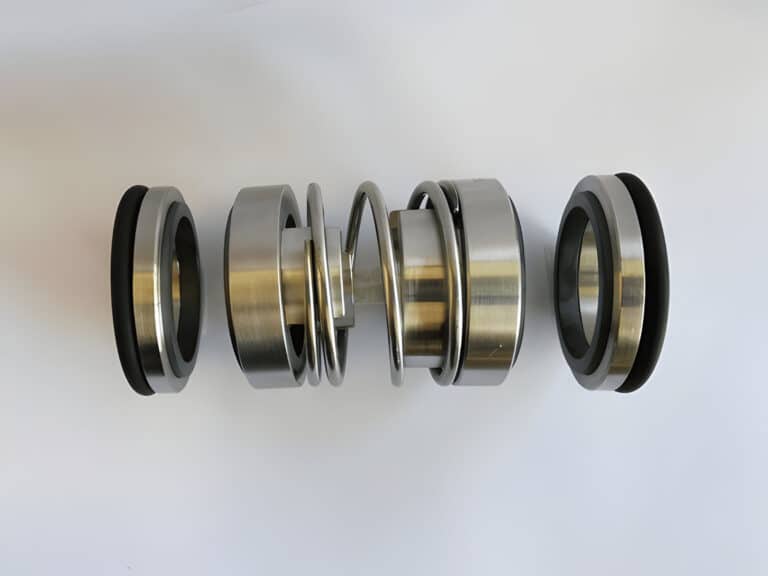
A Gulf Coast chemical plant lost its local John Crane service contract when the regional repair shop consolidated two states away. A four-day turnaround on a Type 21 cartridge became a two-week return-ship cycle, and the plant’s reliability manager was pulling every alternative pre-qualification pack he could find.
That cutover — service-network change, not a product failure — drives most shortlist-building today. The right question is not “is John Crane good?” It is “which alternative matches this site’s profile when lock-in weakens?” The credible alternatives sit within the broader global mechanical seal manufacturer landscape and divide cleanly across price, lead time, and qualification trade-offs.
How to Evaluate John Crane Alternatives
All vendors get scored on the same five dimensions: product overlap, price tier, lead time, qualification status, and service-network coverage. Product overlap comes first because it is binary — a vendor with no Type 21 equivalent is not a candidate for a Type 21 fleet.
The EN 12756 dimensional standard makes several lines true drop-ins (MG1 pairs with AESSEAL B02 and Flowserve 190), but dimensional fit is the precondition for qualification, not a substitute for it.
OEM and aftermarket tiers diverge on lead time more than on price. OEM parts routinely take weeks; aftermarket suppliers quote shorter, more flexible windows.
Price tier is useful for TCO modeling and misleading alone: a $40 seal that fails at six months costs more than a $120 seal that runs three years. The aftermarket-versus-OEM trade-off logic underwrites the price-versus-availability axis.
Flowserve
Flowserve’s installed-base overlap with John Crane runs deepest of any alternative, spanning cartridge, component, and dry-gas seal families. The ISC2-682 cartridge is fully compliant with API 682 Type A and Type B — the qualification match that matters when a JC spec cites API traceability. Operating envelope runs up to 20.6 bar, -40 to 204 °C, 23 m/s, and 25 to 200 mm shaft sizes, covering the bulk of JC Type 1/2/21 replacement work.
- Strengths: Broad catalog; strong API 682 documentation; global pump-OEM approvals.
- Trade-offs: Premium pricing at or above JC; lead time is not a differentiator — build-to-order for most API 682 configurations.
- Price tier: Premium.
- Product overlap: Full — ISC2 family, Durco range, component seals.
- Lead time: Medium.
Spec and service detail once the shortlist narrows is covered in the John Crane versus Flowserve comparison.
EagleBurgmann
EagleBurgmann offers the tightest named cross-reference to JC in the elastomer-bellows class. Per 2025 cross-reference data, MG1 replaces AESSEAL B02, Flowserve 190, and MTU FG1; MG12 replaces AESSEAL B012 and Flowserve 192. Operating range: -20 °C to +200 °C, speeds to 10 m/s, shaft sizes 12 mm to 120 mm.
- Strengths: Broadest named cross-references in the industry; strong European pump-OEM penetration; MG series is the de facto standard for many legacy JC Type 1 retrofits.
- Trade-offs: Elastomer bellows carries the usual chemical-compatibility limits versus pusher designs; cartridge family narrower than Flowserve or AESSEAL.
- Price tier: Premium.
- Product overlap: Full MG series for component retrofits; cartridge coverage narrower.
- Lead time: Medium.
AESSEAL
AESSEAL competes on lead time and service-network density. The CURC and CDSA cartridge ranges use modular components to increase availability and reduce lead time, and the company runs 9 manufacturing facilities and 44 repair locations globally — the closest functional analogue to JC’s footprint for sites where global service matters.
DMSF and SMSS seals are qualification-tested to API 682.
- Strengths: Modular cartridge design favors stock availability; dense repair network reduces cutover pain; API 682 qualification on key lines.
- Trade-offs: Premium pricing; some pump-OEM approval lists still lag JC and Flowserve.
- Price tier: Premium.
- Product overlap: Strong cartridge coverage; CDSA inventoried 24 mm to 125 mm, available to 300 mm.
- Lead time: Short for standard cartridge sizes; medium for custom.
Chesterton for Water and Wastewater
A.W. Chesterton is the natural candidate for water, wastewater, and packing-to-seal conversions.
The Chesterton 155 cartridge handles 711 mm Hg vacuum to 40 barg, -55 to 300 °C, and up to 5000 fpm across 25 to 120 mm shafts. Standard sizes usually ship in 1 to 2 weeks through distribution.
- Strengths: Water and wastewater depth; strong packing-conversion support; distributor-stocked standard configurations.
- Trade-offs: A 3 percent Chesterton surcharge took effect April 15, 2025 and appears as a separate line item on orders — factor it into multi-year supply modeling. Narrower petrochemical presence than Flowserve or AESSEAL.
- Price tier: Mid-to-premium.
- Product overlap: Standard cartridge and split-seal ranges for general industrial.
- Lead time: Short (1-2 weeks for the 155 family).
Cowseal
Cowseal sits in the alternative-OEM and aftermarket tier, producing JC-compatible Type 1, Type 2, and Type 21 lines under cross-references that mirror the tier pattern — Victor W21, for example, is a published analogue for JC Type 21 and Burgmann MG921. Vendors in this tier typically quote 10 to 20 day lead times after prepayment.
- Strengths: Short lead times; value pricing; broad dimensional cross-reference coverage of JC Type 1/2/21.
- Trade-offs: No API 682 qualification paperwork traceability; no global 24/7 on-site service network — field support is regional or remote; performance equivalence beyond dimensional fit requires verification testing before production adoption.
- Price tier: Value.
- Product overlap: Broad at the dimensional level; narrower at the qualification-package level.
- Lead time: Short (stock cross-references) to medium (build-to-order).
Hi-Seal and Regional Manufacturers
Hi-Seal and other regional manufacturers — Asino, TNG, Victor, and the wider Wenzhou cluster — fill out the aftermarket tier. Operational capability resembles Cowseal’s: cross-references to JC Type 1/2/21, 10 to 20 day lead times after prepayment, value-tier pricing.
- Strengths: Lead time and price tier competitive with any aftermarket source.
- Trade-offs: Same qualification and service gaps as the tier; vendor-to-vendor quality variance is higher than in the OEM tier.
- Price tier: Value.
- Product overlap: Broad at dimensional level, vendor-specific at qualification level.
- Lead time: Short to medium, vendor-dependent.
When John Crane Stays the Answer
Three scenarios keep JC at the top of the shortlist regardless of alternative strengths.
First, spec-bound procurement, where the MEL or drawing cites a JC part number that cannot be substituted without an engineering change order. Second, API 682 refinery service where qualification paperwork traceable to the original OEM is part of the deliverable. Third, a standing 24/7 global service SLA across multiple continents that no alternative can realistically replicate.
For sites where alternatives are viable, the supplier-qualification methodology applies regardless of which vendor wins the shortlist.
The John Crane Alternative Verdict
No single alternative wins across the board, because procurement priority is not universal.
For breadth parity on API 682 cartridge work, shortlist Flowserve. For elastomer-bellows component retrofits with the deepest named cross-reference, EagleBurgmann. For lead-time depth with global service coverage, AESSEAL.
For water, wastewater, or packing conversion, Chesterton. For short lead time at the value tier — with qualification-traceability gaps named and verification testing planned — the aftermarket and alternative-OEM tier, Cowseal and Hi-Seal among them.
Rank the site’s top priority, shortlist the matching vendors, then run qualification in parallel.