What is API Plan 32
API Plan 32 is a type of mechanical seal support system that is used to help keep seals working properly in certain kinds of pumps and other rotating equipment. This system is designed to make sure that the seal always has clean liquid around it to keep it cool and lubricated.
How Does API Plan 32 Work
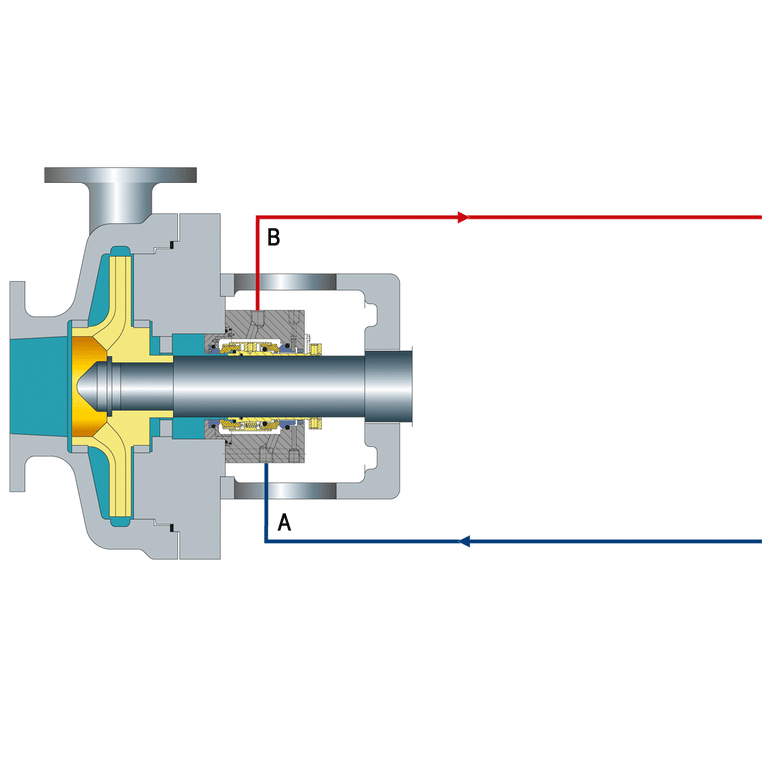
In API Plan 32, a clean, cool liquid (usually water) is injected into the seal chamber from an external source. This liquid is called the flush fluid.
The flush fluid enters the seal chamber through a dedicated port or connection in the gland. Because the flush comes from an outside supply, that supply must be genuinely clean — any grit or debris carried in with it would defeat the purpose of the plan and abrade the seal faces.
Once inside the seal chamber, the flush mixes with the process fluid the pump is handling. It cools the seal, lubricates the faces, and keeps the hotter, dirtier process fluid away from them. To keep that isolation working, the flush is held at a pressure above the seal chamber pressure so it always flows inward.
Plan 32 is almost always paired with a close-clearance throat bushing at the bottom of the seal chamber. The bushing throttles the flow, holds the flush pressure up around the faces, and forms a physical barrier that keeps the pumped product out of the seal area.
The flush then leaves the seal chamber past the throat bushing and exits with the process stream rather than through a separate recovery line. Because the flush leaves with the product, it is consumed continuously and is never recovered or recirculated.

Flush Flow Rate and Pressure Requirements
A common starting point for Plan 32 flush flow is about 1 gpm per inch of seal diameter at 3600 rpm; slower or smaller seals need proportionally less. The correct flush flow rate depends on the seal’s heat load and how dirty the process fluid is, so this rule of thumb is a first estimate, not a final number.
Flush pressure needs as much attention as flow. In field practice it runs roughly 10 to 25 psi above seal chamber pressure so clean fluid always flows inward.
API 682 guidance points to a minimum margin on the order of 2 bar (about 29 psi) for demanding service. Too little margin lets process fluid creep back to the faces; too much wastes clean fluid.
The close-clearance throat bushing is sized around this flow. A target velocity of roughly 15 fps across the bushing is a typical starting point for setting the clearance — tight enough to hold pressure, but open enough to pass the injected flush.
Design of API Plan 32
API Plan 32 is deliberately simple because it is a once-through system: clean fluid is supplied from outside, passed through the seal chamber once, then leaves with the process fluid. There is no reservoir, no circulation pump, and no heat exchanger loop — the plan relies on an outside clean-fluid source rather than recycling its own.

- External clean-fluid source: A supply of clean, cool liquid compatible with the process, such as filtered water, condensate, or a compatible stream from elsewhere in the plant. The supply must be reliable and available at adequate pressure.
- Injection connection: A port or connection in the seal gland directs the flush straight into the seal chamber, close to the seal faces.
- Flow control: An orifice, flow meter, or control valve sets the flush flow rate so the seal gets enough clean fluid without wasting supply.
- Pressure regulation: A regulator, or the supply pressure itself, holds the flush above seal chamber pressure so clean fluid flows inward and process fluid cannot reach the faces.
- Filtration: A filter on the incoming supply keeps particles out, since any debris entering with the flush would abrade the seal faces.
- Throat bushing: A close-clearance throat bushing at the bottom of the chamber throttles the flow and holds flush pressure around the faces.
- Instrumentation: Pressure gauges and flow meters let operators confirm the flush is flowing at the right rate and pressure.
Advantages of API Plan 32
The main advantage of API Plan 32 is positive isolation: a steady supply of guaranteed-clean external fluid keeps dirty, abrasive, or hot process fluid away from the seal faces.
- Positive face isolation: Clean fluid always flows inward, so the seal faces run in a controlled, clean environment instead of the raw process fluid — the main reason Plan 32 is chosen for dirty or abrasive service.
- Independent of process conditions: The flush comes from outside the pump, so even a hot, gritty, or poorly lubricating process fluid still leaves the seal seeing clean, cool liquid.
- Increased seal reliability: A clean, cool, well-lubricated face environment reduces wear and heat damage, cutting unplanned shutdowns and extending seal life.
Disadvantages of API Plan 32
The drawbacks of API Plan 32 come from the fact that it consumes clean fluid continuously and mixes that fluid into the process.
- Ongoing fluid consumption: The flush is used once and leaves with the product, so the plan needs a constant supply of clean liquid. This is a real operating cost, and the extra flow often has to be treated or disposed of downstream.
- Process dilution: Because the flush mixes with the pumped product, the process fluid is diluted by whatever is injected. Plan 32 only fits where that dilution is acceptable.
- Dependence on an external supply: The seal is only as reliable as its clean-fluid supply. If the external source loses pressure or cleanliness, the seal loses its protection almost immediately.
Applications of API Plan 32
API Plan 32 fits services where the process fluid itself is the threat to the seal — dirty, abrasive, hot, or a poor lubricant — and where a clean external flush can be supplied affordably.
- Refineries and petrochemical plants: Pumps on dirty or coking hydrocarbons use Plan 32 so a clean external flush keeps solids and heat away from the faces.
- Chemical processing: For reactive or particle-laden fluids, the external flush isolates the faces from a stream that would otherwise attack or clog them.
- Power generation: Ash-handling and some boiler-feed pumps use Plan 32 where a reliable clean-water supply is already available to protect the seal.
- Pulp and paper mills: Stock and slurry pumps handle highly abrasive fluids, so a continuous clean flush is often the only practical way to stop the faces wearing out.