
A part number stamped on your Armstrong nameplate matches a dozen seal listings, and not all of them will seat correctly in your pump.
Shaft diameter, rotary head code, material combination, and discharge-configuration generation can all differ between two seals sold under the same model family. I’ve replaced enough Armstrong seals to know that a nameplate match is where verification starts, not where it ends.
Armstrong Fluid Technology builds HVAC circulators, vertical in-line, and base-mounted pumps across dozens of frame sizes, and the mechanical seal is the most common part to fail on any of them.
Whether you order the OEM part or a compatible equivalent, the seal that fits is the one whose fit-determining variables match — not the one whose part number looks familiar.
How Armstrong Pump Models Map to Seal Sizes
Armstrong replacement seals are indexed by three spec fields: shaft diameter, rotary head type, and a material code for the faces and elastomers.
A part number like 975002-334 is shorthand for that combination — a 1-5/8 in shaft, a VGXB2 pressure-balanced head, and an XCFLF material set in 316 stainless. Match those three fields and you have narrowed the field to the seals that could physically fit your pump.
| Armstrong pump | Shaft diameter | Head type / code | Material code |
|---|---|---|---|
| HVAC circulators, small frames | 0.500 in (most common) | Type C rotary | Ceramic + carbon |
| Series 4300 vertical in-line | 1-1/8 to 2-5/8 in | VGXB2, pressure-balanced | 316SS, rated to +450 °F |
| 4600 base-mounted | 2-1/2 in | Type C | BCFKF |
Type C rotary heads cover more than half of common Armstrong seal listings. Those pumps run clean, conditioned water at moderate pressure — the standard duty for HVAC pump seals across the circulator and in-line ranges.
The Series 4300 is the exception worth flagging. Its VGXB2 head is pressure-balanced and set-screw driven, rated to +450 °F — which is why a 4300 seal is not a drop-in for a circulator even when the shaft diameter happens to match.
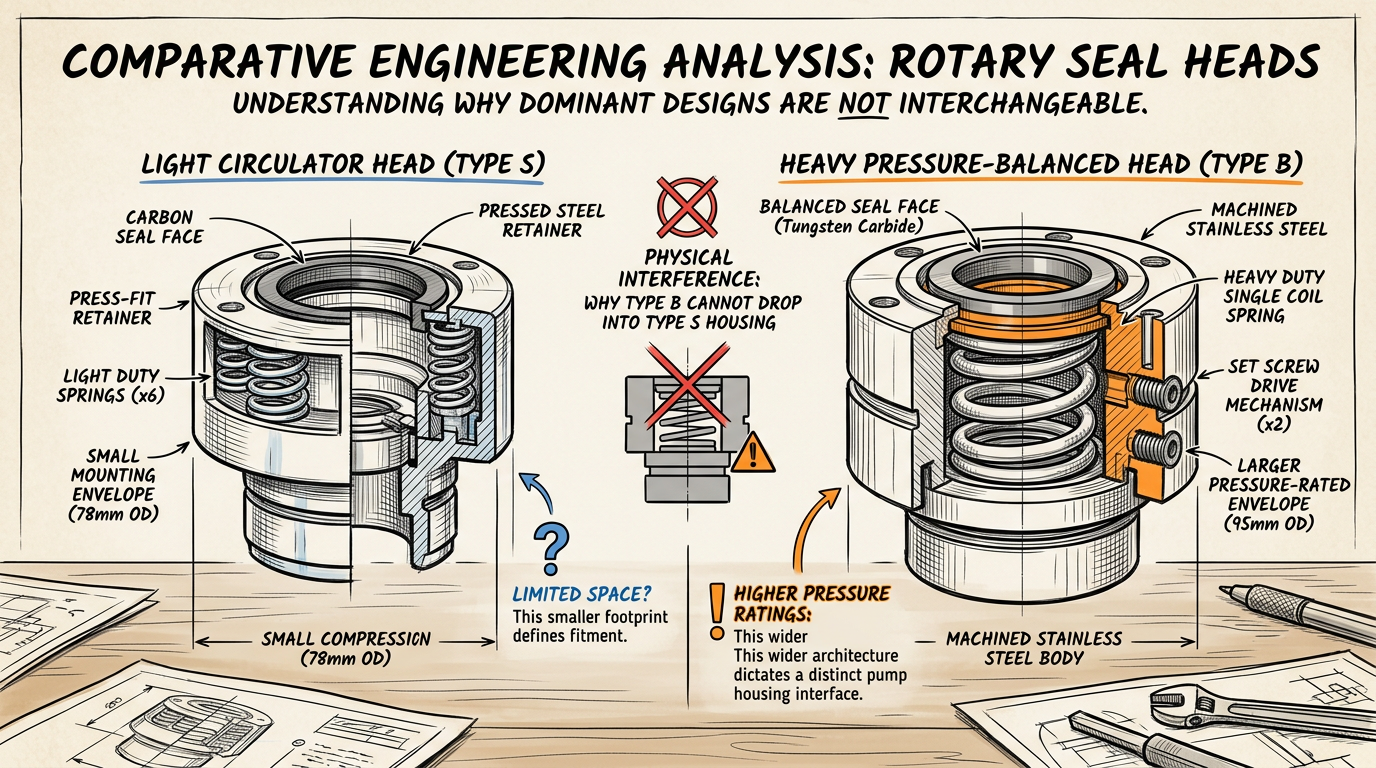
What the spec sheet won’t tell you is that the material code carries as much weight as the shaft size. A ceramic-versus-silicon-carbide face swap changes abrasion tolerance, not just price.
Why a Matching Part Number Doesn’t Confirm Seal Fit
A matching part number confirms shaft diameter and head type, but not the discharge-configuration generation, seat style, or construction variants that actually decide whether a seal seats and holds pressure. Two pumps from the same Armstrong model family, built years apart, can require different seats.
The clearest example is discharge configuration. O-ring and L-cup style seats interchange freely between centerline discharge pumps, but not between centerline and legacy tangential discharge pumps.
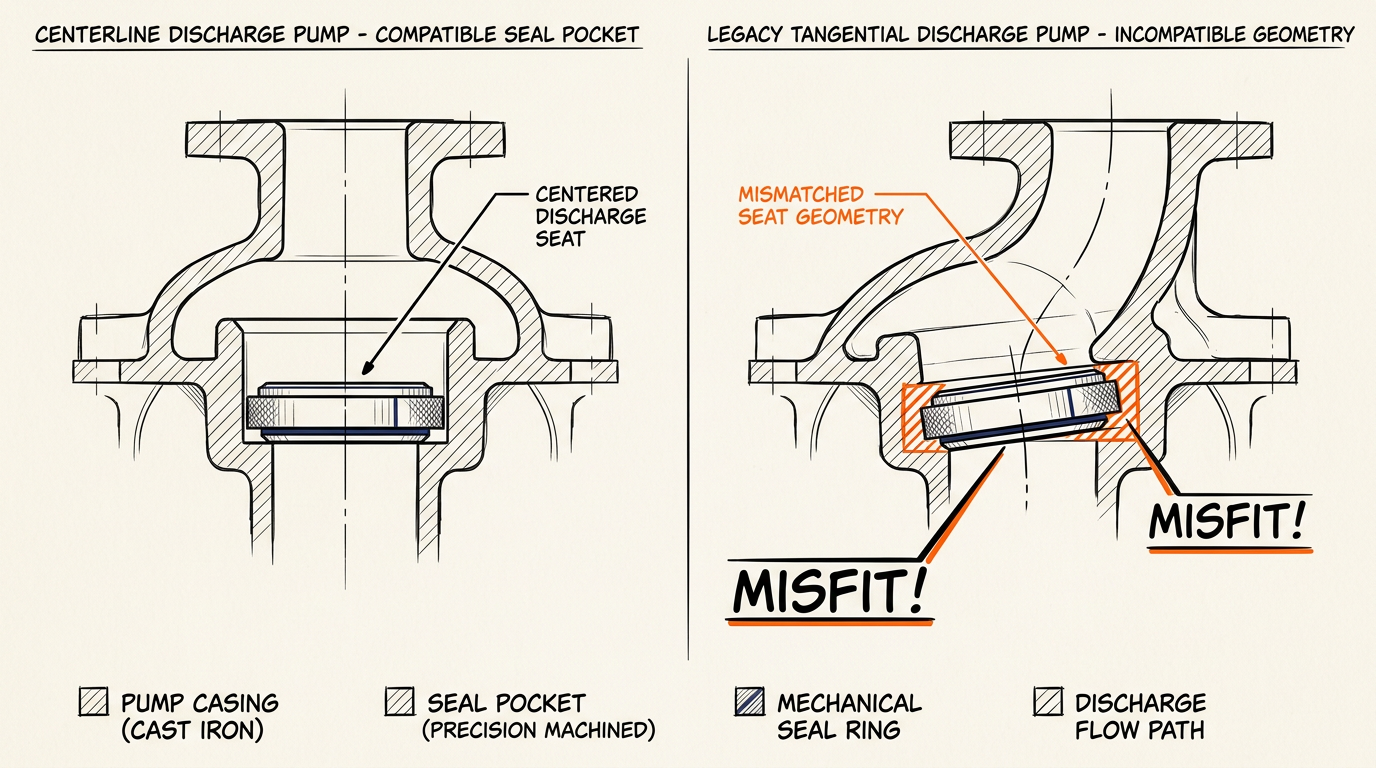
Joe Tibando of Armstrong Fluid Technology has flagged this as the classic trap in older installs. I’ve seen this failure pattern dozens of times — a seal that measures identical on the bench refuses to seat because the pump is an earlier tangential-discharge casting.
The cross-reference notes carry the rest of the traps: a tapered spring instead of a standard one, an abrasion-resistant carbon face, a non-standard spring holder, or a slotted mating ring. Any of these can share a part-number root with the standard build and still not drop in.
Before ordering, gather four things:
- A photograph of the data plate — the nameplate carrying the model and part number.
- The measured shaft diameter, taken from the shaft itself.
- The seal chamber bore, the same dimension you’d capture when you identify a seal for replacement.
- The pump’s discharge configuration, read off the casting, not the paperwork.
Before replacing the seal, check the discharge orientation on the casting — the nameplate won’t tell you. If your measured dimensions don’t match a standard listing, that’s the signal to send those measurements and the data-plate photo to a seal supplier.
Verifying fit is necessary but not sufficient. A correctly matched seal still fails if the face is contaminated during install, so handle the faces with the cardboard disc the seal ships with, never bare fingers. Skin oil on a lapped face is enough to start a slow leak.
OEM vs. Compatible Armstrong Seals
The real difference between an OEM Armstrong seal and a compatible equivalent is dimensional-tolerance certainty, lead time, and cost — not an automatic quality gap.
An OEM seal is machined to the exact stuffing-box dimensions Armstrong designed around, while a compatible seal reverse-engineers those tolerances, which introduces some variability. On a balance-of-plant HVAC circulator running conditioned water under 10 bar at ambient temperature, that variability rarely affects service life. On a high-temperature or high-pressure duty, it can.
A well-specified seal — OEM or compatible — can stretch pump MTBF from an industry-cited 12-18 months to 36-60 months, though those figures are estimates rather than guarantees.
The seal itself is under 10% of total cost of ownership. An OEM part typically carries a 30-50% price premium and a 4-12 week lead time, against 1-3 weeks for a compatible equivalent.
| Factor | OEM Armstrong | Compatible equivalent |
|---|---|---|
| Dimensional tolerance | Exact stuffing-box spec | Reverse-engineered |
| Lead time | 4-12 weeks | 1-3 weeks |
| Price | 30-50% premium | Baseline |
| Best fit | Critical / high-temp duty | Balance-of-plant HVAC |
Switching seal source is not a reliability lever on its own. A refinery running a pressurized dual seal on hydrocarbon service upgraded its seal vendor and watched reliability at 1,000 hours fall from 97.9% to 94.2%. The cause was flush-plan cooling and seal-face orientation, not the seal’s origin.
Proper selection prevents most failures, but only after the flush plan and face flatness are right.
A compatible seal engineered to the same Armstrong OEM shaft, head, and material spec can be sourced in 1-3 weeks, at lower cost than the factory part and without changing the fit. That is exactly what an OEM-compatible seal line is built to do, once the fit variables are verified.
The same verify-then-decide logic applies across brands. A Grundfos-compatible seal demands the same shaft, seat, and material check before the OEM-versus-aftermarket question comes into play.
What This Means in Practice
The most common mistake I see is treating a nameplate match as confirmation of fit. It is not.
Before you order anything, photograph the data plate, measure the shaft and the seal chamber bore, and confirm whether the pump is a centerline or legacy tangential discharge casting. Those four checks eliminate most wrong-seal returns.
Once the fit variables are verified, the OEM-versus-compatible decision comes down to criticality. Pay the OEM premium and lead time on high-temperature or high-pressure duty; take the faster, cheaper compatible seal on balance-of-plant HVAC.
And remember which variable actually moves reliability — a verified seal in a pump with a bad flush plan still fails. Fix the flush and the faces first; the seal source is the last call, not the first.