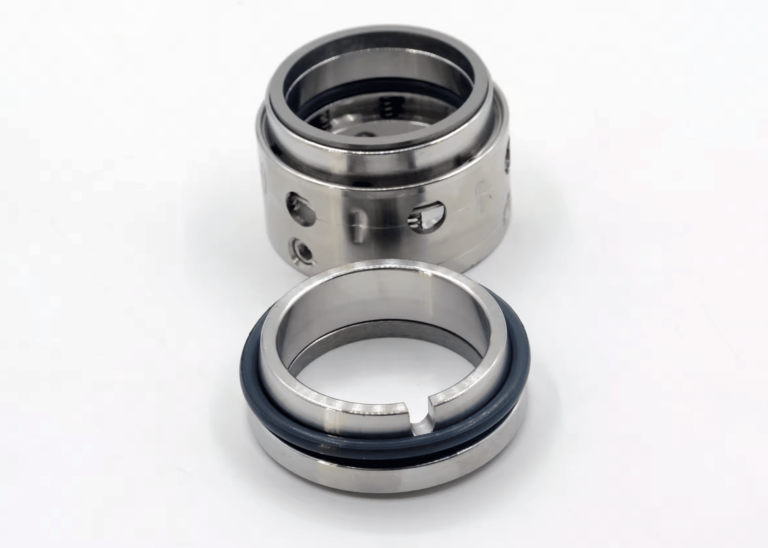
Most incomplete seal orders I receive are missing the same three things: seal chamber bore, upset operating conditions, and the carbon grade. The supplier gets a shaft diameter, a vague fluid description, and a request to “match the old one.” Two weeks later, the seal arrives and doesn’t fit.
Existing guides tell you “temperature and pressure matter” without telling you what to actually write on the purchase order. Here’s what your supplier needs, organized by where you find each piece of information.
Dimensions Your Supplier Actually Needs
Shaft diameter alone does not define seal fit — three measurements do. Most ordering forms ask for shaft size and stop there, but your supplier needs the seal chamber bore and chamber depth just as critically. Get any one wrong, and the seal won’t seat properly or won’t have enough compression to seal.
Shaft Diameter
Measure the shaft at the seal mounting location with a micrometer, not calipers. Worn shafts can be undersized enough to cause the seal to slip. Record the actual measured value, not the nameplate value.
Seal Chamber Bore and Depth
The bore determines which stationary seat fits the housing. The depth sets the working length and spring compression. You’ll find both on the pump’s mechanical seal assembly drawing, or measure directly with a depth gauge and inside micrometer once the old seal is removed.
Make sure the chamber is free of carbon deposits or corrosion scale before measuring — buildup on the bore wall gives a reading that’s too tight.
Also record the gland bolt circle diameter, bolt count, and bolt size. If the stuffing box face is scored or pitted, mention it — your supplier may recommend a different gland plate.
Operating Conditions That Determine Seal Design
Providing a single temperature or pressure value is the most common oversimplification I see on purchase orders. Your supplier needs the full operating envelope: normal, maximum, and upset conditions.
Pressure and Temperature Envelope
Specify three values for each parameter:
- Normal operating — the condition the seal runs at 90% of the time
- Maximum continuous — highest sustained level during normal production
- Upset or transient — peak value during startups, shutdowns, or process excursions
Above roughly 205°C and 35 kg/cm2, balanced seal designs become necessary. If you only report normal operating temperature and the application occasionally hits upset conditions above those thresholds, your supplier will quote an unbalanced seal that burns out within weeks.
Shaft Speed
Report speed in RPM. Speed combined with pressure creates the PV (pressure-velocity) value that determines which face material combinations survive. Carbon running against silicon carbide handles about 1,470 bar-m/s. The same carbon against cast iron manages only 245 bar-m/s — a 6x difference. Without knowing your speed, your supplier is guessing at the face materials.
Fluid Properties and Other Parameters
Specify the fluid by name and concentration. “Acid” is not a specification — “65% nitric acid at 40°C” is. Include solids content, particle size, and any tendency to crystallize or polymerize at ambient temperature.
Specify rotation direction (clockwise or counterclockwise from the drive end) and mounting orientation. Many seal designs are rotation-specific, and vertical installations change flush plan requirements. If a flush plan is in place — API Plan 11, 32, 53 — note the plan designation and barrier fluid.
Material Specifications and the 5-Character Code
Telling your supplier “carbon and ceramic faces with Viton O-rings” sounds specific but leaves critical gaps. Which carbon grade? Which ceramic — aluminum oxide or silicon carbide? What about the metal body and spring?
The Industry Standard Material Code
The 5-character coding system encodes all five material selections in a single string:
| Position | Component | Common Codes |
|---|---|---|
| 1 | Elastomer | V = Viton, E = EPDM, K = Kalrez |
| 2 | Rotary face | C = Carbon, T = Tungsten Carbide, L = SiC |
| 3 | Metal parts | F = 316 SS, B = Bronze, D = Hastelloy C |
| 4 | Stationary face | L = SiC, Q = Ceramic (Al₂O₃), C = Carbon |
| 5 | Spring | F = 316 SS, H = Hastelloy C, M = Monel |
“VCFLF” tells the supplier: Viton elastomers, carbon rotary face, 316 SS body, silicon carbide stationary, 316 SS spring. If you can decode the part number on your existing seal, you can often extract the material code directly.
Why Carbon Grade Matters
“Carbon” is not one material. Grades range from resin-bonded commodity carbon to antimony-impregnated and metal-powder-filled varieties, each with different PV limits and chemical resistance. I’ve seen maintenance teams order generic carbon rings because the PO just said “carbon face.” The replacement ran three months instead of three years.
Specify the carbon grade by manufacturer designation, or describe the service conditions so your supplier can match the grade.
For elastomers, specify by trade name or chemical family — not “rubber.” Viton handles general chemical service to about 200°C; EPDM covers steam and mild alkalis to 150°C; Kalrez/Chemraz handles aggressive chemicals above 200°C at 10–20x the cost. Perfluoroelastomers like Kalrez are technically plastics, not elastomers — specifying “elastomer” generically may exclude them from your supplier’s quote.
The Most Common Ordering Mistake: Sending Incomplete Specs
Many orders that come back wrong were technically ordered correctly — the supplier filled in the blanks the buyer left empty, and those assumptions didn’t match the application.
The three most commonly missing data points: seal chamber bore (buyers provide shaft diameter only), upset operating conditions (buyers provide steady-state only), and carbon grade (buyers write “carbon” and assume it’s universal). The supplier picks the most common default for each gap — and that default fails more often than you’d expect.
Gather information from all three sources before calling: the pump nameplate (shaft size, speed, model), the existing seal or its documentation (dimensions, material code, part number), and the process data sheets (fluid, temperatures, pressures at all conditions).
When a data point is missing — old seal destroyed, nameplate illegible, P&ID outdated — photograph what you have. A clear photo of remaining seal components and the pump nameplate gives an experienced application engineer enough to narrow down the specification.
Your Ordering Checklist
The fastest path to a correct order is walking through all three sources before calling your supplier.
From the pump: shaft diameter (measured, not nameplate), shaft speed in RPM, rotation direction, mounting orientation, pump model number.
From the existing seal: chamber bore, chamber depth, gland bolt pattern, material code or part number, flush plan designation.
From process data: fluid name and concentration, normal/maximum/upset temperatures and pressures, solids content, special conditions (crystallization, polymerization, cryogenic service).
If you’re missing the chamber bore, don’t guess — measure it or ask your supplier to look up the pump model. One measurement saves you a month of waiting for the wrong seal before the correct one arrives.