I replaced the same mechanical seal on a cooling water pump three times in one year. Each time, the new seal leaked within weeks. On the fourth visit, I finally checked the bearings — and found them completely shot. The shaft was wobbling so badly that no seal could have survived. That pump taught me something every technician should know early: seals and bearings do completely different jobs, but when one fails, the other usually follows.
A mechanical seal prevents fluid from leaking out along the shaft. A bearing supports the shaft and keeps it spinning smoothly. They sit in different locations, wear out for different reasons, and show different symptoms when they fail. But they depend on each other more than most people realize.
What Does Each Component Do?
The Mechanical Seal
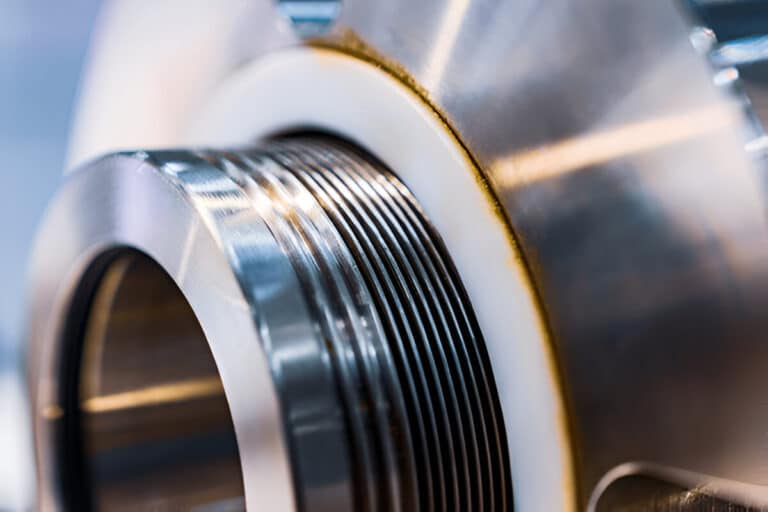
A mechanical seal is a barrier. Two flat faces — one rotating with the shaft, one stationary in the housing — press together with spring force to block fluid from escaping where the shaft passes through the pump casing. A thin lubricating film between these faces prevents them from grinding apart.
The seal’s only job is containment. It does not support any load, does not reduce friction on the shaft, and does not handle any mechanical force. It simply keeps the pumped fluid inside the pump and contaminants out.
Seal faces are precision-lapped to a flatness measured in light bands. Even microscopic disturbance — vibration, shaft wobble, thermal distortion — can break that contact and cause a leak.
The Bearing
A bearing supports the shaft’s weight and absorbs the hydraulic forces generated during pumping. Rolling elements — balls or cylindrical rollers — sit between an inner and outer race, allowing the shaft to spin with minimal friction.
Bearings handle radial loads (pushing the shaft sideways) and thrust loads (pushing it along its length). Without bearings, the shaft would grind against the housing and seize within seconds.
The bearing has nothing to do with fluid containment. It does not prevent leaks. A pump with perfect bearings and a damaged seal will still leak. A pump with a perfect seal and damaged bearings will vibrate, overheat — and then the seal will fail too.
How to Tell Which One Failed
When a pump starts acting up, the first question is always: is it the seal or the bearing? Get this wrong, and you replace the wrong part — or worse, you replace the seal when the bearing was the root cause, and the new seal fails just as fast.
| Symptom | Likely Cause |
|---|---|
| Visible drip or spray at the seal area | Seal failure |
| Grinding or rumbling noise from the bearing housing | Bearing failure |
| Excessive vibration felt on the bearing housing | Bearing failure |
| Milky or discolored bearing oil | Seal leak contaminating bearing lubricant |
| Shaft feels loose with noticeable play | Bearing wear |
| Pump runs fine but leaks at the shaft | Seal failure (check bearing condition before replacing) |
One diagnostic shortcut: put your hand on the bearing housing while the pump runs. Excessive heat or vibration points to bearings. Visible leakage at the seal faces points to the seal. But here is the catch — if both symptoms appear together, start with the bearings. Seal leakage combined with vibration almost always means the bearing is the primary problem.
The Most Common Mistake: Replacing the Seal When the Bearing Is the Problem
This is the mistake I see more than any other. A technician finds a leaking seal, replaces it, and the new seal fails within months. They replace it again. Same result. The seal gets blamed — wrong brand, wrong material, bad luck. But the real problem is sitting 6 inches away in the bearing housing.
Here is how the failure chain works. As bearings wear, they develop internal clearance — extra space between the rolling elements and the races. That clearance allows the shaft to move off-center during each revolution. This movement is called shaft runout (wobble). Even a few thousandths of an inch of runout — beyond 0.002 inches TIR (Total Indicated Runout) — causes the seal faces to separate momentarily during each revolution. That intermittent gap lets fluid escape, creating a slow leak that looks exactly like a seal failure.
Roughly 13% of mechanical seal failures originate from bearing problems. That number comes from a review of 11,000 seal failures across 148 industrial plant sites. One in eight “seal failures” was actually a bearing problem in disguise.
Before you install any new seal, check the shaft runout at the seal location with a dial indicator. If it reads above 0.002 inches TIR, stop. Fix the bearings first. A new seal on a worn bearing is money wasted — if you skip this step, you’ll be back in a week doing the same job.
My standard practice: whenever I replace a seal, I inspect the bearings. If there is any roughness, play, or noise, I replace them at the same time. It adds an hour to the job but saves you from making three more trips.
The Bottom Line
Mechanical seals keep fluid in. Bearings keep the shaft spinning true. They are not interchangeable, not redundant, and not independent — they form a system where the condition of one directly affects the life of the other.
Next time a seal fails prematurely, resist the urge to grab another seal off the shelf. Check the bearings first. Measure shaft runout. The cheapest seal replacement is the one you only have to do once.