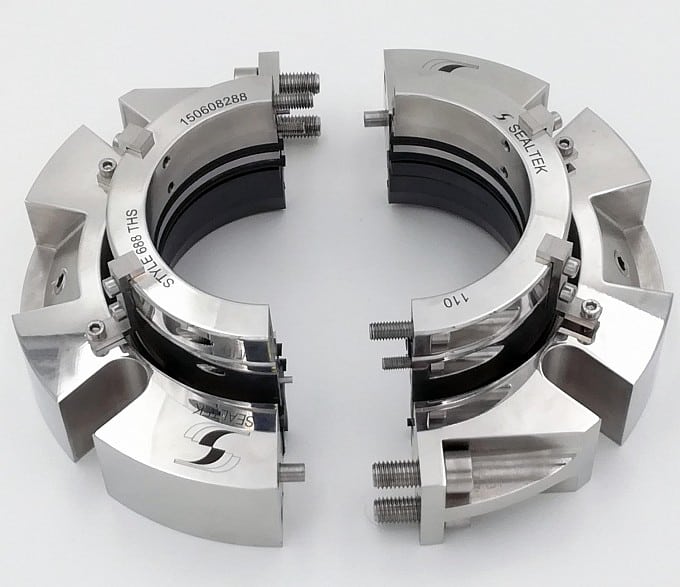
API 610 is the standard for the centrifugal pump in petroleum, petrochemical and natural gas service; API 682 is the standard for the mechanical seal and sealing system that goes into that pump. The two are written to be used together: API 610 calls for the pump’s seal to be supplied to API 682, so on one pump datasheet the pump vendor works to 610 and the seal vendor to 682.
What Is API 610
API 610 is the American Petroleum Institute standard for centrifugal pumps in petroleum, petrochemical and natural gas process services, published as Centrifugal Pumps for Petroleum, Petrochemical and Natural Gas Industries.
The current edition is the 13th, published in June 2026. Its international counterpart is ISO 13709: the 11th edition of API 610 was identical to ISO 13709:2009, and the 12th and 13th have no ISO twin.
What Is API 682
API 682 is the API standard for the shaft sealing systems of centrifugal and rotary pumps in the petroleum, natural gas and chemical industries, published as Pumps—Shaft Sealing Systems for Centrifugal and Rotary Pumps. It is written mainly for hazardous, flammable and toxic services.
Alongside the seal requirements, API 682 carries the standard piping plans and their auxiliary hardware, seal instrumentation, and the protocol for qualification-testing a seal design.
The current edition is the 4th edition, published in May 2014 and reaffirmed in March 2022. As of October 2026 no 5th edition has been published. Its ISO counterpart, ISO 21049:2004, matches the 3rd edition; the 4th edition was issued by API alone.
The Difference Between API 610 and API 682
API 610 stops at the seal chamber, and API 682 covers the seal that goes into it and the system that supports that seal. Through the 8th edition (1995), the pump standard carried its own seal clauses. From the 9th edition (2003), API 610 has made an API 682 seal the default: the pump must be fitted with a mechanical seal and sealing system to API 682, and the purchaser specifies the seal category.
Pump Coverage
API 682 reaches further than API 610: API 610 covers only new centrifugal pumps built to it, and API 682 covers the seal on API 610 pumps and on pumps built to other standards. A 682 seal can go on an ASME B73.1 or B73.2 chemical pump or an API 676 pump, on a new pump or as a retrofit on an existing one.
API 682 covers seals for shafts from 20 mm (0.75 in) to 110 mm (4.3 in).
In the 4th edition the three API 682 seal categories line up as follows:
| Seal category | Seal chamber it is written for | Temperature range | Maximum pressure (gauge) |
|---|---|---|---|
| Category 1 | ASME B73.1 and B73.2 | −40 to 260 °C (−40 to 500 °F) | 300 psi |
| Category 2 | API 610 | −40 to 400 °C (−40 to 750 °F) | 600 psi |
| Category 3 | API 610 | −40 to 400 °C (−40 to 750 °F) | 600 psi |
A seal outside the shaft range or outside its category’s window is designated an Engineered Seal.
Classification
API 610 classifies the pump by its construction; API 682 classifies the seal on four separate axes. API 610 sorts pumps into three families, overhung, between-bearings and vertically suspended, and gives each specific pump type its own designation.
The four API 682 axes are:
- Category: 1, 2 or 3, each a set of features, materials, operating window and intended pump. Categories 2 and 3 differ in the 4th edition only in testing, qualification and documentation.
- Type: Type A is a seal with elastomer secondary seals; Types B and C are bellows seals, B with elastomers and C, for high temperature, with flexible graphite. All three are cartridge seals.
- Arrangement: Arrangement 1, 2 or 3, a single seal, a dual unpressurized seal or a dual pressurized seal, set by the number of seals in the cartridge and the pressure of the buffer or barrier fluid.
- Orientation: for dual seals, how the two seals face each other: face-to-back, back-to-back or face-to-face.
API 610 no longer classifies the seal at all. Its old five-character seal code, such as BSTFN, is listed in API 682 as obsolete. If an old datasheet still describes the seal that way, restate it in 682 terms before asking for an API 682 seal.
The Seal Chamber
The seal chamber is a pump part under API 610; API 682 covers how the seal fits it. On the pump side, API 610 sets:
- Dimensions: the chamber is built to standard dimensions tabulated in the pump standard.
- Pressure rating: the chamber and the seal gland must be rated for at least the casing’s maximum allowable working pressure and temperature.
- Shaft deflection: deflection at the seal faces is limited under the worst operating conditions.
- Sealing pressures: the maximum static and dynamic pressures expected in the chamber are agreed with the purchaser and stated by the pump vendor on the datasheet.
API 682 carries no chamber dimension tables of its own and refers back to the pump’s standard: API 610 for a 610 pump, ASME B73 for a chemical pump. It specifies the seal’s side of the interface: the gland plate and its connections, the clearances between rotating and stationary parts, and the seal sleeve.
The two overlap on chamber geometry: both standards illustrate chamber register concentricity and face runout.
Testing
Each standard sets the tests for its own equipment: API 610 for the pump, and API 682 for the seal, once as a design through qualification testing and once per assembly through an air test before shipment.
Under API 610, each pump gets a performance test before shipment unless the purchaser waives it, and the casing gets a hydrostatic test. An NPSH test is added when specified, and for critical or unspared pumps the contract may call for a mechanical run test. That run test also checks leakage through the mechanical seal.
Under API 682, each seal assembly gets a pressure-decay air test before it ships: at 25 psi (1.7 bar), the pressure may drop no more than 2 psi (0.14 bar) in five minutes.
Qualification testing is how the seal manufacturer shows that a design can meet the standard’s performance and life expectations. The test fluids are water, propane, 20% NaOH, cold oil and hot oil. The 5.6 g/h figure sometimes quoted as API 682’s leakage allowance is the maximum liquid leakage per pair of faces that the 2nd edition set for qualification testing, not an air-test limit.
When buying an API 682 seal, ask for the qualification record for your seal category and the test fluid nearest your service.