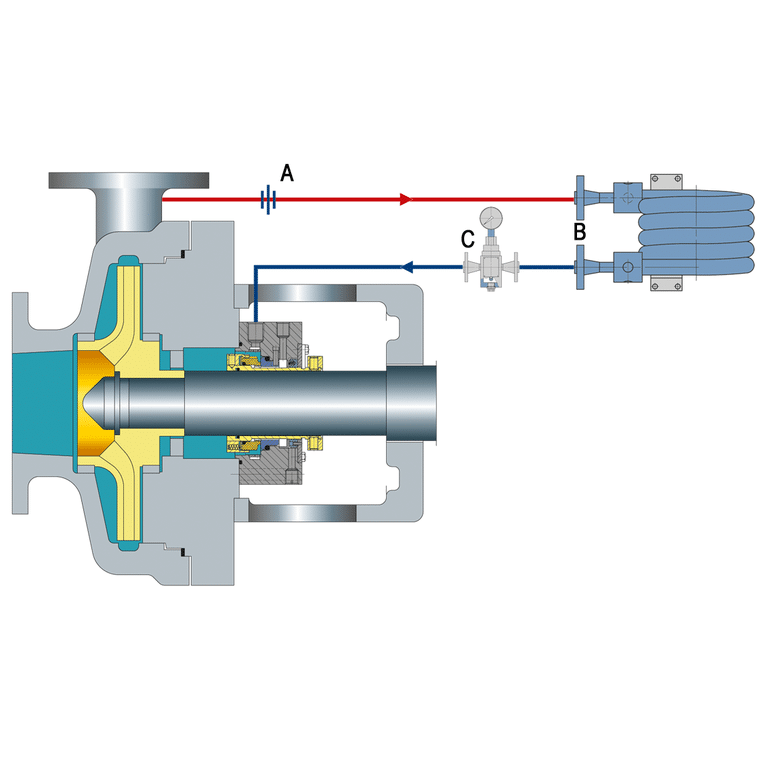
What is API Plan 54
API Plan 54 is a piping arrangement used with mechanical seals to provide a more reliable and safer sealing system. It is designed to control leakage from the seal, while also preventing the process fluid from entering the atmosphere.
How Does API Plan 54 Work
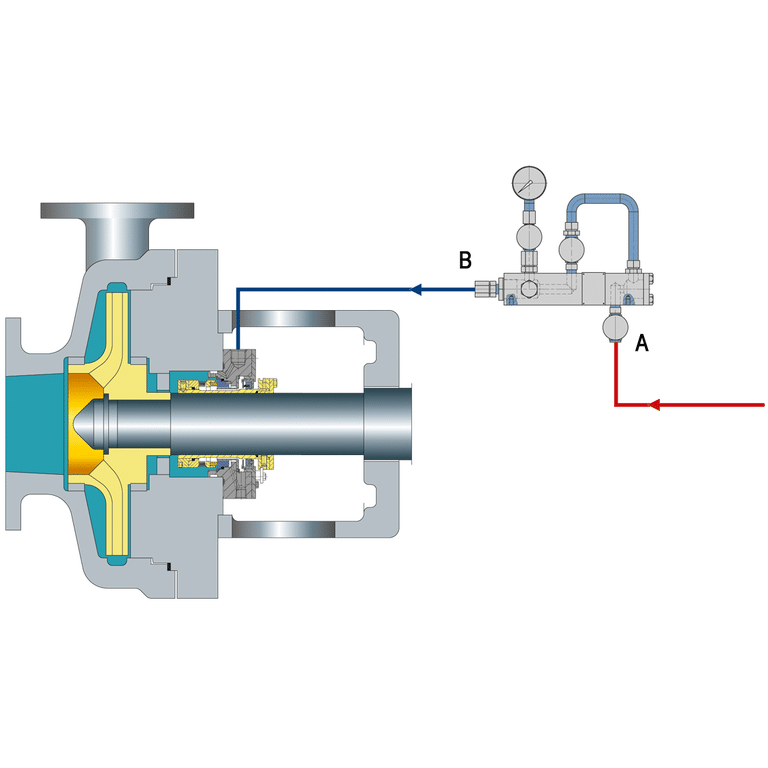
The API Plan 54 system uses an external reservoir to supply clean, cool barrier fluid to the mechanical seal. This barrier fluid is maintained at a pressure higher than the pressure in the pump, which helps prevent process fluid from entering the seal chamber and causing damage or contamination.
The barrier fluid is circulated from the reservoir, through the seal chamber, and back to the reservoir in a closed loop. This circulation is driven by an external pump in the Plan 54 supply unit, which both holds the barrier above process pressure and forces a steady flow through the seal — Plan 54 does not rely on the seal’s own pumping ring.
As the barrier fluid circulates, it helps to lubricate and cool the seal faces, reducing friction and wear. The higher pressure of the barrier fluid also provides a positive flow of clean fluid across the inboard seal faces into the process, so process fluid cannot leak past the primary seal.
The reservoir in a Plan 54 system serves several important functions. It acts as an expansion tank to accommodate changes in fluid volume due to temperature variations. It also holds the reserve of barrier fluid that is gradually lost across the inboard seal into the process, so the level can be monitored and topped up.
Additionally, the reservoir allows the condition of the barrier fluid to be monitored. Pressure, temperature, and level sensors can be installed on the reservoir to alert operators to any potential issues with the sealing system.
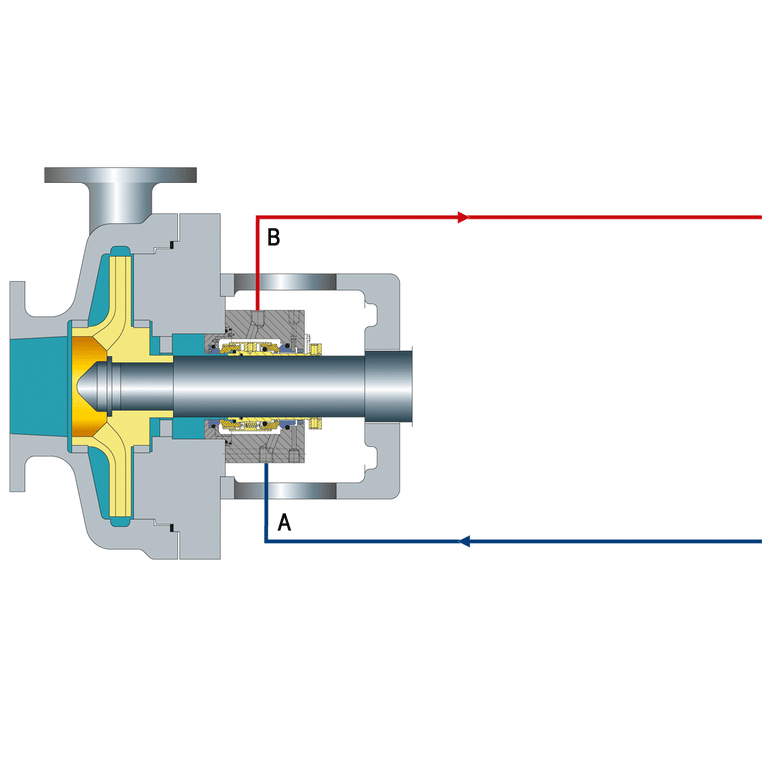
Design of API Plan 54
- External Barrier-Fluid Unit (Skid): a self-contained console holding the barrier fluid — often sized to serve a row of seals — that supplies clean, cool, pressurized barrier fluid rather than relying on the pumped process fluid.
- Circulation Pump: an external pump in the unit both pressurizes the barrier above seal-chamber pressure and forces it through the dual seal; circulation does not depend on the seal’s pumping ring.
- Reservoir, Cooler, and Filter: the reservoir accommodates thermal expansion and holds the reserve that replaces barrier fluid lost across the inboard seal, while the cooler and filter keep the barrier fluid temperature-controlled and clean before it returns to the seal.
- Pressure Control: the unit holds barrier pressure above process pressure so any leakage is barrier-into-process, keeping process fluid off the atmospheric side (a double/dual-seal arrangement).
- Instrumentation: pressure, temperature, and level sensors on the barrier loop flag low pressure, high temperature, or leakage.
Advantages of API Plan 54
- Enhanced seal life: By maintaining a cool and clean environment, API Plan 54 extends the life of mechanical seals.
- Improved system reliability: The closed-loop design reduces the risk of contamination and ensures a stable seal environment.
- Increased efficiency: Proper cooling and lubrication of the seal faces minimize friction and wear, improving overall system efficiency.
- Flexibility: API Plan 54 can be adapted to various pump and process conditions, making it a versatile solution for high-temperature applications.
Disadvantages of API Plan 54
- Increased complexity: The additional components and piping required for API Plan 54 increase system complexity compared to simpler seal support plans.
- Higher initial cost: The external heat exchanger, circulation pump, and additional piping and instrumentation result in higher initial installation costs.
- Maintenance requirements: Regular maintenance of the heat exchanger, circulation pump, and other components is necessary to ensure optimal system performance.
Applications
- Refineries and petrochemical plants
- Oil and gas production
- Chemical processing
- Power generation
- Pulp and paper industry
- Food and beverage processing