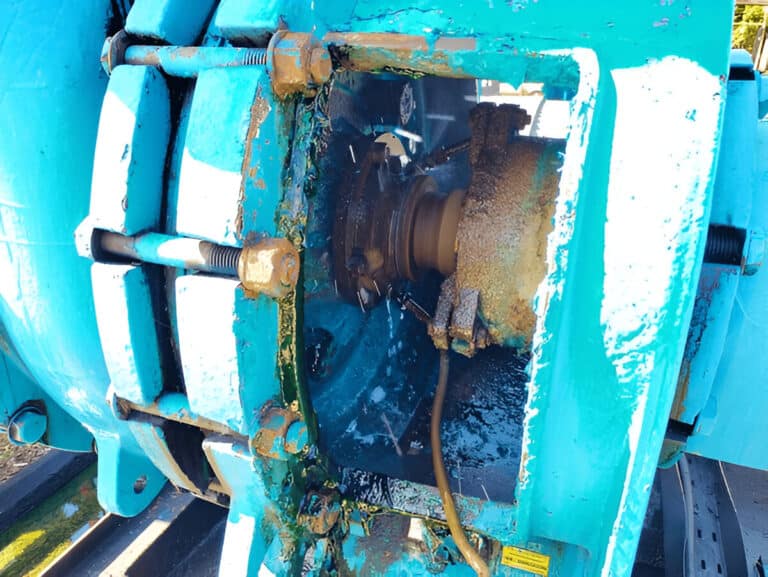
The first time I sized packing on a pump that had already been repacked four times in eighteen months, I caught myself measuring a wear groove and pretending the box was in spec. The math worked. The pump leaked again three weeks later.
Sizing gland packing takes five minutes; the harder question is whether you should be sizing it at all.
Most centrifugal pumps past their first failure cycle save more in MTBF gain by upgrading to a mechanical seal than they ever recover by perfecting the packing fit. So before you cut another ring, run the upgrade decision first. If the answer is “still packing”, the sizing math is below.
Stop Sizing — Is Replacement the Right Question?
Four signals tell me to stop the repack and quote a seal conversion. If two or more of these hit, I do not size new packing.
- The pump has been repacked within the last twelve months and is leaking again.
- The shaft sleeve has a wear groove deeper than 0.005 inches under the packing zone.
- The site has tightened its allowable leakage spec — common after a water-conservation audit, food-grade upgrade, or HSE finding on the floor.
- The application is on a list of seals the maintenance program is converting (typical in API 682 retrofit programs).
A repack on a pump meeting any two of these is not maintenance — it is rework you will redo in three months. The five-minute sizing job costs a real four hours by the time you account for the next failure.
If none of these signals fire, packing is still the right answer. Size it.
If You Must Repack: How to Determine Gland Packing Size
Even if you are repacking today, treat it as the stopgap it is: repacking is a recurring labor-and-downtime cost that a one-time conversion to a mechanical seal eliminates. If the bore is already worn or the gland is near the end of its travel, size the seal, not the packing.
Two measurements determine your packing cross-section: the stuffing box bore inside diameter (ID) and the shaft outside diameter (OD).
> Packing cross-section = (Bore ID − Shaft OD) / 2
Use inside calipers or a telescoping gauge for the bore, and an outside micrometer for the shaft. Measure the stuffing box bore at two points 90 degrees apart and take the larger reading — worn bores are rarely round. For the shaft, measure at least two inches outside the packing zone to avoid the wear groove giving a falsely small OD.
Gland Packing Size Chart
Standard packing cross-sections come in 1/16 inch increments. When your calculation falls between sizes, round to the nearest standard dimension.
Imperial packing size by shaft diameter:
| Shaft Diameter (inches) | Packing Cross-Section (inches) |
|---|---|
| 5/8 – 1-1/8 | 5/16 |
| 1-3/16 – 1-7/8 | 3/8 |
| 1-15/16 – 3 | 1/2 |
| 3-1/16 – 3-1/2 | 9/16 |
| 3-9/16 – 4-3/4 | 5/8 |
| 4-13/16 – 12 | 3/4 |
Metric packing size by shaft diameter:
| Shaft Diameter (mm) | Packing Cross-Section (mm) |
|---|---|
| 16 – 28 | 8 |
| 30 – 46 | 10 |
| 50 – 75 | 12.5 |
| 75 – 120 | 16 |
| 125 – 300 | 19 |
These tables are rules of thumb for pumps and valves; ANSI B73.1 itself covers only end-suction chemical process pumps. Shafts under 5/8 inch (16 mm) need manufacturer guidance — standard charts do not cover small-bore reliably.
Ring Count and Cut Length
Divide stuffing box depth by the packing cross-section to get the number of rings. Industry practice sets total packing depth at 5W for boxes without a lantern ring and 7W with one (W = packing cross-section). With a lantern ring at 7W, three rings sit on the pressure side, then the lantern ring, then two rings on the gland side.
For cut length, average the bore and shaft diameters and multiply by pi:
> Cut ring length = (Bore ID + Shaft OD) / 2 × π
Example: bore 3.0 in, shaft 2.0 in → mean diameter 2.5 in × 3.1416 = 7.854 in, round to 7-7/8 in. Cut each ring at a 45-degree scarf and offset joints 90 degrees from the previous ring. Butt-cut rings with aligned joints create a straight leak channel — the packing looks installed but never seals.
When the Sizing Math Itself Signals Upgrade
Three sizing outcomes are not sizing problems. They are upgrade triggers wearing a sizing problem’s clothes.
The first is when calculation lands on a non-standard cross-section. If your formula gives 0.34 in but the pump’s history says it has been running 5/16 in for years, the bore is bell-mouthed or the shaft is grooved. Forcing 5/16 in again resets the failure clock; converting to a cartridge mechanical seal eliminates the geometry drift entirely.
The second is when bore ID and shaft OD measured 90 degrees apart disagree by more than 1/32 in. Out-of-round bores are common after years of packing-driven shaft wobble. Repacking restores the seal for one cycle; the box geometry will keep re-deforming the new packing.
The third is when the shaft wear groove is deeper than the packing cross-section tolerance. At that point you are sizing for the groove, not the original shaft. A seal conversion typically requires a shaft sleeve replacement anyway — the groove repair and the seal install land in one job rather than two.
Mechanical Seal vs Repacking: What Actually Changes
| Dimension | Gland Packing | Mechanical Seal |
|---|---|---|
| Allowable leakage | Visible drip required for cooling (1 drop per 5–10 sec) | ≤ 5 g/hr (visually dry) |
| MTBF (typical centrifugal pump) | 6–18 months | 3–5 years |
| Water consumption (cooling/flush) | Continuous gland water | Zero on plain seals; closed loop on Plan 23/53 |
| Material cost (per change) | $30–$80 packing | $300–$1,500 seal kit |
| Labor per replacement | ~ 5 min cut + 30 min install | ~ 30–60 min install (cartridge ~ 15 min) |
| Shaft wear | Continuous abrasion under load | Minimal — faces run on each other, not the shaft |
For most water, light-chemical, and HVAC duty, a Type 1 or Type 21 single-spring seal handles the conversion directly. Pre-set cartridge mechanical seals eliminate setting-height errors and are usually the right path when the team repacks more often than they replace bearings.
When to Stay With Packing
The conversion case is not universal. Stay with packing when:
- Slurry above 25% solids, or media that destroys hard seal faces (fly ash, abrasive tailings, lime).
- Process temperature above 500°F where elastomer secondary seals will not survive without expensive metal-bellows construction.
- Legacy stuffing box geometry that fights cartridge fit and would require shaft, sleeve, and gland follower modifications a converted seal pays back too slowly.
- Strict no-mod constraints on pumps still under OEM warranty.
In those cases, the retrofit feasibility evaluation — cost, downtime, return on MTBF — actually favors a better packing material rather than a seal. PTFE-graphite or aramid-fiber packings narrow the MTBF gap on the harshest duties.
Common Sizing Mistakes That Mask the Upgrade Decision
Three errors look like sizing problems and are really decision problems.
Overtightening the gland follower to compensate for undersized packing scores the shaft, accelerates wear, and shortens the next packing’s life. I have seen technicians chase this for two failure cycles before realizing the box never had room for the size they ordered. That is the moment to convert.
Guessing cross-section instead of measuring is the second. Even 1/16 inch off causes problems — undersized packing leaks continuously; oversized gets hammered in and burns the bottom rings.
After two repacks where the cross-section was not measured, the box dimensions are no longer trustworthy. Convert and start fresh.
Not rounding to standard sizes is the third. Your formula gives 0.34 inches; the standard sizes are 5/16 in (0.3125) and 3/8 in (0.375). Some technicians order the larger “just to be safe”, which adds friction and shortens packing life.
If you consistently land between standard sizes, the box is out of spec — and a seal conversion solves the dimensional drift the chart cannot.
The Bottom Line
Measure the bore and shaft first; that takes a minute. Then run the four upgrade signals before you cut any rings.
The signals are: repeat repack, shaft groove, tightened leakage spec, or active conversion program. If two or more fire, evaluate a Type 1, Type 21, or cartridge mechanical seal instead of ordering more packing.
If none fire, the chart and formulas above will get you a clean repack on the first try. The five-minute sizing job earns its keep when it is the right job to be doing.