Two pumps running the same fluid at the same discharge pressure can expose their mechanical seals to completely different stuffing box pressures — and the difference comes down to impeller design. An open impeller with back vanes puts stuffing box pressure at suction plus 25% of the differential, while a closed impeller with balance holes keeps it around suction plus 10%. Get the wrong number on your seal datasheet, and you are selecting a seal for conditions that do not exist in your pump.
Stuffing box pressure is the static pressure acting on the mechanical seal inside the seal chamber — an intermediate value determined by how the impeller manages fluid between its back shroud and the pump casing. Every seal selection, flush plan, and balance ratio calculation starts with this number.
How Impeller Design Sets Stuffing Box Pressure
Open Impeller (Back Vanes)
Back vanes act as a secondary pump. They fling fluid outward along the back shroud, generating centrifugal force that breaks stuffing box pressure down from discharge toward suction.
Formula: Suction Pressure + 25% of (Discharge – Suction)
Closed Impeller (Balance Holes)
Balance holes drilled through the impeller hub equalize pressure between the front and back. That equalization bleeds off most of the differential, leaving the stuffing box only slightly above suction.
Formula: Suction Pressure + 10% of (Discharge – Suction)
Double Suction
The symmetric design cancels axial thrust entirely, and the stuffing box sees suction pressure with zero contribution from the differential.
Formula: Stuffing Box Pressure = Suction Pressure
What the Spread Means in Practice
A pump with 200 PSI discharge and 20 PSI suction gives you 65 PSI at the stuffing box with an open impeller, 38 PSI with a closed impeller, and 20 PSI with a double suction design. That spread — 65 versus 20 PSI — means you could be specifying a seal for three times the actual seal chamber pressure if you pick the wrong formula.
I have seen engineers apply the open impeller formula to a closed impeller pump and then wonder why the seal ran hot. The excess closing force generated heat at the faces.
Stuffing Box Pressure Formulas by Pump Type
For single-stage end-suction centrifugal pumps, two general approximation formulas are widely used:
| Formula | Calculation | Result (50 PSI discharge, 10 PSI suction) |
|---|---|---|
| Divide-by-4 method | (Discharge – Suction) / 4 + Suction | 20 PSI |
| Divide-by-3 method | (Discharge – Suction) / 3 + Suction | 23.3 PSI |
Both are accepted approximations. The /4 method yields a conservative estimate closer to suction; the /3 method is preferred for pumps with tighter wear ring clearances.
Use these as quick estimates when impeller type is unknown. When you know the impeller configuration, the percentage-of-differential method is more accurate.
Which Formula Applies to Your Pump
- Known impeller type — use the percentage method (25%, 10%, or 0% of differential)
- Single-stage end-suction, impeller type unknown — use the /4 or /3 general formula
- Axial flow pump — do not use any centrifugal pump formula. Axial flow pumps expose the stuffing box to full discharge pressure
- Positive displacement pump — stuffing box pressure equals discharge pressure on the high-pressure side
The API 682 standard specifies this for a reason: seal selection depends on accurate pressure data, and using the wrong formula gives you the wrong seal.
Multistage and Special Configurations
Multistage centrifugal pumps create a pressure problem that single-stage formulas cannot solve. Each stage adds to the total head, and by the last stage, discharge pressure can exceed 2,000 PSI — far beyond standard seal ratings.
Engineers solve this with hydraulic equalization lines that route pressure from an intermediate stage to the stuffing box. A pump generating 2,000 PSI at discharge can have its seal exposure reduced to below 500 PSI through passive piping alone.
The equalization line connects to a specific stage chosen so the resulting pressure falls within the seal’s rating. This is not trial and error — the stage selection is part of the pump design, and the seal vendor needs to know which stage feeds the stuffing box.
Vertical Pumps
Vertical pumps add a complication unrelated to pressure formulas. Long shafts with inadequate bearing support cause radial runout at the stuffing box, forcing packing to serve as both bearing and seal.
Rigid materials fail fast under combined radial and axial loads. Pressure calculation still follows impeller type rules, but material selection must account for shaft deflection.
When Stuffing Box Pressure Causes Seal Failure
Most seal failures blamed on “bad seals” trace back to pressure conditions the seal was never designed to handle. Two failure modes dominate.
Vaporization at the Seal Faces
When stuffing box pressure drops close to the fluid’s vapor pressure, liquid flashes to vapor at the seal faces. The vapor bubble eliminates the fluid film that lubricates and cools the faces. Without that film, faces run dry, overheat, and either crack from thermal shock or deposit solids that lock them open.
Maintain stuffing box pressure at least 25 PSI (175 kPa) above the fluid’s vapor pressure. Below that margin, vaporization becomes intermittent — faces repeatedly open and close as vapor forms and collapses, accelerating wear with every cycle.
Insufficient Flush Pressure
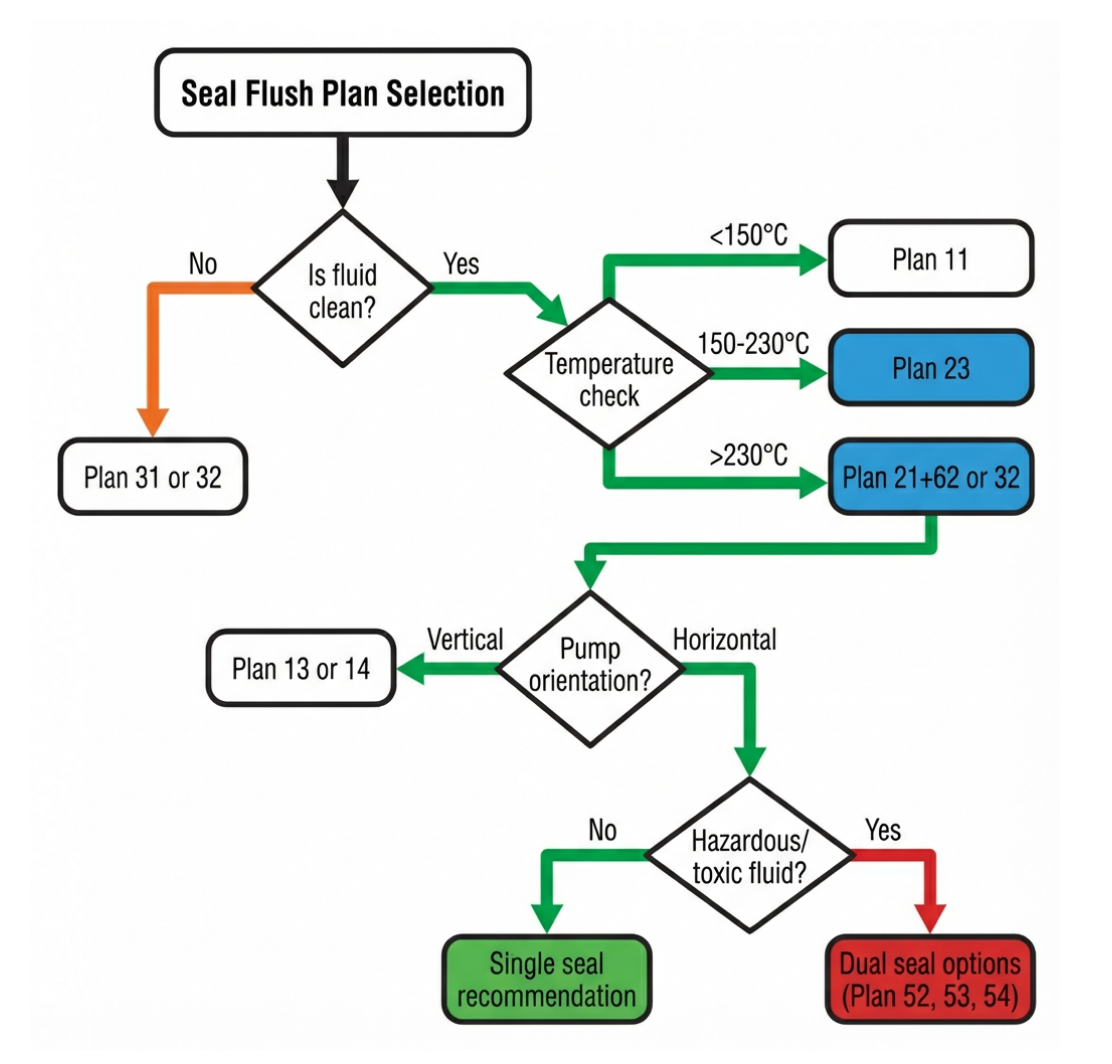
Flush systems (API Plan 32 or similar) inject clean fluid into the stuffing box to cool the seal and exclude contaminants. Flush pressure must exceed stuffing box pressure by 15 to 30 PSI. Anything less, and process fluid pushes back into the seal chamber, defeating the flush entirely.
Before replacing a seal that failed prematurely, check the flush pressure differential. I have pulled seals at 90 days that should have lasted three years, and every time the flush line gauge showed less than 10 PSI above box pressure. Raise flush supply pressure or install a restrictive bushing (0.002 inch per inch of shaft diameter clearance) to maintain back-pressure.
The real lesson from pressure-related seal failures is that upgrading to a more expensive seal rarely fixes the problem. Control the pressure environment first.
Getting the Impeller Type Right Before the Formula
Start every seal application by identifying the impeller type and calculating stuffing box pressure with the correct formula — not a generic approximation. A 15 PSI error between open and closed impeller calculations is enough to select the wrong balance ratio and cut seal life in half.
When a seal fails early, check pressure before ordering a replacement. Measure stuffing box pressure directly, verify flush differential, and confirm vapor margin. The pressure gauge tells you more about seal reliability than any metallurgical report on the failed faces.