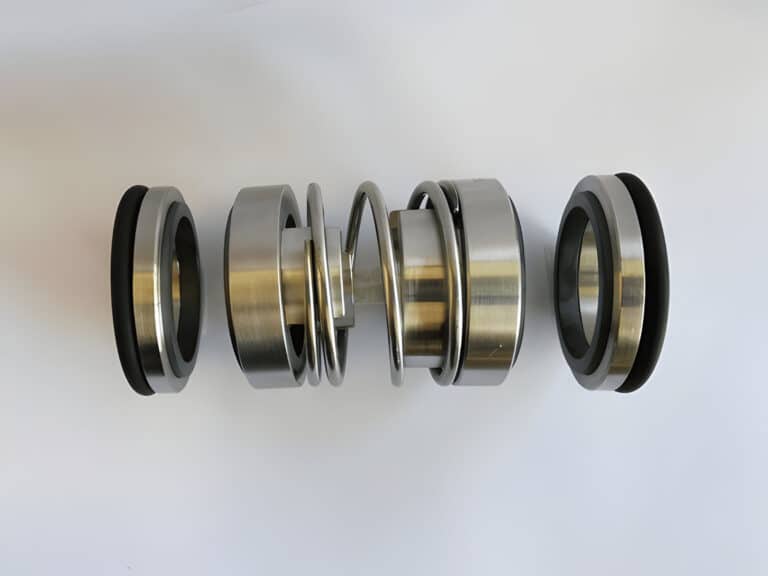
API 682 was written around an assumption that the seal would sit on an API 610 centrifugal pump with shaft deflection under 0.002 inch TIR. Most pumps outside a refinery are not API 610 machines. The standard says so itself: it states it is “not a general purpose standard for mechanical seals”.
Its own exclusion list drops large seals, high-pressure service, rotary-pump and mixer seals, outside-mounted configurations, and elastomeric bellows designs. Specifying API 682 for a cooling-water or general process pump buys refinery-pump margin the equipment cannot use.
The conventional “API or DIN by equipment origin” framing misses this. European OEMs have specified DIN for decades not because of geography but because API 682’s refinery-pump design basis stops describing the machine once you leave that service. The cleaner question is what equipment class the seal will live in: centrifugal hydrocarbon-service pump (API 682), or general non-refinery industrial pump (DIN EN 12756 with deflection-appropriate hardware). The upstream American-standards comparison — ANSI B73.1 chamber dimensions vs API 682 seal qualification — sits on the ANSI vs API standards page; this page focuses on the API-vs-DIN choice where shaft deflection, equipment class, and non-refinery industrial use actually shift the answer.
Understanding API 682 and DIN EN 12756 Standards
API 682 is the American Petroleum Institute’s mechanical seal standard, developed by approximately 400 member companies primarily serving the petroleum and chemical industries. The standard requires seals to operate continuously for 25,000 hours without replacement—a rigorous benchmark that drives both design requirements and cost.
DIN EN 12756 (formerly DIN 24960) is the European standard that defines principal dimensions and performance requirements for mechanical seals in general industrial applications. It covers a wider range of seal configurations and places less emphasis on qualification testing than its American counterpart.
The key distinction isn’t geographic. API 682 assumes your application involves hazardous fluids, critical service, and the consequences of seal failure justify premium investment. DIN EN 12756 assumes a broader industrial context where seal requirements vary by application.
Key Differences Between API and DIN Seals
Design Philosophy and Testing
API 682 takes a prescriptive approach. The standard specifies seal categories (1, 2, and 3) based on operating conditions, with Category 1 covering -40F to 500F and up to 300 psi, Category 2 extending to 750F and 600 psi. Each category includes mandatory qualification testing that can require up to 200 hours per seal type.
DIN EN 12756 is more flexible in approach. It defines dimensional standards and material specifications but allows manufacturers greater latitude in design execution. This flexibility reduces cost but shifts more responsibility to the user for ensuring seal suitability.
Dimensional and Performance Specifications
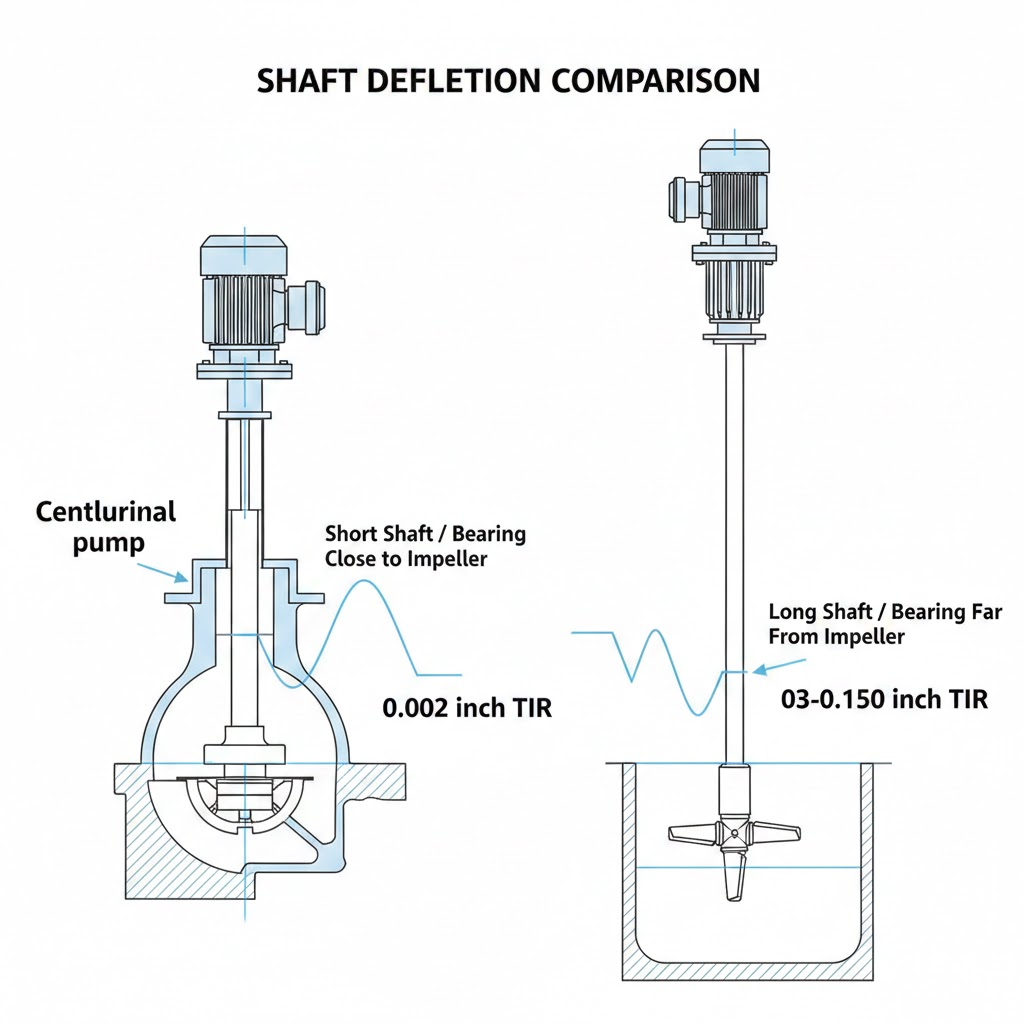
The most significant technical difference involves operating assumptions. API 682 assumes pump shaft deflection of 0.002 inch TIR (Total Indicator Runout) or less. That figure describes a stiff, short-overhang API 610 pump.
A general-duty ANSI/ASME B73.1 process pump, a long-shaft vertical, or an end-suction water pump does not necessarily deliver it. Every one of those is a machine a mechanical seal has to live on.
Once actual deflection exceeds the design basis, the API 682 margin stops being protection and starts being cost. Mixers and agitators make the point plainly: they run at 0.03 to 0.150 inch TIR, fifteen to seventy-five times the API assumption. That is why API 682 excludes mixer seals outright.
The DIN approach matches seal design to actual operating conditions rather than worst-case refinery assumptions, which is what makes it the workable default across the non-refinery industrial pump population.
How to Select the Right Standard
When comparing options, the key factors aren’t where your equipment was manufactured or which standard your predecessor specified. They’re application severity and consequence of failure.
When API 682 Is the Right Choice
API 682 makes sense when:
- Process fluid is hazardous, toxic, or environmentally regulated
- Seal failure creates significant safety or environmental risk
- Operating conditions approach the edges of seal capability (high pressure, high temperature, aggressive chemistry)
- Downtime costs justify premium seal investment
- Your facility operates under API 610 pump requirements
The 4th Edition of API 682 introduced hazard-based selection using UN Globally Harmonized System classifications. Hazard-based tiering acknowledges that even within refineries, not every seal application demands the same level of protection.
A Mumbai refinery audit of 600 seals ran the same hazard tiering in practice: critical equipment received three-month inspection intervals, semicritical equipment six months, and noncritical applications as-needed maintenance. The audit achieved 0.97 availability on critical equipment by matching investment to actual risk—not by applying maximum specification everywhere.
When DIN EN 12756 Makes More Sense
DIN EN 12756 is often the better choice when:
- Process fluid is water, mild chemicals, or non-hazardous
- Equipment runs with more shaft deflection than an API 610 pump assumes: general process pumps, long-shaft verticals, mixers
- Operating conditions fall comfortably within standard seal capabilities
- Cost optimization is a priority without compromising reliability
- Equipment design already accommodates DIN dimensional standards
The hidden cost most buyers miss is over-specification. Specifying API 682 for a cooling water pump doesn’t make the seal last longer—it just increases purchase price and potentially complicates replacement sourcing.
Common Selection Mistakes
The most expensive mistake isn’t choosing the wrong standard—it’s assuming standard compliance alone ensures reliability.
A charge pump failure analysis revealed this clearly. After repeated seal failures, the facility upgraded to a higher-specification seal from a premium vendor. The result? Reliability got worse, not better. Weibull analysis showed characteristic seal life dropped from 3,859 hours to 2,321 hours after the “upgrade.”
Root cause wasn’t seal quality. Inadequate cooling capacity and poor seal face orientation were causing failures regardless of which standard the seal met. The facility had invested in a better seal without fixing the actual problem.
API 682 itself acknowledges this reality — the exclusion list quoted at the top of this page was not an oversight. It reflects the task force’s decision to focus on refinery pump applications rather than attempt universal coverage, which means compliance answers a narrower question than most buyers assume it does.
When upgrading existing equipment, dimensional constraints add another layer of complexity. API 682 seals often won’t fit into existing ASME B73 pump seal chambers without housing modifications. This was intentional in the original standard design but frustrates users who assume API and DIN seals are directly interchangeable.
Making the Right Decision
Standard selection should follow application risk assessment, not regional preference or equipment origin. Start with these questions:
- What are the consequences of seal failure? (Safety, environmental, cost)
- Do your operating conditions require API 682’s design margins?
- Does your equipment actually accommodate API 682 dimensional requirements?
- Does the cost premium align with the risk reduction you’re achieving?
For critical hydrocarbon service in refinery environments, API 682 delivers the reliability its designers intended. For general industrial applications—process pumps, water systems, and non-hazardous fluids—DIN EN 12756 often provides adequate reliability at appropriate cost.