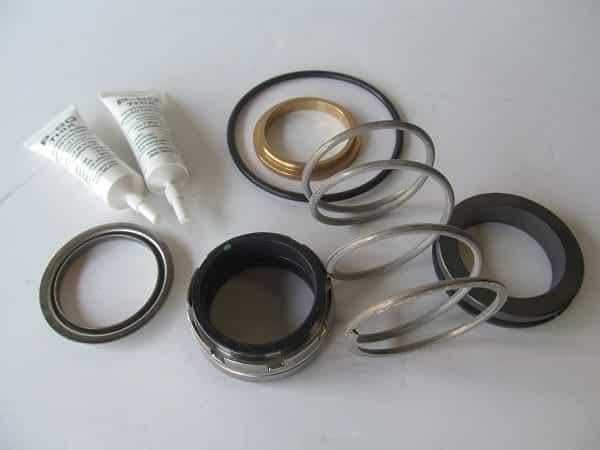
The pitting on a cavitation-damaged seal face almost never sits where the vapor bubbles actually formed. Bubbles nucleate in a low-pressure pocket, drift downstream, then collapse against the faces somewhere else entirely — which is exactly why the damage gets written off as misalignment or chemical attack.
If you are pulling seals every few months on a pump that knocks and rattles, the cavitation is not just a pump problem. It is machining your seal faces one implosion at a time.
The damage runs in a chain: bubble collapse, shaft vibration, face separation, then leakage. Each link leaves a signature you can read off the failed part.
How Cavitation Bubble Collapse Erodes Seal Faces
Cavitation erodes seal faces through shock waves, not abrasion. When a vapor bubble reaches the higher-pressure zone at the sealing interface, it collapses in microseconds and fires a shock wave that hammers the face material with a sharp, localized impact force.

The tribologist E.C. Fitch describes this as a two-phase pressure cycle: tensile stress boils the fluid into bubbles, then compressive stress forces those bubbles to implode against the nearest metal surface. At the seal, that surface is the face.
Seal faces are the first casualty because they sit directly in the fluid path, separated by a film roughly one micron thick — about 75 times narrower than a human hair. An implosion right at that interface delivers its full impact to the sealing surface with nothing to absorb it.
Hard, brittle face materials suffer the fastest. Silicon carbide resists ordinary wear beautifully, but its brittleness is a liability under cavitation — the shock loading chips it where a tougher material would flex and survive, and every fresh pit seeds more bubbles.
Why Cavitation Chips Faces Suddenly Instead of Wearing Them Down
Cavitation chips faces in an instant because the faces physically separate and slam back together. Repeated implosions shake the rotor, lifting the faces off their fluid film for a fraction of a second. When the liquid flashes to vapor across the gap, the faces snap shut and strike edge-first.

Malik Durojaiye, a Swagelok field engineer, calls this fluid vaporization across the faces “causing rapid separation and then closing” — essentially slamming the faces against each other. Do that a few thousand times and the carbon breaks at the edge, where the impact concentrates.
What the spec sheet doesn’t tell you is that this is why cavitation chipping looks nothing like normal service wear. I’ve pulled faces chipped clean at the outer diameter on a pump that had been cavitating for weeks — not worn smooth, chipped, as if someone had taken a chisel to the carbon.
Those implosions do not stay local. They shake the rotor, and the vibration reaches the seal faces the same way any imbalance would — except cavitation delivers it in sharp, irregular bursts rather than a steady shake. Chipping starts at the inside or outside diameter, then the face leaks.
How to Tell Cavitation Damage from Other Seal Failures
Cavitation damage shows up as pitting and edge chipping in a zone offset from where the bubbles formed, and that displacement is the single biggest reason it gets blamed on misalignment, dry-running, or chemical attack. The cavities form in one zone and do their damage in another, so tracing the pitting back to a low-pressure inlet rarely lines up.
Two failures produce pits, but the pattern differs by cause. Reading the face is faster than reading the vibration trace.
| Root cause | Face signature | The tell |
|---|---|---|
| Cavitation | Pitting plus sudden edge chips | Damage zone offset from the low-pressure inlet |
| Misalignment | Uneven wear on one sector | Heaviest wear tracks on a single side |
| Dry-running | Heat checking, glazing, discoloration | Concentric cracks, blistered elastomer |
| Chemical attack | Uniform etching across the whole face | Even material loss on both faces |
| Installation damage | Fan-shaped fracture at the ID or OD | Radial fracture from handling, not operation |

A fan-shaped fracture is the one signature that clears cavitation entirely. That radial pattern points to installation or handling damage — a dropped or cocked face — not to anything happening while the pump runs.
One more distinction saves misdiagnosis: only vaporous cavitation erodes metal. Gaseous cavitation, where dissolved air comes out of solution, leaves no erosion at all — it degrades the fluid chemistry instead. A chemically etched face on an air-entraining system is not the same failure as a pitted one.
Fixing the Cavitation Source vs. Replacing the Seal
Fixing the cavitation source stops new damage, but it does not undo what is already done — a pitted or chipped face keeps leaking until it is re-lapped or replaced. This is the trap I see most often: a crew corrects the alignment, bearings, and impeller, declares the vibration fixed, and never re-inspects the faces that cavitation already wrecked.
A chipped face does not self-heal — correcting the hydraulics stops the damage clock but never rolls it back.
Before replacing the seal, check the seal chamber pressure against the fluid’s vapor pressure. Holding the chamber roughly 50 psi above vapor pressure stops the liquid flashing at the faces in the first place.
Running seal water pressure too low lets the chamber vaporize right at the sealing surfaces. An API Plan 21 or 23 cooling loop with correct orifice sizing fixes the source systemically, rather than treating the seal as a consumable.
Then judge the face honestly. Light pitting can sometimes be re-lapped flat; a chipped edge cannot.
When cavitation has chewed the faces past re-lapping, replacement with a properly matched mechanical seal is the practical next step — not a repair. This bites hardest on hot water and light hydrocarbons running near their vapor pressure.
What Most Teams Get Wrong
The failure I see repeated most often is not the cavitation itself — it is declaring victory after fixing the hydraulics and dropping a fresh seal onto faces that were already scrapped. Cavitation is a suction-side problem that leaves its scar on the seal, so the seal is the symptom and the vapor margin is the disease.
Correct the chamber pressure and the flush plan first, then treat every pitted or chipped face as scrap rather than salvage. A new seal in a pump that still cavitates is just a reset clock — it will be back on your bench in a matter of weeks.