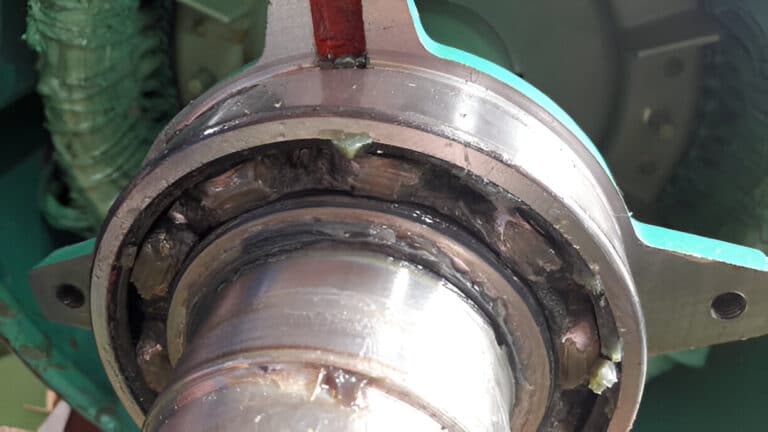
I pulled an RBSiC seal face from a caustic circulation pump last year that looked like a sponge. The free silicon had leached out completely, leaving a porous skeleton where a precision sealing surface used to be. The pump had been running in 50% caustic — well above pH 11 — and the RBSiC face never stood a chance. That failure was entirely preventable with one specification change.
The SSiC vs RBSiC debate comes down to a single variable most compatibility charts gloss over: free silicon content and the specific pH boundaries where it turns from a non-issue into a failure mechanism. Get this right, and both grades deliver excellent seal life. Get it wrong, and you are replacing faces on a schedule that has nothing to do with wear.
What Separates SSiC from RBSiC
RBSiC contains 8-12% free silicon metal trapped in the SiC matrix from the reaction bonding process. SSiC is sintered from pure SiC powder and contains virtually no free silicon — purity sits above 99%.
That free silicon difference drives every meaningful performance split between the two grades.
Hardness and Wear
SSiC runs harder at HRA 93+ versus HRA 90 for RBSiC, with finer crystal structure (5-7 micrometers versus 8-20). In clean services within the safe pH range, this difference rarely matters. RBSiC’s free silicon actually improves its tribological behavior — the softer silicon phase provides a degree of self-lubrication that gives RBSiC better pressure-velocity performance in many pump applications.
For standard water, light hydrocarbon, and neutral-pH chemical services, RBSiC is not a compromise. It is the correct choice.
Cost
RBSiC costs 20-40% less than SSiC. That savings is real and justified within the grade’s operating envelope. Specifying SSiC across the board because it is “the better material” wastes money in applications where RBSiC performs identically or better.
Where Free Silicon Becomes a Liability
The pH 4-11 rule is the single most important selection criterion for SiC grade.
Strong acids (pH below 4) and strong bases (pH above 11) directly attack the free silicon metal in RBSiC. The silicon dissolves, leaving voids in the seal face. Once that surface porosity develops, the face can no longer maintain the fluid film needed for sealing. Leakage accelerates, and no amount of spring load adjustment fixes a face that has lost its microstructure.
SSiC, with no free silicon to attack, resists virtually all chemical environments. Weight loss in corrosive media stays below 2 mg/cm2 per year for SSiC faces — a negligible rate that keeps seal face flatness intact over multi-year service intervals.
The Industry Already Knows This
Refineries and petrochemical plants have standardized on RBSiC as their default hard face. Their process fluids — hydrocarbons, water, mild caustic washes — sit comfortably within pH 4-11. Chemical processing and pharmaceutical plants, handling concentrated acids and bases, default to SSiC. The industry split itself validates that pH is the real selection variable, not some abstract notion of “chemical resistance.”
The risk sits at the boundary. Processes that normally run at pH 6 but see caustic cleaning cycles or acid upsets push temporarily outside that 4-11 window. Those pH excursions attack the free silicon just as effectively as steady-state exposure — and they are easy to overlook during seal specification because the “normal” operating pH looks safe.
Temperature Limits That Actually Matter
On paper, SSiC handles temperatures up to 1650 C and RBSiC tops out around 1400 C. Free silicon melts at 1414 C while the SiC matrix remains stable past 2700 C, so the temperature ceiling is fundamentally a free silicon limitation.
None of that matters for most mechanical seal applications.
What the spec sheet does not tell you is that a solid SiC ring rated for 427 C (800 F) drops to an effective limit of just 93 C (200 F) when pressed into a 316SS holder. Differential thermal expansion between the ceramic face and the metal holder creates stress concentrations that crack the SiC ring long before the material itself reaches its thermal limit.
Since the vast majority of mechanical seals use metal holders, the temperature advantage of SSiC over RBSiC is academic. Both grades hit the same practical ceiling — set by the holder, not the SiC. This shifts the entire selection decision back to chemistry: where the grades genuinely differ is pH resistance, not temperature capability.
The 3-Question Selection Test
Stop comparing property tables. Three questions decide the correct grade for any mechanical seal application:
Question 1: What is the process fluid pH — including upset and cleaning conditions?
If pH stays within 4-11 under all operating scenarios (including CIP cycles, caustic washes, and acid upsets), RBSiC is safe. If pH drops below 4 or exceeds 11 at any point during operation, specify SSiC. No exceptions.
Question 2: Does the fluid contain dissolved solids or particles that could accelerate silicon leaching?
High-purity aggressive fluids (concentrated HCl, NaOH, HF) attack free silicon fastest. But even mildly acidic fluids with high dissolved solids or elevated temperatures can push leaching rates beyond acceptable limits. When fluid purity is questionable and pH sits near the 4 or 11 boundary, default to SSiC.
Question 3: Is the seal face mounted in a metal holder?
If yes — and it almost always is — the temperature difference between SSiC and RBSiC is irrelevant to your selection. Base the decision on Questions 1 and 2. If the face runs as a standalone silicon carbide ring without a metal holder (rare, but possible in some specialty designs), then SSiC’s higher thermal stability provides a genuine advantage at elevated temperatures.
This framework replaces the vague “SSiC for chemicals, RBSiC for everything else” guidance that oversimplifies the decision. Most chemical applications work perfectly with RBSiC — the question is never “chemicals or not” but “which chemicals at what concentration and temperature.”
The Right Grade Depends on Your pH, Not Your Budget
The SSiC-versus-RBSiC choice is not a quality decision. It is a chemistry compatibility decision.
RBSiC within pH 4-11 delivers equal or better seal performance than SSiC at 20-40% lower cost, with superior tribological properties in many services. Specifying SSiC in these applications adds cost without adding reliability. Outside pH 4-11, SSiC is not a premium upgrade — it is the only grade that survives. The free silicon in RBSiC will dissolve, and no seal design compensates for a face that has lost its sealing surface.
Check your process pH across all operating modes — steady state, startup, shutdown, cleaning. If it never leaves the 4-11 window, save the money and run RBSiC. If there is any doubt, the cost of SSiC is trivial compared to an unplanned seal change on a running pump.