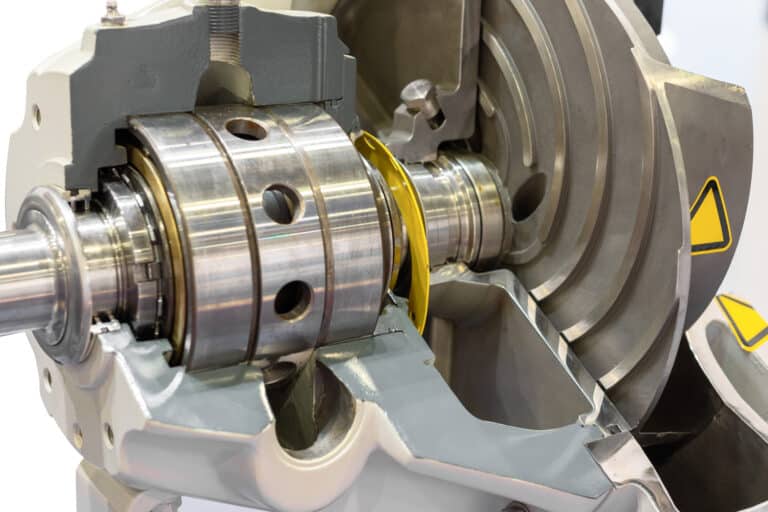
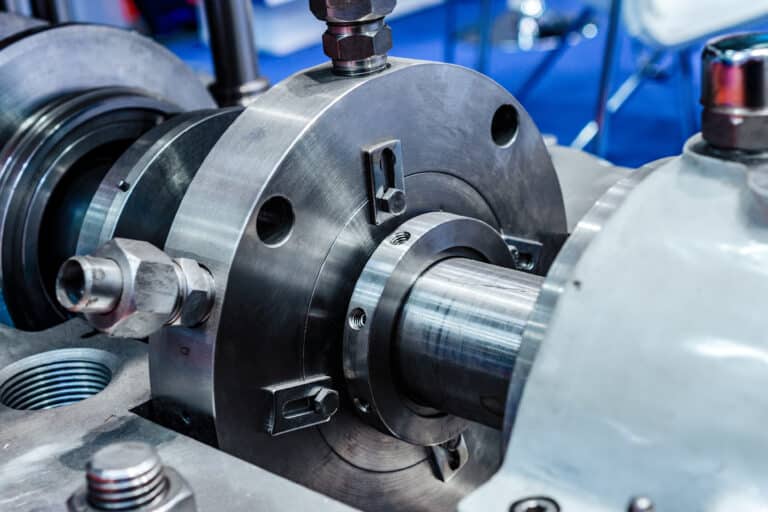
A hot water pump running SiC-on-SiC faces failed within weeks of its “upgrade.” The carbon-graphite faces it replaced had lasted two years. The problem was never the material — it was the system around it. That failure captures the most common mistake I see with carbon-to-SiC upgrades: treating them as a parts swap instead of a system change. Before ordering SiC faces, run a 5-point system check. Half the pumps I evaluate do not actually need the upgrade, and half that do need changes beyond the seal faces themselves.
The 5-Point System Check Before You Order SiC Faces
Carbon-graphite conducts heat at 5-8 Btu/hr-ft-F. Silicon carbide conducts at 40-100. That 5-10x jump in thermal conductivity changes how your entire seal chamber manages heat — and it is the reason a face swap alone fails.
Flush Flow Recalculation
SiC faces dissipate heat faster into the seal chamber fluid, but a hard-face pair (SiC/SiC) also generates more frictional heat than carbon/SiC. Your existing flush plan was sized for carbon’s heat profile. Recalculate the required flow rate. If you are running API Plan 11, check that the throat bushing clearance can deliver the higher flow. If it cannot, the upgrade stalls here.
Thermal Profile and Vapor Margin
Map the fluid temperature at the seal faces against its vapor point. SiC/SiC narrows this margin because of higher interfacial heat generation. Any pump operating within 15-20 degrees of the fluid’s boiling point under seal chamber pressure needs a hard look — this is where carbon/SiC often outperforms the “upgrade.”
Press-Fit and Housing Compatibility
SiC has a different coefficient of thermal expansion than carbon-graphite. Press-fit dimensions designed for carbon may not hold SiC securely across the operating temperature range — or worse, may crack the ring during thermal cycling. Verify the housing bore tolerance against the SiC manufacturer’s press-fit specifications. Machinists working with SiC-to-stainless assemblies know this tolerance is tighter than most engineers expect.
SiC Grade Match to Service Conditions
Not all silicon carbide is the same. Reaction-bonded SiC (RBSiC), sintered SiC (SSiC), and graphite-loaded composites each serve different conditions. Selecting the wrong grade costs more than staying with carbon.
Go/No-Go Decision
If your pump fails any of these checks — insufficient flush capacity, narrow vapor margin, incompatible press-fit, or unclear service conditions — do not proceed. Fix the system constraint first, or accept that carbon-graphite is the correct face material for this application. The most common mistake I see is skipping straight to procurement because “SiC is better.” It is better *when the system supports it.*
Choosing the Right SiC Grade
Specifying “silicon carbide” on a purchase order is like specifying “steel” for a pressure vessel — the grade determines whether it works.
Reaction-Bonded SiC (RBSiC)
RBSiC is the industrial workhorse. It contains free silicon in its matrix, giving it outstanding thermal shock resistance and strong wear performance. For most pump upgrades in water, light hydrocarbons, and general chemical service, RBSiC is the default starting point. Its PV limits handle the majority of standard pump applications.
Sintered SiC (SSiC)
SSiC has no free silicon, making it the most corrosion-resistant seal face material available. Concentrated acids, strong caustics, and ultra-pure applications demand it. The trade-off: removing free silicon also removes some PV performance. If you are upgrading for chemical resistance, SSiC is your grade. If you are upgrading for wear life in a mechanically demanding service, RBSiC is likely the better fit.
Graphite-Loaded Composites
Here is where grade selection gets counter-intuitive. Some SiC grades deliberately incorporate graphite porosity to trap lubricating films at the seal face. They are technically “less hard” than pure SiC — and they outperform it in poorly lubricated conditions. Hot pressurized water and fluids near their vapor point benefit from these dual-capability grades because the graphite provides emergency dry-running protection.
Face Pairing: SiC/SiC vs Carbon/SiC
The upgrade does not automatically mean SiC-on-SiC. Carbon/SiC remains the right pairing for clean, non-abrasive fluids where the carbon face provides a compliant sealing surface. SiC/SiC makes sense for abrasive slurries, high-PV applications, and services where both faces see erosive attack. Blanket SiC/SiC standardization reduces inventory complexity but creates dry-running risk in marginal flush conditions — particularly near the fluid’s vapor point.
3 Upgrade Failures I Keep Seeing
Every one of these failures came from skipping a system check, not from a defective seal.
Cracked Rings Before the Pump Even Starts
SiC approaches diamond hardness, but it is brittle. I have pulled cracked rings out of boxes that never made it to the pump. Out of 120 SiC seal installations I tracked at one facility, roughly 12 rings cracked from handling and installation damage alone — a 10% loss rate that does not exist with carbon faces. The fix is procedural: dedicated SiC handling trays, controlled installation torque sequences, and never using the carbon-face installation technique of tapping a ring into place. If you skip this step, you will be back in a week replacing what you just installed.
Hard Faces in Hot Water That Needed Soft
A pump running hot water near its vapor point got “upgraded” to SiC/SiC. It failed within weeks. The original carbon-on-SiC pairing had run for years because the carbon face generated less interfacial heat and tolerated the narrow vapor margin. SiC/SiC pushed the seal faces past the fluid’s boiling point at the interface. The lesson: an upgrade that increases heat generation in a thermally marginal application is a downgrade. Before you start, make sure you know your vapor margin.
Flush Plan Unchanged After the Swap
The third failure is the quietest. The new SiC faces go in, the pump starts, and everything looks fine for a few months. Then the seal fails “prematurely” and nobody connects it to the upgrade. What happened: the flush flow was sized for carbon’s heat profile, SiC changed the thermal equation, and the seal chamber ran hotter than designed. The faces did not fail because of material deficiency — they failed because nobody recalculated the flush requirement. This is the check that gets skipped most often because there is no obvious reason to revisit it.
Next Steps
Run the 5-point system check on your next scheduled pump outage — before you call your seal supplier. The check takes less time than the paperwork for a failed upgrade. Start with flush flow and vapor margin, because those two eliminate the majority of upgrade-induced failures. For pumps that pass all five gates, match the SiC grade to the lubrication conditions, not just the chemical compatibility chart. The real cost of a bad upgrade is not the seal — it is the unplanned shutdown three months later when nobody remembers changing the faces.