Most engineers treat “double mechanical seal” as a single product category. It isn’t.
API 682 defines two distinct dual-seal arrangements — Arrangement 2 (unpressurized) and Arrangement 3 (pressurized) — and three physical configurations: back-to-back, face-to-face, and face-to-back (tandem). The terms describe different design dimensions, and confusing them is one of the fastest ways to spec a seal that fails within months.
This page is an awareness-level overview of what a double mechanical seal is, how it works, the configurations available, and when a service requires one. Selection between arrangements, detailed pressure-balance analysis, and barrier-fluid trade-offs are covered on the linked sister pages.
How Does a Double Mechanical Seal Work?
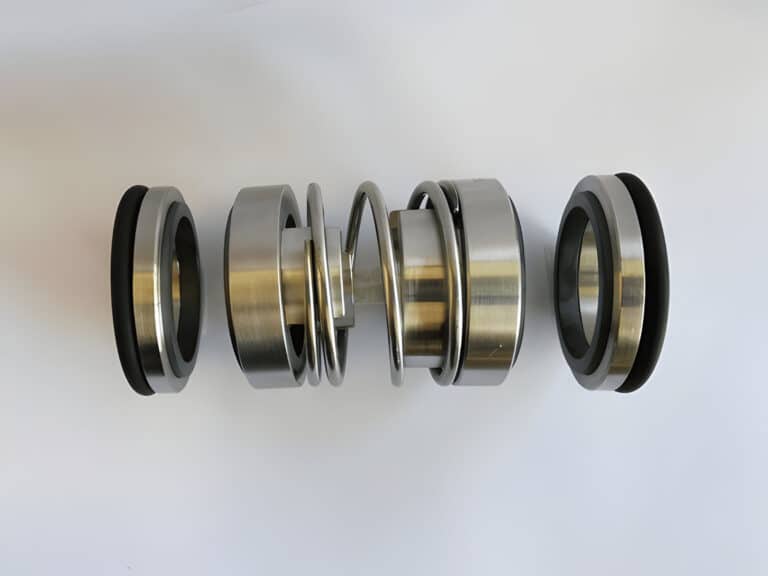
A double mechanical seal uses two sets of seal faces mounted in series on the same shaft. The inboard seal faces the process fluid; the outboard seal faces the atmosphere. Between them sits a barrier or buffer fluid cavity that lubricates both face pairs and creates a monitored boundary between process and environment.
Both seal-face pairs maintain dynamic contact during operation — spring-loaded rotating faces ride against stationary seats. The fluid between them circulates through an external support system (reservoir, pumping ring, or pressurized supply) that removes heat and maintains the correct pressure differential.
If the inboard seal fails, the outboard seal contains the process fluid. This containment capability is why API 682 guidance points hazardous, toxic, or flammable services to double seals, and why EPA leak rules exempt barrier-fluid dual seals from routine Method 21 monitoring.
Both the inboard and outboard seals typically run a carbon face against a silicon carbide face, the API 682 default pairing. Two hard faces — silicon carbide or tungsten carbide — go on the inboard seal where the process demands abrasion and corrosion resistance.
The Three Arrangement Types — At a Glance
API 682 classifies dual seals into three physical configurations based on how the seal faces are oriented relative to each other and to the process pressure. A one-line definition of each:
- Back-to-back (opposed). Both seal sets face outward from a shared center; barrier or buffer fluid sits between them under controlled pressure. Used most often in pressurized (Arrangement 3) service.
- Face-to-face. Both seal sets face inward toward each other with the fluid surrounding them from outside. Produces the shortest axial length, used where the seal chamber is tight.
- Face-to-back (tandem). Both seal sets face the same direction, with the outboard seal sitting behind the inboard seal. API 682’s default configuration; back-to-back and face-to-face are explicit purchaser’s options.
That’s the full taxonomy at the naming level. The pressure-balance trade-offs, contamination paths, thermal-management constraints, and MTBF data that drive selection between the three live on the arrangement pillar — see mechanical seal arrangement types.
Barrier Fluid vs Buffer Fluid: Why the Word Matters
The fluid term you use signals the arrangement number. Getting it wrong invalidates the entire support system design.
- Arrangement 2 (unpressurized) uses buffer fluid at a pressure below process pressure. The buffer fluid lubricates the outboard seal only, forming a buffer zone between process and atmosphere. Inboard-seal leakage migrates into the buffer cavity — detectable, but not prevented.
- Arrangement 3 (pressurized) uses barrier fluid at a pressure above process pressure — typically 20–25 psig above maximum process pressure. The barrier fluid lubricates both seals, creating an absolute barrier against process leakage.
For toxic or flammable services where zero atmospheric emission is mandatory, Arrangement 3 is the only compliant option. Arrangement 2 covers services where leak detection and containment are enough — contaminated water, mild chemicals, environmental compliance. Detailed fluid-property selection (viscosity caps, thermal stability, inhibited-vs-uninhibited glycol traps) lives on the buffer and barrier fluids page.
When Does a Service Actually Require a Double Seal?
The defining question is whether a single-seal leak is acceptable. If a controlled minor leak to atmosphere is operationally and regulatorily fine, a single seal — possibly with a flush plan — is sufficient. If it is not, a double seal becomes necessary:
- Toxic or hazardous fluids — chemicals on EPA HAP lists, anything with significant inhalation toxicity.
- Flammable or explosive process streams — light hydrocarbons, solvents, anything where leakage creates an ignition hazard.
- Carcinogenic, mutagenic, or reproductive-toxin services that require zero workplace exposure.
- Services covered by OSHA PSM, EPA RMP, or local fugitive-emission regulations.
- High-value process fluids where leakage cost outweighs the dual-seal support-system cost.
The corollary: water, clean cooling fluid, and many mild process services do not need a double seal — the support-system cost outweighs the marginal containment benefit. Once the service requirement is clear, selecting the right arrangement and API piping plan is the next step.
Specify the Arrangement, Not Just the Seal
Ordering a “double mechanical seal” without specifying Arrangement 2 vs 3, configuration type, and support system is like ordering a pump without specifying the impeller. The seal itself is one component; the barrier or buffer fluid system, the piping layout, and the venting design determine whether that seal reaches its design life or fails at the first restart.