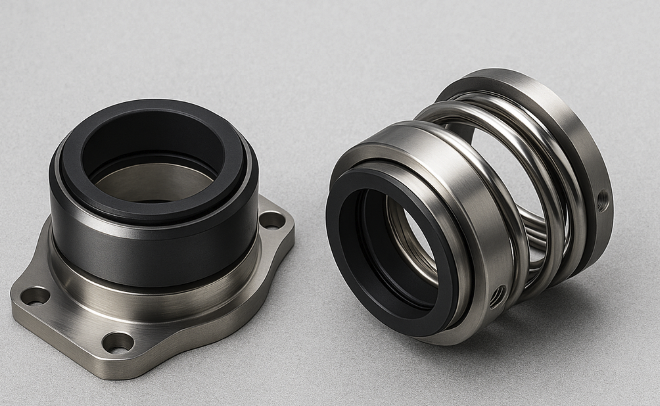
A working pump mechanical seal rides on a fluid film about 1 micron thick — roughly 75 times narrower than a human hair. A labyrinth seal runs on a clearance gap of around 200 microns. That is a 200× dimensional difference between two devices the search engines keep handing pump engineers as peers. They are not peers. They occupy entirely different physics regimes, on entirely different classes of rotating equipment, and the comparison most pump readers are searching for is the wrong comparison to begin with. This article fixes that — and routes you to the right answer for the equipment you actually run.
Is a Labyrinth Seal a Type of Mechanical Seal?
In the broad etymological sense, yes. In the way pump engineers actually use the term, no — and that distinction is the source of most of the confusion in this comparison.
Wikipedia opens its labyrinth article with the sentence: “A labyrinth seal is a type of mechanical seal.” That reading uses “mechanical” as a generic adjective meaning “mechanically engineered.” Under that definition, almost any non-elastomeric shaft seal qualifies.
Pump industry practice is narrower. API Standard 682 — first issued in 1994, currently in its 4th Edition — is titled “Pumps — Shaft Sealing Systems for Centrifugal and Rotary Pumps,” and its scope explicitly covers *end-face mechanical seals*: two flat precision faces, one rotating, one stationary, held in contact by spring load and hydraulic pressure. Centrifugal compressors are governed by API 617, gas turbines by API 616. Three different standards, three different equipment classes — partitioned by the standards bodies for more than thirty years.
When a pump reliability engineer says “mechanical seal,” they mean an end-face contact seal governed by API 682. Reading Wikipedia’s broader taxonomy and then shopping for labyrinth hardware sends you straight into a turbomachinery aisle that has nothing to do with your pump.
Two Physics Regimes, Not Two Flavors of the Same Thing
The mechanical seal contains liquid by squeezing it into a controlled film. The labyrinth seal *throttles* a leak rather than stopping it. These are not minor variations on a theme.
A pump mechanical seal works because the rotating face and stationary face are forced together by spring load plus hydraulic pressure, and a thin liquid film — about 1 micron thick — separates them. The film lubricates the faces, carries away frictional heat, and contains the process fluid against pressures that routinely reach hundreds of psi. There is no clearance gap. The “seal” is the controlled film itself.
A labyrinth seal does the opposite. Successive teeth and chambers force the working medium through a series of throttle stages, dissipating kinetic energy as turbulence. A typical industrial geometry uses seven teeth, a 3.8 mm pitch, 0.3 mm tip width, and a 0.2 mm radial clearance. There is always a gap, and the gap leaks by design. The mechanism works on gas and liquid alike, but it only limits leakage — and the leakage is sensitive: doubling the radial clearance roughly doubles leakage.
Port that same 200-micron gap from a steam turbine to a centrifugal pump and the physics collapses. Liquid is roughly 800 times denser than atmospheric air and essentially incompressible, and the throttle stages only slow its escape through the gap, never stop it. What was a tolerable efficiency cost in a turbine becomes a continuous product release in a pump.
Decision Table: Which Seal Class Belongs on Which Equipment
Skip the feature-by-feature comparison. The honest decision is made one level higher — at the equipment class.
| Equipment | Medium | Delta-P Regime | Correct Seal Class | Why (Physics) |
|---|---|---|---|---|
| Centrifugal pump | Liquid | Moderate (5-40 bar) | End-face mechanical seal (API 682) | Liquid will not dissipate through clearance throttling |
| Process / chemical pump | Liquid | Moderate, often hazardous | End-face mechanical seal (API 682) | Zero-leakage containment required for product and emissions |
| Steam turbine HP stage | Steam (gas) | Very high | Labyrinth (API 612) | Throttle-and-dissipate works at high pressure ratio |
| Centrifugal compressor | Gas | High | Labyrinth or dry gas seal (API 617) | Non-contact tolerable; contact face would overheat |
| Pump bearing housing | Air / oil mist | Near-zero | Labyrinth bearing isolator | No process containment — just contaminant exclusion |
| High-speed rotor (>10,000 rpm) | Gas | Variable | Labyrinth or dry gas | Contact face PV limit exceeded |
API 682 governs the first two rows. API 610, API 612, API 616 and API 617 govern the rest. The standards bodies already drew the line — this article just makes the line visible.
Where Labyrinth Seals Actually Live on a Pump
There is one place a labyrinth does belong on a centrifugal pump, and it is not the shaft seal chamber. It is the bearing housing.
Labyrinth bearing isolators sit at the outboard end of the pump, between the bearing housing and the atmosphere. Their job is to keep airborne dust, washdown water, and process vapor *out* of the bearing cavity, and to keep oil mist *in*. They do not contain pumped product. They do not see process pressure. On API 610 centrifugal pumps running 3,600 rpm on 65 mm shafts — where ordinary lip seals fail in weeks — labyrinth isolators routinely deliver around two years of service and extend bearing life by roughly threefold. Roughly 13% of mechanical seal failures trace back to ineffective bearing housing protection, which is why this small piece of hardware matters even though it never touches process fluid.
This architectural distinction resolves the most common objection to this article: “but I see labyrinth on my pump.” Yes — at the bearing end. Meanwhile, the end-face mechanical seal is doing the actual shaft sealing at the wetted end of the same machine. Two devices, two jobs, two different physics regimes, on opposite ends of one pump. The same architectural logic, on a different axis, plays out in our mechanical seal vs oil seal comparison.
The Bottom Line
If you run pumps — centrifugal, process, chemical, rotary — the answer is an end-face mechanical seal. Type 1, Type 2, Type 21, or a cartridge variant, with API 682 Type A, B or C cartridges where that standard governs your service. Labyrinth hardware is not a substitute, not an upgrade, and not a peer for the wetted shaft on these machines. Your next step is the centrifugal pump mechanical seal selection guide.
If you run steam turbines, centrifugal compressors, or high-speed gas-handling rotors, labyrinth and dry gas seals are exactly right for you — and you will be best served by your OEM’s turbomachinery channel against API 612, API 616 or API 617. Labyrinth research is alive and well in that domain: a 2025 peer-reviewed study on twin-labyrinth geometry reported a 38% leakage reduction over straight-through configurations, a meaningful gain in turbine economics. The technology is not obsolete. It is simply not yours to specify if your job title has the word “pump” in it.
One disclosure: Cowseal manufactures pump mechanical seals; we do not produce labyrinth seals. That is exactly why this article exists — to route pump readers to the seal class their equipment was designed for, and to acknowledge labyrinth’s legitimate domain rather than sell against it.