A tandem seal handles 8,700 psig. A back-to-back seal from one maker is rated to about 609 psig. That pressure difference should be the first thing any engineer considers when specifying a double seal arrangement — yet the selection is rarely treated with that level of precision.
Descriptions of back-to-back, tandem, and face-to-face arrangements are everywhere, but guidance on which one to pick for a given set of operating conditions is almost nonexistent. API 682 provides a classification framework that maps directly to your selection decision, and it has nothing to do with how the seal faces are oriented.
API 682 Arrangement Classification: Pressurized vs Unpressurized
API 682 classifies double seals into Arrangement 2 (unpressurized) and Arrangement 3 (pressurized) — based entirely on whether the fluid between the two seals is at higher or lower pressure than the process.
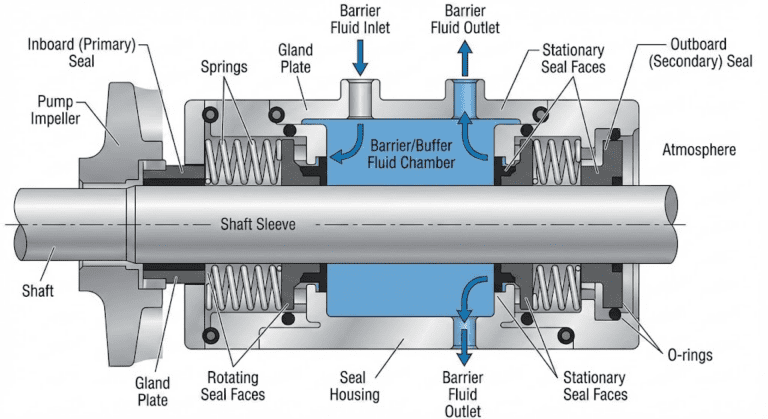
Arrangement 2 uses a buffer fluid at lower pressure than the seal chamber. The buffer circulates between the inboard and outboard seals, providing lubrication and cooling without creating a positive pressure barrier. If the inboard seal leaks, process fluid migrates into the buffer — not the other way around.
Arrangement 3 uses a barrier fluid pressurized above the process, actively preventing any process fluid from crossing the inboard seal face. This is the configuration required for toxic, lethal, or zero-emission services.
The critical distinction: these arrangement numbers describe pressurization, not physical configuration. A tandem (face-to-back) seal can operate as either Arrangement 2 or Arrangement 3 depending on whether you pressurize the fluid between the seals. API 682 lists back-to-back and face-to-face only as Arrangement 3. Engineers must specify both the physical arrangement and the API arrangement number — one describes the mechanical layout, the other defines the support system.
Back-to-Back Arrangement
How It Works
Back-to-back places two seal faces oriented in opposite directions, pointing away from each other. Barrier or buffer fluid fills the space between them. In Arrangement 3 configuration, the barrier fluid pressure exceeds process pressure by a minimum of 20 psig (1.4 bar), forcing both seals to seal inward.
This is the most commonly specified double seal configuration — compact, straightforward to install, and well-supported by manufacturers. For clean, moderate-pressure applications where barrier fluid contamination of the product is acceptable, back-to-back works reliably.
Limitations
The popularity of back-to-back masks operational risks that I’ve seen cause repeated failures.
Product dilution is the most overlooked limitation. When the inboard seal wears or fails in an Arrangement 3 configuration, pressurized barrier fluid leaks directly into the process stream. For pharmaceutical, food-grade, or high-purity chemical applications, this contamination is unacceptable — and it happens gradually, often without triggering alarms until product quality testing catches it.
Back-to-back limits are product-specific: one API 682 back-to-back cartridge is rated to 609 psig seal chamber pressure, surface speeds to 76 ft/s and temperatures from -40 to 350 degF. Any application exceeding these limits needs a different arrangement — and I’ve seen engineers miss this ceiling because back-to-back was their default specification.
The worst failure mode occurs when operators split barrier fluid pressure equally between the stuffing box and atmosphere. Both seals carry equal loads, wear at the same rate, and fail simultaneously — eliminating the redundancy that justified the double seal in the first place. The API 682 standard specifies this for a reason: one seal should always carry the primary sealing load.
Tandem Arrangement
How It Works
Tandem arranges two seals in series — both facing the same direction, with the inboard seal handling full process pressure and the outboard seal acting as backup. The space between them contains low-pressure buffer fluid, typically at atmospheric or slightly above atmospheric pressure.
This is API 682 Arrangement 2 in its most common physical form. The buffer fluid operates unpressurized, circulated by a pumping ring through a Plan 52 buffer fluid reservoir. Because the buffer runs at lower pressure than the process, any leakage past the inboard seal flows into the buffer system — not into the product.
Advantages Over Back-to-Back
Tandem handles far higher pressures — up to 8,700 psig, with a -270 to 410 degF temperature range and 660 ft/s surface speed capability. This makes tandem the default for high-pressure refinery and chemical services.
The failure mode is inherently safer. When the inboard seal degrades, process fluid enters the buffer system, where monitoring instruments detect the change in fluid level, temperature, or composition. The outboard seal continues operating normally, providing a controlled containment window. In tandem configurations, the secondary seal never experiences full process conditions during normal operation, which extends its service life well beyond what back-to-back delivers.
Zero product dilution is the defining advantage for process-sensitive applications. Since the buffer fluid runs below process pressure, it cannot migrate into the product stream — eliminating the contamination risk inherent in pressurized back-to-back arrangements.
Face-to-Face Arrangement
Face-to-face positions both seal sets with faces oriented toward each other, sharing a common central area. This configuration requires the least axial space of any double seal — a critical advantage in pumps with short stuffing boxes or where retrofit space is limited.
The reliability criticism you will hear — that a single stationary failure takes out both seal sets — applies specifically to older designs using a common stationary seat with drilled fluid passages. Modern face-to-face seals with independent stationary seats eliminate this single point of failure entirely. Each seal set operates on its own seat, making the arrangement no less reliable than back-to-back or tandem in comparable conditions.
Face-to-face is listed in API 682 only as an Arrangement 3 (pressurized) configuration. I specify it when the stuffing box cannot physically accommodate a tandem arrangement and the process does not demand the higher pressure capability that tandem provides.
How to Match Arrangement Type to Your Operating Conditions
The selection decision comes down to four factors: seal chamber pressure, process fluid hazard level, product contamination tolerance, and available axial space.
Start with pressure. If seal chamber pressure exceeds the back-to-back seal’s rated limit (609 psig for one API 682 cartridge), back-to-back is off the table. Tandem handles up to 8,700 psig and is the only viable option for high-pressure services. Below that limit, all three arrangements are candidates.
Then check the fluid hazard. Toxic, lethal, or VOC services requiring zero emissions need Arrangement 3 — pressurized barrier fluid, typically via Plan 53A with barrier pressure set 20-25 psig above maximum process pressure. If your fluid is non-hazardous but regulations require secondary containment, Arrangement 2 with Plan 52 buffer and leakage monitoring provides adequate protection at lower cost.
Evaluate contamination tolerance. Arrangement 3 pushes barrier fluid into the process when the inboard seal leaks. If your process cannot tolerate dilution — pharmaceutical, food processing, polymer production — switch to Arrangement 2 (tandem) where leakage flows away from the product, or select a barrier fluid fully compatible with your process stream.
Finally, check axial space. Tandem requires the most stuffing box length. Face-to-face requires the least. If retrofit constraints eliminate tandem physically, face-to-face with independent stationary seats gives you dual seal protection in a shorter envelope.
| Selection Factor | Back-to-Back | Tandem | Face-to-Face |
|---|---|---|---|
| Max pressure | Product-rated (609 psig for one API 682 cartridge) | ~8,700 psig | Moderate |
| Typical API arrangement | Arr 3 (pressurized) | Arr 2 (unpressurized) | Arr 3 (pressurized) |
| Flush plan pairing | Plan 53A | Plan 52 | Plan 53A |
| Product dilution risk | Yes (barrier leaks in) | No (buffer leaks out) | Yes (barrier leaks in) |
| Axial space required | Moderate | Most | Least |
| Best application | Clean, moderate-pressure | High-pressure, hazardous | Space-constrained |
What the spec sheet does not tell you is that the most common misapplication I see is engineers defaulting to back-to-back because it is the most familiar, without checking whether process pressure, fluid hazard, or contamination sensitivity actually supports that choice. Run through these four factors in sequence, and the correct arrangement identifies itself.
Making the Right Selection
The API 682 arrangement number and physical configuration are two separate specifications — and both matter. Arrangement 2 or 3 determines your support system: Plan 52 buffer for unpressurized, Plan 53A barrier for pressurized. The physical layout determines mechanical behavior, pressure limits, and failure modes.
Start every double seal specification by defining the pressurization requirement first, then match the physical arrangement to your operating envelope. If you default to back-to-back without running through pressure limits, contamination risk, and space constraints, you are choosing by habit rather than by engineering.