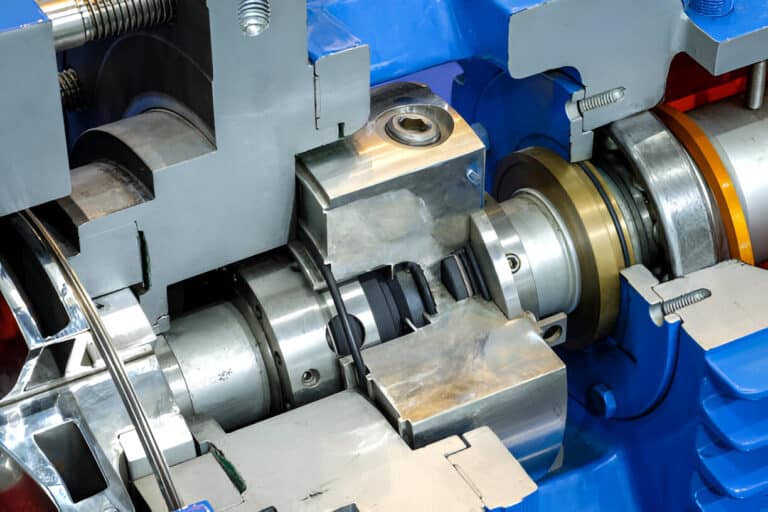
You pull up an equipment spec and it calls for a face-to-face dual seal. Everything you have read says back-to-back is the standard, so you wonder: is face-to-face a lesser option? It is not. Face-to-face is a deliberate engineering choice for specific conditions, and the API 682 4th Edition treats it as equally valid to any other dual seal orientation.
How a Face-to-Face Arrangement Works
Two sets of seal faces point inward toward each other, with the barrier or buffer fluid cavity sitting between them. Picture two seals installed nose-to-nose on the shaft: the inboard seal faces the process fluid, the outboard seal faces atmosphere, and their rotating faces converge toward a shared fluid space in the middle.
Physical Orientation
Both mating rings (the stationary seats) sit between the two seal rings (the rotating components). This is the opposite of back-to-back, where both seal rings sit between the mating rings. The distinction determines where barrier or buffer fluid contacts the seal faces and how axial forces distribute across the assembly.
Pressure Behavior
The fluid cavity between the two inward-facing seal sets creates symmetric pressure loading. Both seal faces receive roughly equal hydraulic force from the barrier or buffer fluid, reducing stress concentration on either individual seal. This balanced loading is a genuine engineering advantage, not merely a side effect of saving space.
With pressurized barrier fluid, the higher-pressure fluid between the seals pushes outward against both faces. The inboard seal keeps barrier fluid from entering the process. The outboard seal keeps it from leaking to atmosphere. Both seals share the workload.
Face-to-Face in API 682
API 682 classifies dual seals by pressurization method, not by physical orientation. The arrangement number tells you about the fluid system. The orientation tells you how the seal faces point.
Arrangement 2: Buffer Fluid
Arrangement 2 uses unpressurized buffer fluid, typically circulated via a pumping ring through an external reservoir under Plan 52. Buffer fluid pressure stays below process pressure. If the inboard seal fails, process fluid migrates into the buffer cavity, triggering a level or pressure alarm. The buffer system acts as a detection layer, not a containment barrier.
Face-to-face works naturally in Arrangement 2 because the unpressurized buffer fluid sits in the cavity between the inward-facing seals. No external pressurization hardware is needed.
Arrangement 3: Barrier Fluid
Arrangement 3 uses pressurized barrier fluid, maintained at a minimum of 20 to 25 psig above maximum process pressure through systems like Plan 53A, 53B, or 53C. The higher barrier pressure prevents any process fluid from crossing the inboard seal faces. This is the configuration for toxic, hazardous, or zero-emission applications.
Before you start specifying a face-to-face Arrangement 3, make sure your support system can deliver that pressure margin reliably. A barrier system that drifts below process pressure defeats the entire purpose of pressurized containment.
The API 682 4th Edition explicitly states that any orientation, including face-to-face, can be used in either Arrangement 2 or 3, provided the design features match the application. Earlier editions favored face-to-back as the default. That preference was removed in 2014.
When Face-to-Face Is the Right Call
Face-to-face is not a compromise. It is the correct choice in at least two scenarios that other orientations handle poorly.
Shallow stuffing boxes. Older pumps and compact equipment often have limited axial space in the seal chamber. A back-to-back cartridge extends outward from the gland plate and may exceed available depth. Face-to-face nests both seal sets within the existing chamber because the mating rings sit between the rotating elements rather than extending beyond them. I have seen maintenance teams order back-to-back cartridges per general guidance, only to discover the seal will not physically fit. Face-to-face solves this without gland modifications or equipment changes.
Unpressurized buffer applications. When the process fluid is not hazardous enough to require pressurized containment but still warrants a secondary seal for leak detection, Arrangement 2 with face-to-face orientation keeps the system simple. No accumulator, no pressure source, no external pressurization hardware. The most common mistake I see is engineers defaulting to Arrangement 3 and back-to-back for every dual seal application when an unpressurized face-to-face setup would have been cheaper, simpler, and entirely adequate.
Face-to-Face vs Back-to-Back vs Tandem
| Feature | Face-to-Face | Back-to-Back | Tandem |
|---|---|---|---|
| Face orientation | Inward (toward each other) | Outward (away from each other) | Same direction (series) |
| Axial space | Shortest | Moderate | Longest |
| Typical pressurization | Buffer (Arr. 2) or barrier (Arr. 3) | Barrier (Arr. 3) | Buffer (Arr. 2) |
| Best application | Shallow stuffing boxes, simple buffer systems | General-purpose pressurized containment | Toxic service, sequential containment |
Back-to-back remains the most common orientation for Arrangement 3 because it accommodates a wider range of stuffing box geometries. Tandem seals excel in critical toxic service where sequential containment, not pressurized barrier fluid, is the primary safety strategy.
If the stuffing box is shallow or the application does not require pressurized containment, check whether face-to-face eliminates hardware you do not need.
Choosing the Right Arrangement
The arrangement number, 2 or 3, determines your containment strategy. The orientation determines how the seal fits the hardware. Pick the arrangement first and the orientation second — that sequence prevents the most common specification errors.
If the spec calls for face-to-face, check the stuffing box depth and fluid system before second-guessing the choice. A properly applied face-to-face seal meets the same API 682 target of three years uninterrupted service as any other orientation. The arrangement is not the weak link. The application match is.