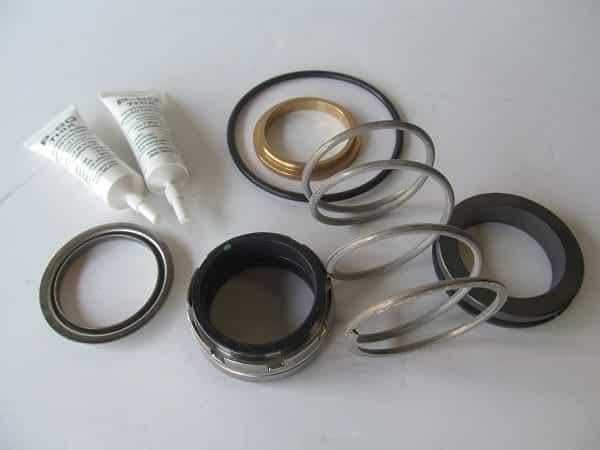
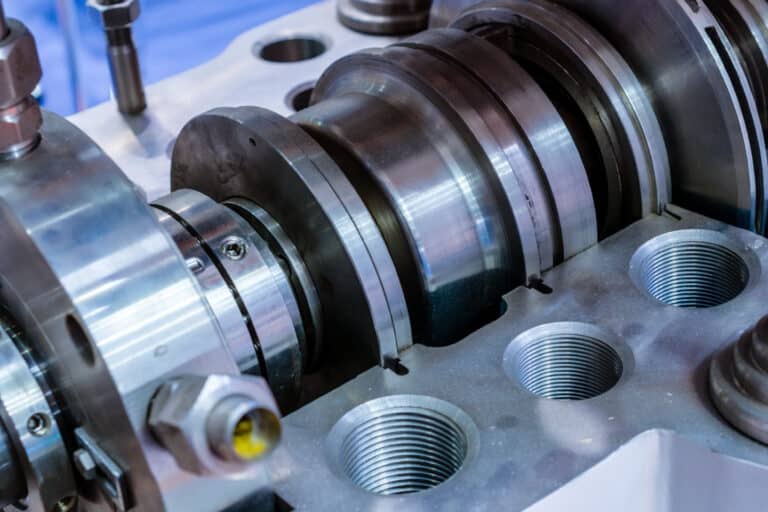
A boiler feed pump normally takes a single, balanced pusher seal in a cartridge at each shaft end, cooled by an API Plan 23 loop, with carbon against silicon carbide faces and EPDM O-rings. Check the plant’s water treatment before ordering faces, because low-conductivity feedwater corrodes the standard pair at high face speed.
What Boiler Feed Service Does to a Seal
A boiler feed pump seal runs in water at 100 to 200 °C and 20 to 48 bar, and water that hot lubricates the faces poorly and sits close to flashing between them.
An uncooled feed pump seal chamber also runs near the temperature limit of the elastomer O-rings in a pusher seal.
Seal Type and Arrangement
A boiler feed pump takes a single, balanced pusher seal, usually supplied as a cartridge seal. The pressure at the seal normally rules out a metal bellows seal.
Most feed pumps have a seal at each end of the shaft, and each seal needs its own cooling loop.
Either a rotating or a stationary spring assembly will do; API 682 treats the two as technically equivalent.
To quote a feed pump seal, a seal maker needs the pump model and seal chamber dimensions, the shaft speed, the seal chamber pressure and temperature, and the feedwater treatment with its conductivity.
Whether the Seal Needs a Plan 23 Cooler
Yes, in most cases. A single pusher seal on boiler feed duty needs a support system that cools its seal chamber, and an API Plan 23 loop is the usual and most efficient one; a working loop holds the water at the seal at about 50 to 60 °C.
A Plan 21 makes sense where a Plan 23 will not fit. A Plan 23 needs axial and radial room in the seal chamber for its throat bushing and pumping device, and some pumps do not have it.
A feed pump seal can do without a cooler in three cases:
- A dual pressurized seal: a double seal with a pressurized barrier fluid removes the need to cool the seal chamber, but adds a barrier system to run.
- Plan 11 on a low-duty pump: Plan 11 needs no separate cooling, and is usually used only on low-duty feed pumps, together with a higher-leakage seal.
- A seal rated to run uncooled: some seal makers rate particular designs for feed pumps without a cooler. That rating belongs to that design, so check it against your own seal chamber pressure and temperature.
Fitting a Plan 23 does not by itself make the seal last. On a refinery feed pump in a 2024 Texas A&M case study, a tighter, segmented throat bushing, a stronger pumping ring and a shell-and-tube cooler with less flow resistance raised the Plan 23 loop flow from 0.3 to 1.1 GPM, and the seal had run more than 48 months without an outage when the study was published.
Build the loop for low flow resistance. Specify a shell-and-tube cooler rather than a plate exchanger, sized for the seal’s own heat plus the heat soaking in from the pump.
The loop also needs a high-point vent. Vent it before startup and periodically after, without venting so often that hot pump water is drawn past the throat bushing.
Materials for Boiler Feedwater
Carbon against silicon carbide faces and EPDM O-rings are the starting point for boiler feedwater.
Seal Faces
Boiler feedwater calls for carbon-graphite against silicon carbide. Single, balanced seals with a silicon carbide rotating face and a carbon stationary face have lasted 40,000 hours or more on feed pumps in older plants on all-volatile treatment.
Avoid two hard faces. The Fluid Sealing Association (FSA) advises against hard face pairs in hot water, which is too thin to lubricate them, and asks for carbon-graphite as one of the faces wherever possible.
Some face selection tables list tungsten carbide as the preferred face for feedwater, but its nickel binder leaches out in neutral water, and the carbide itself corrodes in ultra-pure water.
On low-conductivity feedwater, the standard pair suffers electro-corrosion when the faces run fast. The plants where it appeared ran feedwater below 5 µS/cm at face speeds above 40 m/s. For a feed pump in that low-conductivity, high-speed service, ask the seal maker for a silicon carbide face treated or coated so that its electrical conductivity matches the carbon’s.
The carbon grade depends on the water treatment too. Antimony-impregnated carbon is one of the established grades for fossil feed pumps, but metal-impregnated carbons lose binder faster under electro-corrosion. On low-conductivity water, the hard-soft pair that held up was resin-impregnated carbon against sintered silicon carbide.
Elastomers
Use EPDM rather than FKM. EPDM is the standard O-ring across a boiler house’s treated water and treatment chemical lines.
The FSA does not recommend fluoroelastomers (FKM) in water above 70 °C, and the seal chamber passes that as soon as the cooling loop loses flow.
Where heat from the faces runs the O-rings hotter than EPDM tolerates, as it can in a high-pressure feed pump, step up to a perfluoroelastomer (FFKM) in a grade chosen for the duty.