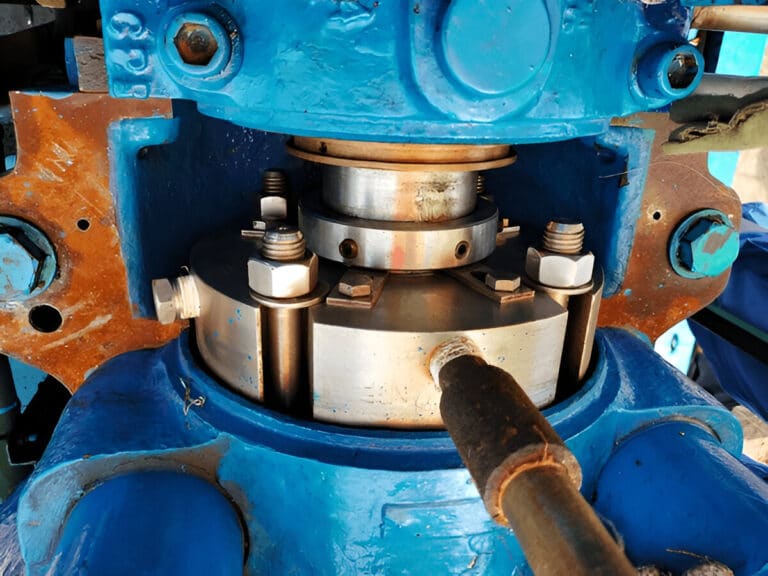
To select a mechanical seal for a chemical plant, start from the fluid’s full chemistry and hazard data, decide whether API 682 applies, and then choose the arrangement, the seal type, the materials and the piping plan, in that order.
Service Data to Collect First
Start the seal datasheet from a complete analysis of the fluid, the conditions at the seal, and the hazard statements on the fluid’s safety data sheet:
- Composition: every component and its concentration, trace compounds included.
- Operating conditions: temperature, seal chamber pressure, specific gravity and viscosity, at normal running and at the extremes.
- Vapor pressure: at pumping temperature, for the margin check below.
- Solids and deposits: whether the fluid carries solids, crystallizes as it cools or dries, or polymerizes.
- Hazard statements: the GHS H codes on the safety data sheet, which API 682’s fourth edition can use to choose the arrangement.
- Cleaning and upsets: steam-outs, caustic or solvent washes, and whatever reaches the pump during an upset. Treat them as design cases.
- Failure history: when the new seal replaces one that failed, how the old one failed shows which earlier choice was wrong.
Check the vapor pressure margin as soon as these numbers are in. API 682’s fourth edition asks for seal chamber pressure at least 3.5 bar (50 psi) above the fluid’s vapor pressure. Where that cannot be met, it accepts a 1:1.3 ratio of vapor pressure to seal chamber pressure. The seal chamber must also stay at least 0.35 bar (5 psi) above atmospheric pressure.
Whether API 682 Applies
API 682 covers seals for pumps in the chemical industry, ASME B73.1 and B73.2 chemical-process pumps included, but it applies only when the purchase specification names it, directly or through an API 610 pump order, since API 610 references it. The standard’s scope is limited to shafts from 20 mm to 110 mm (0.75 in to 4.3 in).
For a chemical plant, the part that matters is Category 1, the seal category intended for chemical-duty pumps. Category 1 seals fit ASME B73.1 and B73.2 seal chambers and cover −40 °C to 260 °C (−40 °F to 500 °F) at up to 315 psi absolute.
Hotter or higher-pressure duty falls under Categories 2 and 3, which assume an API 610 seal chamber. A seal outside the standard’s scope, by design or by operating window, is what API 682 calls an engineered seal.
Single or Dual Seal
A chemical service needs a dual seal when a leak would put people at risk or exceed the plant’s emissions limit. A fluid that is corrosive only to metal is a materials question and can still run on a single seal.
API 682 names three arrangements:
- Arrangement 1: a single seal.
- Arrangement 2: a dual unpressurized seal, with buffer fluid below seal chamber pressure.
- Arrangement 3: a dual pressurized seal, with barrier fluid above seal chamber pressure.
API 682’s fourth edition added a way to choose among them from the safety data sheet, by sorting the fluid’s GHS hazard statements into four groups. A published risk-based guideline built on the same four groups assigns them as follows:
- Group I, Arrangement 3: fluids dangerous by their presence alone, such as H250 (catches fire spontaneously if exposed to air).
- Group II, Arrangement 1, 2 or 3: fluids dangerous through toxicity, mainly by inhalation, such as H330 (fatal if inhaled) and H350 (may cause cancer). The choice depends on how much of the hazardous substance the fluid contains and the concentration a seal’s small, continuous leakage would build around the pump.
- Group III, Arrangement 2: fluids that need a second condition, such as an ignition source, to cause harm, among them H224 (extremely flammable liquid and vapor) and H314 (causes severe skin burns and eye damage).
- Group IV, Arrangement 1: the remaining, less hazardous fluids, such as H226 (flammable liquid and vapor).
Check your fluid’s codes against the standard’s own H-statement table, which may not match the guideline code for code.
After the hazard check, a pressurized dual is still the usual choice for a fluid that lubricates poorly, carries solids, or is abrasive or polymerizing.
With Arrangement 3, some barrier fluid always leaks into the process, so it has to be compatible with the process fluid and with everything downstream. Arrangement 2 keeps its buffer out of the process.
Where the arrangement has to meet an emissions limit, compare the limit with the Fluid Sealing Association’s figures for each arrangement, shown below.
Pusher or Bellows Seal
Choose a bellows seal when solids or crystals in the fluid would build up around a pusher seal’s sliding O-ring, or when the temperature rules out elastomers. For a clean fluid at moderate temperature, a pusher seal is enough. Check the seal maker’s bellows pressure rating against the seal chamber pressure before choosing a bellows seal.
API 682 defines three seal types:
- Type A: a balanced cartridge pusher seal with elastomer O-rings.
- Type B: a cartridge metal bellows seal with elastomer secondary seals.
- Type C: a cartridge high-temperature metal bellows seal with flexible graphite secondary seals.
For concentrated caustic, use a rotating bellows. When the temperature is beyond what the elastomer can take, use Type C with flexible graphite.
Materials for Chemical Service
Faces, elastomers and metal parts are chosen in no fixed order: each has to resist the full fluid analysis, trace compounds and cleaning chemicals included. Compatibility charts rate families of chemicals, so confirm each choice against field experience in the same fluid.
Seal Faces
For chemical duty, run carbon against sintered silicon carbide in clean fluids, and sintered silicon carbide on both faces where the fluid carries solids.
Specify sintered rather than reaction-bonded SiC. Caustics, amines and hydrofluoric acid, including small amounts of it in phosphoric acid, attack the free silicon in reaction-bonded SiC and weaken the face. A seal bought to API 682 can come with either grade, because the fourth edition accepts both as the default hard face.
SiC against SiC needs a fluid that lubricates, and the pair can break suddenly under shock loads if the seal is not designed for them.
Carbon and tungsten carbide each need a grade check:
- Carbon: resin-impregnated grades handle strong acids through strong bases. Antimony-impregnated carbon rates poorly in both acids and bases.
- Tungsten carbide: nickel-bound grades only, and the nickel binder still limits the face, mostly in acids.
Elastomers
Use FKM, the standard secondary seal in the process industries and API 682’s basic elastomer, for hydrocarbons, acids and water, and change it for amines, ketones, low-molecular-weight esters and ethers, hot water or steam.
- FKM: good to about 204 °C (400 °F) in hydrocarbons, and generally not used below −26 °C (−15 °F). In strong caustic, check the specific grade.
- EPDM: the usual choice for hot water and steam to about 204 °C (400 °F), and for ketones and alcohols. Any hydrocarbon swells it, including hydrocarbons that reach the pump during an upset.
- FFKM: the upgrade for aggressive chemicals and high temperatures. Choose the specific compound for the fluid. It swells in fluorinated fluids and expands about 50 % more than FKM, so check the groove when upgrading. Most grades should not run below −7 °C (20 °F).
- PTFE: inert to almost any process fluid, used where no elastomer survives and in batch plants whose chemicals change too often for one elastomer. It has almost no resilience, and most guidelines keep it below 260 °C (500 °F).
Metal Parts
Make the wetted metal parts from 316 stainless steel unless the fluid carries high chlorides, hydrofluoric acid or hot sulfuric acid; the springs and bellows are a higher alloy whatever the fluid. Match the seal metal to the fluid, not to the pump casing.
- 316 stainless steel: the base for most seal metal parts. It resists many acids and caustics, depending on concentration and temperature, and most organics, but high chlorides pit it.
- Alloy C-276: brines, seawater, many acids and strong oxidizers. It is the standard spring alloy, and is used for sleeves and glands only where 316 is not suitable.
- Alloy 20: hot sulfuric acid, and other aggressive chemicals where no common alloy is acceptable.
- Alloy 400: hydrofluoric acid, for both the metal parts and the welded bellows.
- Alloy 718: welded bellows. API 682 made it the Type C bellows material and now also allows it for Type B.
For chlorides, the Nickel Institute’s guideline for continuous exposure at neutral pH and ambient temperature allows 316 up to 1,000 ppm. Higher temperatures lower that figure, and above 60 °C, 316 risks sudden failure by chloride stress corrosion cracking.
Flush and Piping Plan
In clean chemical service, a single seal runs on Plan 03 or Plan 11. A dirty or crystallizing fluid changes the plan, and a dual seal takes the piping plan that matches its arrangement.
For a single seal:
- Plan 03: no external piping. A tapered seal chamber with flow modifiers circulates the fluid past the seal, a design found mostly on smaller ASME B73 chemical-duty pumps.
- Plan 11: recirculation from the pump discharge through an orifice. The fluid has to be clean and lubricate the faces.
- Plan 32: clean fluid injected from an outside source, for fluids that are dirty or abrasive, or that polymerize or solidify during a batch. It dilutes the product and costs too much energy to run for cooling alone. The seal materials then have to suit the flush fluid as well as the process.
- Plan 62: a quench on the atmospheric side. Water stops a fluid that crystallizes in air from building up under the faces, but the quench does not contain process leakage.
For a dual seal:
- Plan 52: for Arrangement 2, a buffer reservoir held near atmospheric pressure and vented to flare or vapor recovery. It may need cooling water and a connection to the plant’s leakage disposal system.
- Plan 53A, 53B or 53C: for Arrangement 3, a pressurized barrier reservoir, with 53B (bladder) or 53C (piston) for higher barrier pressures. A 53C’s reference line carries process fluid, which in corrosive, abrasive or slurry service can attack or clog it.
- Plan 54: for Arrangement 3, barrier fluid circulated from an external system.