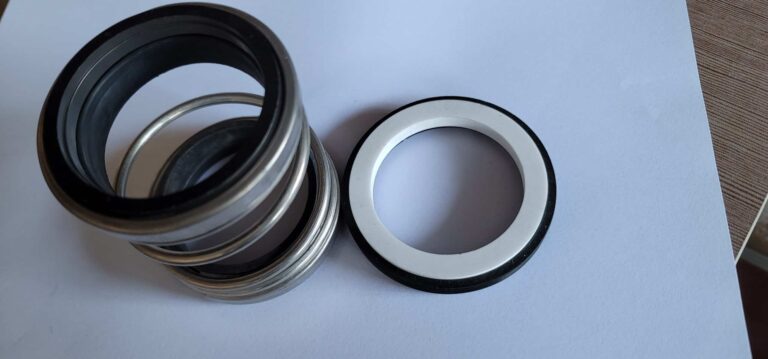
A mechanical seal on a slurry pump fails in seven ways, and three of them are caused by the solids themselves: abrasive wear between the faces, solids packing the springs and faces, and a seal water failure that lets slurry into the seal chamber. The other four — dry running, cavitation, installation and setting errors, and O-ring failure — can happen to any seal, but slurry changes how each one starts.
Which mode is most common varies with the duty, but the typical single-seal failure follows one sequence: solids score the faces, then migrate across them and clog the springs.
A leak at the gland or a moisture alarm shows that the seal is failing, but not which mode is failing it. That comes from the pump’s operating record and from the pulled seal.
Abrasive Wear Between the Faces
Hard particles that get between the faces score them, and the seal fails once the scoring lets it leak too much to stay in service. A pump that starts and stops frequently lets more solids reach the seal.
Solids Packing the Springs and Faces
Solids that pack around the springs or the dynamic O-ring hold the flexibly mounted face still, so it can no longer follow its mating face and the two open and leak.
Springs that sit in the slurry clog directly. Springs kept outside the process clog only after the faces have been scored, so clogged external springs mean abrasive wear came first.
Seal Water Failure
A seal water failure lets slurry back into the seal chamber, and the seal then fails by abrasive wear and packing.
On a single seal, the external flush (API Plan 32) fails in these ways:
- Pressure too low: the water has to stay at least 15 psi (1 bar) above seal chamber pressure.
- Flow lost: a plugged orifice, a closed valve or a clogged filter cuts the flow.
- Dirty water: water drawn from a silt-laden river or lake carries its own abrasive to the faces.
Seal chamber pressure is the reference, and it usually sits below discharge pressure. A seal water line that reads below discharge may still be adequate, so measure seal chamber pressure at the pump with the flush shut off before blaming the water.
A double seal’s barrier water fails the same way: below the same margin over seal chamber pressure, slurry crosses the inboard faces into the barrier.
Before the pump is opened up, the seal water flowmeter and pressure gauge show whether this was the mode.
Dry Running
Dry running takes away the liquid film between the faces, and without it they heat up and degrade within seconds or minutes.
On a slurry pump the faces lose their liquid in three ordinary ways:
- Sump drawdown: the sump level falls and the pump runs without liquid in it.
- Trapped air: an unvented seal chamber, most often on a vertical pump with the seal at a high point, fills with air.
- Lost seal water: when the flush or barrier water stops, the faces lose the water that was cooling and lubricating them.
Slurry adds a fourth way, in which the seal runs dry while it sits in product. A slurry lighter than water, such as wood pulp, collects and dewaters in the low-flow area by the gland and insulates the faces, and a slurry with a very high solids content may not lubricate them at all.
In operation, the signs of a dry-running seal are a squeal and a hot gland.
Cavitation
Cavitation fails a slurry seal through the vibration it sends along the shaft and the vapor it forms in the seal chamber.
When the liquid in the seal chamber cavitates too, the film between the faces vaporizes and they run as if dry.
A cavitating pump crackles or pops at the casing.
Installation and Setting Errors
The setting error peculiar to slurry pumps is a seal left at its old setting after the impeller clearance has been adjusted.
When a seal fails soon after an impeller adjustment, check whether it was reset afterwards.
The other errors are common to any seal installation:
- Setting clips: set screws left loose when the clips came out, or clips left in.
- Gland bolts: tightened unevenly, which misaligns the stationary face.
- O-rings: cut or twisted when slid over shaft shoulders, keyways or sharp housing edges.
- Seal faces: nicked in handling.
- Piping connections: flush, quench or drain lines connected to the wrong ports.
O-Ring and Secondary Seal Failure
In slurry service the most exposed secondary seal is the dynamic O-ring under the flexibly mounted face, and when it fails the face can no longer follow its mate.
The dynamic O-ring takes a compression set and loses its resilience. Under vibration it also rocks against the shaft sleeve and wears a groove into it.
Any O-ring on the seal can also fail in the general forms, and each form points to a cause:
- Swelling: chemical incompatibility with the liquid.
- Hardening, cracking or compression set: heat or chemical attack.
- Extrusion: excess pressure or too wide an extrusion gap.
- Cuts and abrasion: sharp edges, or an improper surface finish under the O-ring.
What Each Mode Leaves on the Pulled Seal
Each mode leaves its own set of marks across the faces, springs, O-rings and sleeve:
- Abrasive wear: scored or grooved faces, worst on the softer face, usually the carbon.
- Solids packing: solids caked around the springs and the dynamic O-ring, and a flexibly mounted face that will not slide. The faces can show little wear.
- Seal water failure: the scoring and packing above, plus slurry inside a seal chamber that should have held clean water.
- Dry running: heat-checked, blistered or cracked faces, with hardened or cracked O-rings.
- Cavitation: chipped faces, a fretted groove in the sleeve under the dynamic O-ring, worn drive pins and lugs, loose drive collar set screws, and cracked welds on a metal bellows.
- Installation and setting errors: cut or twisted O-rings, a nicked face, or a face cracked by impact.
- O-ring failure: a swollen, extruded or compression-set O-ring beside faces that are otherwise sound.
Two marks fit more than one mode, so read them with the rest of the seal:
- Heat-checked faces: the faces ran too hot, from loss of the film or from a seal set too tight; the seal water readings, the sump level and the setting record show which.
- An uneven wear track: the faces ran out of parallel, from excess pressure, a misaligned stationary face or vibration.
Faces worn down evenly with nothing else wrong are rare, so a slurry seal with a short life has usually failed by one of the modes above.